Most real estate leads die quietly — not because the prospect lost interest, but because the agent gave up first. A structured 12-touch follow-up system is the single highest-leverage habit a real estate agent can build, turning cold contacts into closed deals through consistent, well-timed communication. According to the National Association of Realtors, 64% of buyers and sellers say they would use the same agent again — yet only 11% actually do, largely because agents go silent after the transaction ends. The agents who change this pattern don’t just earn repeat business; they build a referral engine that pays dividends for years.
Why Most Real Estate Follow-Up Breaks Down Before Touch #3
The uncomfortable truth about real estate follow-up is that most agents quit far too early. Research consistently shows that converting a real estate lead takes between six and eight meaningful touchpoints — but the average agent gives up after just one or two attempts. That gap isn’t a minor inefficiency. It’s where commission checks go to die.
The problem runs deeper than laziness or poor intention. Most agents are genuinely juggling listings, showings, negotiations, and paperwork simultaneously. When a new lead comes in on a Wednesday afternoon while an agent is deep in a contract dispute, following up consistently over the next 90 days feels impossible. So the lead gets a single call, maybe a text, and then gets forgotten.
What makes this worse is the nature of real estate buying cycles. According to NAR’s 2023 Profile of Home Buyers and Sellers, the typical buyer searches for homes for ten weeks before making an offer — and many take six to twelve months to commit. An agent who abandons the 12-touch follow-up process at week two has already disqualified themselves from a deal that hadn’t even started.
The agents who understand this don’t treat follow-up as an afterthought. Instead, they treat it as their primary sales system — and build everything else around it.
What the Top Agents Actually Do
Consider Sarah Mallory, a solo buyer’s agent based in Austin, Texas, working a database of around 600 contacts. Two years ago, Sarah’s follow-up strategy consisted of a CRM full of notes she never opened and a vague intention to “circle back” whenever time allowed. She was closing about 14 transactions per year — which felt reasonable until she realized her existing database alone could support twice that volume if she followed up properly.
Sarah restructured her outreach around a disciplined follow-up sequence. The first 30 days included three direct calls, two personalized text messages, and one value-driven email. Over the following 60 days, she layered in market updates, relevant listings, and check-in calls tied to milestones each lead had mentioned during their initial conversation. By month three, leads that would have previously gone cold were responding, re-engaging, and booking consultations.
The result: Sarah moved from 14 transactions to 22 in a single year — without spending a single additional dollar on lead generation. The difference was entirely follow-up discipline.
In contrast, agents who rely on sporadic outreach — a text here, a social media message there — rarely convert leads past the first few weeks. Consistency, not sheer frequency, is what builds trust and keeps an agent top of mind when a buyer or seller is finally ready to act.
The Research Behind Real Estate Follow-Up and Why 12 Touches Work
The number twelve isn’t arbitrary. Multiple studies on sales conversion and buyer behavior point to the same conclusion: meaningful, repeated contact over time dramatically outperforms one-off or sporadic outreach.
Research from the Brevet Group found that 80% of sales require at least five follow-up calls after the initial conversation, yet 44% of salespeople abandon the effort after a single attempt. This pattern plays out in real estate daily, and the financial consequences are significant.
For real estate specifically, the effect is amplified by high financial stakes and extended decision-making timelines. A buyer considering a $650,000 home isn’t making a snap decision — they need repeated, reassuring contact with an agent who feels knowledgeable and invested in their outcome.
HubSpot’s research on multi-touch sales cadences further reinforces this, showing that structured, sequential outreach significantly outperforms unplanned communication when it comes to lead conversion rates. The reason is simple: a planned follow-up cadence aligns with the prospect’s buying timeline rather than the agent’s convenience.
Taken together, the evidence is clear. A longer, more consistent outreach strategy isn’t just polite persistence — it’s the mathematically superior approach to building a real estate pipeline.
How AI Solves Your 12-Touch Follow-Up Problem
Here’s where the challenge gets practical. Most agents already know they should be following up more. The obstacle isn’t awareness — it’s execution. A full 12-touch follow-up system requires remembering what to say at each stage, personalizing it to each contact, and delivering it at the right moment. For a solo agent managing 80 to 150 active contacts, that’s hundreds of scheduled interactions per month.
This is precisely the problem that the 12-Month Nurture Agent from AxonEstate was built to solve. Rather than depending on an agent’s memory or calendar reminders, the agent runs automated, personalized nurture sequences across email, SMS, and other channels — calibrated to each contact’s stage in the buying or selling journey.
Specifically, the 12-Month Nurture Agent:
- Sends time-specific follow-up messages based on where each lead sits in the pipeline — first week, first month, 90 days, six months, and beyond
- Personalizes each message using information captured from initial conversations, including suburb preferences, budget range, and timeline
- Automatically adjusts the cadence when a lead re-engages, accelerating outreach during hot windows of interest
- Delivers market updates, property alerts, and milestone check-ins that feel personal rather than templated
- Notifies the agent the moment a lead responds, so human conversations happen at exactly the right time
- Tracks open rates, response signals, and re-engagement patterns across the full 12-month window
The result is a follow-up system that runs continuously in the background while the agent stays focused on showings, listings, and closings.
The Real Cost of Getting This Wrong
Let’s run the numbers on what poor follow-up actually costs.
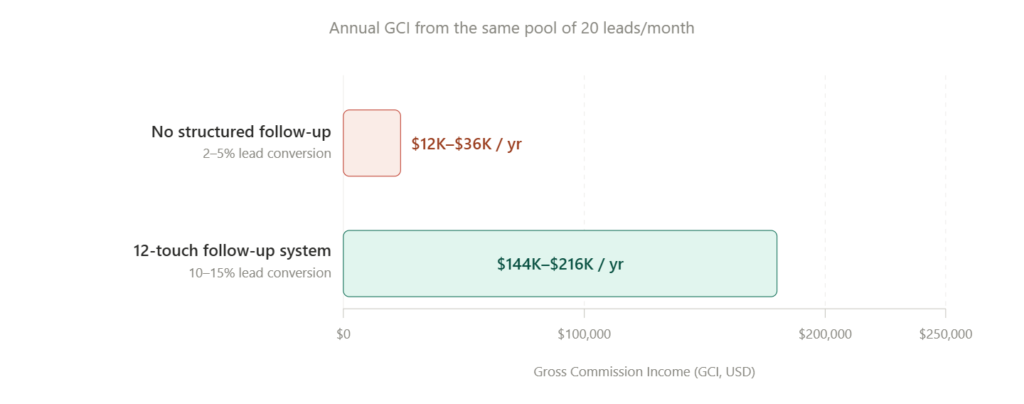
Imagine a mid-volume agent generating 20 new leads per month — a reasonable figure for anyone running digital ads or working an active open house schedule. Of those 20 leads, research suggests that roughly 10% to 15% will convert to a transaction over a 12-month period when properly nurtured. That’s two to three closed deals per month from existing leads alone, at an average commission of $12,000. That’s $24,000 to $36,000 per month in gross commission income.
Now factor in what actually happens without a structured system. Most agents convert only 2% to 5% of unworked leads — at best, one deal per month from that same pool. The revenue gap is $12,000 to $24,000 per month in missed commissions. Over a full year, that’s $144,000 to $288,000 in potential GCI walking out the door because no one followed up consistently.
Beyond the dollars, there’s the referral multiplier to consider. Every converted client becomes a potential referral source. Lose the lead, and you lose every transaction that flows from them over the next decade.
How This Plays Out in Practice
Picture a Saturday afternoon in early March. James, a buyer’s agent working the suburbs of Nashville, is midway through a four-hour showing block. His phone is on silent, his attention is entirely on the couple standing in a kitchen in Brentwood, and three new leads from his Zillow listing have just come through his inbox.
Without a follow-up system, those three leads sit. By Sunday evening, James sends a generic “Hey, saw you reached out!” text to each one — belated, forgettable, and identical. By Monday morning, two of the three have already booked consultations with another agent who responded within 20 minutes. The third ghosts him entirely.
Now run the same Saturday with the 12-Month Nurture Agent active. The moment each lead arrives, a personalized response goes out automatically — referencing the specific property they enquired about, their stated timeline, and a clear next step. Over the following days and weeks, each lead enters a tailored follow-up sequence built around their individual situation. One responds two weeks later, ready to start seriously looking. Another re-engages after 45 days when their lease renewal notice arrives. The third takes three full months to come back — but when they do, James is already their preferred agent because his name has appeared in their inbox, consistently and helpfully, the entire time.
Same leads. Same agent. The only difference is the 12-touch follow-up system running quietly in the background.
Why This Matters More in 2025 Than Ever
Real estate buyers and sellers in 2025 are more informed, more distracted, and more demanding than at any point in the past decade. They compare agents on Google Reviews before the first call, scroll Instagram feeds for social proof, and form strong opinions within minutes of initial contact. In this environment, a single unanswered enquiry doesn’t just mean a lost lead — it means a negative first impression that a competitor will immediately fill.
At the same time, competition among agents continues to intensify. According to NAR’s 2024 Member Profile, the number of active real estate licensees in the United States has continued to grow, meaning more agents are competing for the same pool of qualified buyers and sellers. Additionally, consumer expectations around response time have shifted dramatically. Buyers now expect acknowledgment within minutes, not hours. An agent who responds within 24 hours — once considered reasonably prompt — is now perceived as slow and disinterested.
This is why a consistent follow-up approach has shifted from a competitive advantage to a baseline requirement. Agents who can’t maintain regular, meaningful contact throughout the buying cycle will simply lose deals to those who can.
Bottom Line
The 12-touch follow-up system isn’t complicated. It’s consistent. The agents building six-figure pipelines on repeat and referral business aren’t doing anything magical — they’re simply staying in contact when everyone else drops off.
However, consistency is exactly what’s hardest to maintain when you’re running a real business. That’s where AI changes the equation entirely. Instead of relying on willpower and a packed calendar, the right system follows up for you — every time, on schedule, and in a way that feels genuinely personal to each prospect.
If you’re ready to stop losing deals to agents who simply follow up better, start with 12-Month Nurture Agent — see how it works. Or book a strategy call here to see how AxonEstate can be configured for your specific pipeline and market.
Frequently Asked Questions
How many times should I follow up with a real estate lead before calling them cold?
Most sales research and real estate coaches recommend a minimum of eight to twelve touchpoints before considering a lead inactive. The buying cycle in real estate stretches from weeks to well over a year, so leads that go quiet early may re-engage months later when their circumstances change. A structured 12-touch follow-up system keeps you in the picture throughout that entire window without requiring constant manual effort.
What should I actually say in my follow-up messages so I don’t sound like I’m chasing a commission?
Value-driven outreach works far better than check-in calls that exist purely to ask “Are you ready to buy yet?” Share a market update relevant to their target suburb, send a listing that matches what they mentioned in your first conversation, or acknowledge a timeline milestone like an upcoming lease expiry. When each message offers something useful, it builds trust instead of creating pressure — and that’s what gets responses.
Can AI follow-up really feel personal, or will my leads know they’re talking to a bot?
Modern AI nurture tools like the 12-Month Nurture Agent personalise messages using information captured during initial contact — suburb preferences, budget range, family situation, and timeline. When the outreach references details the lead actually shared, recipients engage with it because it feels relevant to them specifically. The goal isn’t to deceive anyone; it’s to deliver the right message at the right moment, which is exactly what great human follow-up does anyway.
What’s the biggest mistake agents make with their follow-up sequences?
Starting strong and fading out is by far the most common failure pattern. Agents often send two or three solid messages in the first week, then go quiet for a month, and by that point the lead has emotionally moved on to someone else. A consistent rhythm across the full follow-up window — one that accelerates when a lead signals interest — is what keeps deals alive long enough to close. Momentum matters more than volume.