A buyer texts you at 11:47 p.m. about a listing. Your 24/7 real estate business either answers that text within minutes, or it loses the lead to the agent who does. According to NAR’s research, nearly eight in ten homebuyers work with whichever agent responds first. That single fact separates agents who build sustainable businesses from agents who burn out chasing every ping on their phone.
Why a 24/7 Real Estate Business Feels Impossible to Build
Most agents didn’t sign up to be on call around the clock. They signed up to sell homes, build relationships, and earn a living on their own terms. Instead, the job quietly turned into a pager job with a real estate license attached.
Buyers don’t search for homes on a schedule. A meaningful share of qualified inquiries land in the evening or on weekends, right when most agents are at dinner or finally off the clock. In practice, that timing gap is where deals go to die.
Meanwhile, the agent side of the equation isn’t much better. The average agent takes far longer than buyers expect to respond to a fresh inquiry. A WAV Group and Weichert study found that nearly half of all inquiries got no response at all.
Every one of those silences is a listing appointment that walked to a competitor. For example, a single unanswered evening inquiry can be the difference between winning a listing and losing it to whoever called back sooner.
This is why so many agents describe real estate as a 24/7 business they never agreed to run. They check email in the pickup line. They take calls during dinner. As a result, burnout becomes less of a risk and more of a certainty, with roughly 80% of new agents quitting within their first two years.
What the Top Agents Actually Do
Consider Maria Delgado, a broker who leads a six-agent team in Scottsdale, Arizona. Two years ago, her team missed roughly a third of inbound leads simply because nobody was near a phone when they came in. In practice, weekends were the worst offenders.
Maria didn’t hire her way out of the problem. Instead, she rebuilt how her team handled the first five minutes after a lead arrived. Every inquiry now gets an instant, personalized response, whether it lands at 2 p.m. on a Tuesday or 2 a.m. on a Sunday. Even so, Maria didn’t have to hire a night-shift employee to make that happen.
In contrast, consider James Okafor, a solo agent working a similar patch of listings forty minutes away. James is a talented negotiator and a hard worker, but he still checks leads manually between showings. By the time he calls back, a lead has often already toured a home with someone else.
The difference between Maria’s team and James isn’t talent, effort, or marketing budget. It’s the gap between agents with systems and agents relying on willpower alone. Maria’s team closes more deals with fewer wasted hours. James works longer days and still falls behind.
That’s what actually separates a functioning 24/7 real estate business from one that just feels that way on paper.
The Research Behind Running a 24/7 Real Estate Business
The data on speed and responsiveness is consistent, and it has been for years. Research from Dr. James Oldroyd at MIT analyzed more than a million sales leads. Working with InsideSales.com, he found five-minute responders qualify leads far more often than those waiting half an hour. Speed, not charm, drives that gap.
Separately, commission data from Real Trends puts a dollar figure on the problem. Based on typical commission rates, a single mishandled lead can represent thousands of dollars in lost income, multiplied across every missed inquiry in a year.
On top of that, NAR’s own research confirms responsiveness ranks among the top qualities buyers want in an agent. In other words, the research doesn’t just suggest speed matters. It shows speed is often the deciding factor before a buyer ever asks about square footage. Additionally, this pattern holds across property types and price points, from starter condos to luxury listings.
How AI Solves the 24/7 Real Estate Business Problem
This is exactly the gap an AI agent is built to close. Instead of asking a human to be awake at all hours, the Inbound Lead Responder from AxonEstate takes the shift. It answers every inquiry the moment it arrives, day or night, weekday or weekend.
That means a lead texting at 11 p.m. gets a real, conversational reply within seconds, not a voicemail greeting. Because of this, agents no longer have to hit that five-minute window manually. It just happens.
Beyond that, the agent works quietly as part of a broader system. Leads that arrive through a website form, a portal inquiry, or a text message all get the same instant treatment.
Specifically, the Inbound Lead Responder:
- Replies to new leads within seconds across text, email, and web forms
- Asks qualifying questions to identify timeline, budget, and motivation
- Books showings directly onto the agent’s calendar
- Flags hot leads for same-day human follow-up
- Logs every conversation into the CRM automatically
- Keeps responding after hours, on weekends, and during showings
In practice, setup takes an afternoon, not a quarter. This is why agents who adopt it stop treating their phone as a leash. Their 24/7 real estate business keeps running whether they’re at a listing appointment, at a soccer game, or asleep.
The Real Cost of Getting This Wrong
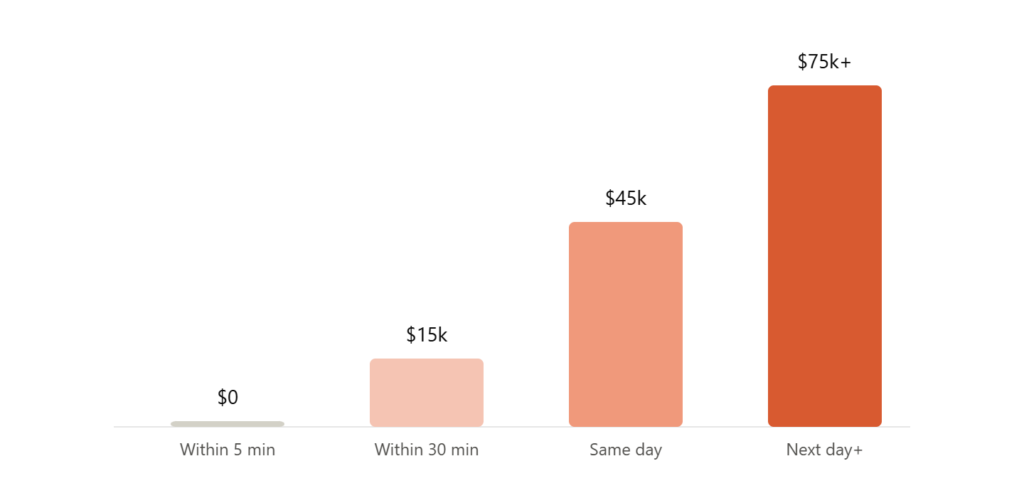
Here’s what slow response actually costs, in real numbers. Say an agent generates 60 leads a month from their website, portal listings, and referrals combined. If 15 of those leads arrive after hours, many are gone by the time anyone calls back.
At a conservative 2 to 3% lead-to-close rate, that’s a real problem. Real Trends’ commission analysis puts the average commission at roughly $7,500 per transaction. For example, a team with even a modest lead volume can lose several of those transactions a year without anyone noticing.
Losing even one extra deal every one to two months to a faster competitor adds up fast. Over a year, that’s $60,000 to $90,000 in commission that never had a chance to happen.
It doesn’t show up as one dramatic loss. Instead, it drains out quietly, one unanswered text at a time. That’s exactly why most agents never notice it until they add up the math.
How This Plays Out in Practice
It’s Saturday afternoon. An agent is standing in a three-bedroom colonial in the suburbs, mid-showing, phone on silent in her back pocket. A lead submits an inquiry about a downtown condo listing at 2:15 p.m.
Without a system in place, that inquiry sits untouched until the showing wraps up around 4:30. By then, the buyer has already messaged two other agents and booked a tour with one of them.
Now picture the same Saturday with the Inbound Lead Responder running in the background. The 2:15 inquiry gets an instant reply asking about the buyer’s timeline, budget range, and pre-approval status. Within two minutes, the buyer confirms they’re ready to move in 60 days and pre-approved up to $475,000.
In practice, it books a showing for Sunday morning and logs every detail into the CRM. Unlike a human assistant, it never needs a lunch break or a day off.
The agent finishes her colonial showing, checks her phone, and finds a qualified appointment already on the calendar. She didn’t touch her phone during the showing. She didn’t lose the lead to a faster competitor. As a result, she picks up a second deal from a day that used to only produce one.
That’s the practical difference between working every hour personally and running a business that works every hour on its own.
Why This Matters More in 2026 Than Ever
Buyer expectations haven’t gotten any more patient. NAR’s 2025 Profile of Home Buyers and Sellers shows most buyers still purchase through a licensed agent. That means competition for that first response is fiercer than ever, not smaller.
At the same time, mortgage rates, inventory swings, and pricing uncertainty have made buyers more cautious. They’re more likely to shop multiple agents before committing to one. Additionally, first-time buyers now skew older and research longer before reaching out, which raises the stakes on that first response even more.
That means the agent who answers first gets the benefit of the doubt on pricing advice and negotiation strategy too. This is why brokerages that adopted after-hours coverage early are pulling ahead in competitive markets.
Meanwhile, teams and brokerages are staying leaner, not larger, which puts more pressure on fewer people to cover more hours. A 24/7 real estate business isn’t a luxury add-on anymore. It’s the baseline expectation buyers walk in with, whether they say it out loud or not.
Bottom Line
Running a 24/7 real estate business was never supposed to mean working every hour yourself. It means building a system that keeps responding and booking showings while you’re at a closing, at dinner, or asleep.
The agents pulling ahead right now aren’t the ones grinding longer hours. They’re the ones who stopped being the bottleneck between a lead and a booked showing. Finally, the tools to make that shift exist today, not somewhere down the road. More importantly, the agents who adopt them now will be the ones setting the pace in their market for years.
Start here: Inbound Lead Responder — see how it works. Or book a strategy call here to map out what a 24/7 setup could look like for your team.
Frequently Asked Questions
Will an AI agent actually sound like a robot to my leads?
No. The Inbound Lead Responder holds a natural, conversational text or chat exchange, not a scripted reply. Most leads won’t realize they weren’t messaging a human until you introduce yourself on the follow-up call.
What happens if a lead asks something the AI can’t answer?
It flags the conversation and routes it to you or a teammate for same-day follow-up. The goal isn’t to replace the human conversation. It’s to make sure nobody waits hours for a first response.
Do I still need to check leads myself?
You’ll still review a daily summary and jump in on hot leads. But you won’t be racing to reply to every inquiry the second it lands. That’s the whole point.
Is this only useful for solo agents, or does it work for teams too?
Both. Solo agents use it to cover hours they physically can’t work. Beyond that, larger teams often see the biggest gains, since more leads means more coverage gaps to close.
Sources
- Real Estate Lead Response Statistics: 15 Numbers Every Agent Should Know in 2026 — AgentZap
- Real Estate Lead Response Time: Tips & Data (2026) — Solvea
- Real Estate Lead Response Time: Stop Losing Leads to Faster Agents — Fyxer
- 30 Real Estate Lead Generation Statistics Every Agent Should Know in 2026 — CloseDaily
- 15 Critical Signs of Real Estate Agent Burnout: The 2026 Survival Checklist — Landvoice
- Research and Statistics — National Association of Realtors