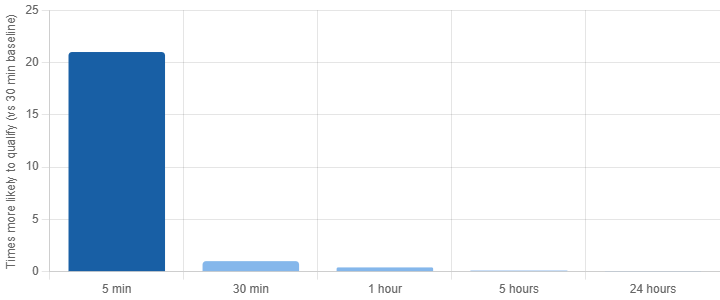
You’ve probably heard it before: speed matters in real estate. But when a 2007 study from MIT’s Sloan School of Management dropped the number — leads contacted within 5 minutes are 21 times more likely to be qualified than those reached after 30 minutes — most people in the industry nodded, said “interesting,” and changed absolutely nothing about their workflow. uspto
That research has only been reinforced since. The average business takes around 47 hours to respond to a new lead, while the first business to respond wins roughly 78% of deals. Casey Response AI
Not 47 minutes. 47 hours.
Let’s talk about why that gap exists, what it costs, and what the top 5% of agents are actually doing in 2025 to close it.
Why Agents Don’t Respond Fast (It’s Not Laziness)
The obvious assumption is that agents just don’t care enough. That’s not it.
The real problem is structural. A new lead comes in at 6:47 PM on a Thursday. The agent is showing a home. The notification fires. It sits. By the time they’re done, it’s 8:30 PM. They tell themselves they’ll call in the morning. The lead has already booked a showing with someone else — or stopped caring entirely.
The drop-off isn’t gradual, either. After just five minutes, the odds of qualifying a lead can fall by around 80%, and waiting even ten minutes instead of five can cut your chances of qualifying a prospect roughly fourfold. Within the first hour, qualification odds drop by roughly 10x, and after 24 hours, the odds of qualifying a lead are essentially zero in competitive markets. KixieLeadresponse
The harder truth: most online real estate leads weren’t deeply committed to begin with. They’re browsing. They filled out a form impulsively. You have a small window where they’re curious and available. Miss it, and you’re starting from scratch.
What the Top Agents Actually Do
A few years ago, a team leader in Phoenix running a 6-agent team through a major brokerage noticed something troubling. Her team was generating roughly 180 leads a month from Zillow and Facebook, converting fewer than 12 of them, and losing the rest to silence.
She tested something simple: she hired a dedicated ISA (Inside Sales Agent) whose only job was to call every new lead within 5 minutes during business hours. Within 90 days, her contact rate went from 22% to 61%. Her conversion rate tripled.
The catch: the ISA cost her $4,800 per month. For a 6-agent team, that was a stretch. And the ISA still didn’t work nights, weekends, or holidays — which is exactly when a significant slice of online leads come in.
This is the dirty secret of the “hire an ISA” advice: it solves the problem for 60 hours of the week and leaves 108 hours unattended.
The Research Nobody Talks About
The “21x” and “5-minute rule” figures trace back to a 2007 study out of MIT’s Sloan School, often cited as the Lead Response Management study. The research was conducted by James Oldroyd along with Kristina McElheran and David Elkington, and was later published through the Harvard Business Review in 2011, examining over 2,241 companies and more than 100,000 web-generated leads. The study tracked both contact rate — whether a sales team successfully reached the lead by phone — and qualification rate, whether the lead progressed to a meaningful sales conversation, measured against how much time elapsed after the form submission. AINORAAINORA
The headline numbers are stark: attempting contact within 5 minutes (versus 30 minutes) makes a company 100 times more likely to actually reach the lead, and 21 times more likely to qualify it — and every contact attempt made after 20 hours hurts the contact rate further. uspto
Subsequent research has only confirmed the pattern. A separate Harvard Business Review analysis found that businesses attempting contact within an hour are about 7 times more likely to have a meaningful conversation with a decision-maker than those who wait even one additional hour. And on the marketing side, a Drift report found that waiting just 5 minutes to respond makes you 10 times more likely to lose the lead, and waiting 10 minutes increases that risk to 100 times. LeadresponseVoiso
None of this is new science. What’s new is that the technology to actually execute on it — for every lead, at every hour — now exists and isn’t expensive.
Where AI Comes In (And What It Actually Does)
The conversation around AI in real estate is muddy. Most of what’s marketed as “AI” is just automated drip email sequences — the same tools you’ve had since 2008 with a new label.
A real AI lead responder is different. When a lead fills out a form on your website, Zillow, or Facebook at 11:30 PM on a Saturday, it:
- Sends a personalized SMS or message response within 60 seconds (not a generic “Thanks for reaching out!”)
- Asks a qualifying question based on what the lead expressed interest in
- Keeps the conversation going until the lead either books a call or goes cold
- Logs every interaction to your CRM
- Flags hot leads for the agent to review first thing in the morning
This isn’t a chatbot that says “Hi! I’m a bot. An agent will be with you shortly.” That’s worse than silence — it signals that no one is actually paying attention.
AxonEstate’s Inbound Lead Responder is built specifically for real estate agents and teams, replying to enquiries from your website, listing portals, and social channels within 60 seconds — 24/7, including weekends, holidays, and 2 AM. It doesn’t just auto-reply — it engages, qualifies, and keeps the door open until a human can take over.
The Real Cost of Slow Response
Let’s do the math for a moment.
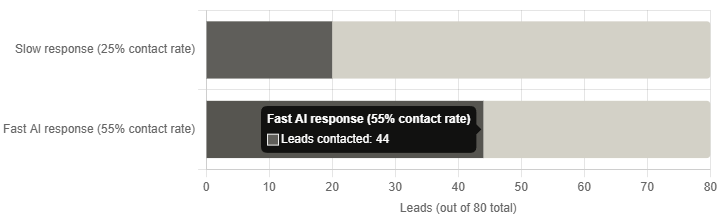
Assume you generate 80 leads per month from paid sources. Average lead cost: $15. That’s $1,200 in ad spend.
If your contact rate is 25% (generous, given the industry average), you’re talking to 20 leads. The other 60 are dead money.
Improve your contact rate to 55% through faster response — a realistic number based on teams that have implemented AI responders — and you’re now talking to 44 leads from the same $1,200 spend. You didn’t buy more leads. You just stopped wasting the ones you already paid for.
That’s the difference between an ad budget that feels like it’s leaking money and one that’s actually working for you.
What Not to Do
Before you run off and set up some Zapier automation that texts every lead “Hi! We got your message!” — stop. Leads hate that. They know it’s automated. It breeds distrust before you’ve had a single real interaction.
What makes an AI lead responder actually work:
- It references the specific property or search they were interested in. “Hey, I saw you were looking at homes in Scottsdale under $600k — is that still where you’re focused?” beats “Hi, thanks for reaching out!” by a mile.
- It doesn’t pretend to be a human, but it also doesn’t announce itself as a robot. The best approach is conversational and helpful — not a formal declaration that “this message was sent by an automated system.”
- It hands off seamlessly to a human. When the lead is ready to talk, the transition should feel natural. The agent picks up knowing what the lead said, what they’re looking for, and where the conversation stands.
How This Plays Out in Practice
Picture a Saturday afternoon. An agent is at a showing, phone on silent. A lead fills out a form on a Zillow listing for a 3-bedroom in their farm area, asking about financing options.
Without an AI responder: that lead sits untouched until Monday morning. By then they’ve already filled out three more forms on competing listings and talked to two other agents.
With an AI responder: within a minute, the lead gets a message referencing the exact property and a quick question about their timeline and pre-approval status. The conversation continues — maybe they mention they’re relocating for a job and need to move within 60 days. By the time the agent checks their phone Saturday evening, there’s a fully qualified lead waiting, complete with context, ready for a real conversation instead of a cold “hi, saw you were interested in a home?”
That’s not a hypothetical efficiency gain. That’s the difference between a lead that converts and one that quietly disappears.
Why This Matters More in 2025 Than Ever
Buyer and seller expectations have shifted. People are used to instant responses from every other service they interact with — food delivery apps confirm orders in seconds, customer service chats respond immediately, even retail websites now have live chat that answers in real time.
For marketing inquiries generally, around 90% of people rate an immediate response as important — and “immediate” in consumer psychology means minutes, not hours. Leadresponse
When a real estate inquiry sits unanswered for hours, it doesn’t just feel slow — it feels like a red flag. If an agent can’t respond quickly to a simple inquiry, what does that say about how responsive they’ll be during a transaction with actual deadlines, financing contingencies, and inspection windows?
Speed isn’t just about catching leads while they’re hot. It’s become a trust signal in its own right.
The Bigger Picture: It’s Not Just About More Leads
A common instinct when conversion rates are low is to generate more leads — spend more on ads, run more campaigns, expand into new zip codes. But if your contact rate is stuck at 25%, throwing more leads into that funnel just means more leads getting wasted at the same rate.
Fixing the response gap first means every dollar you’re already spending on lead generation works harder. It’s the cheapest “growth” move available to most agents and teams, because it doesn’t require a bigger budget — it requires fixing what happens in the first five minutes after someone raises their hand.
Bottom Line
The 5-minute window is real. The data is clear. The agents who treat it seriously are consistently outperforming peers who generate more leads but follow up slowly.
You don’t need to hire a full-time ISA to solve this. You need a system that works when you can’t.
AxonEstate was built for exactly this — a real AI workforce for real estate agents and teams, not a collection of drip campaigns dressed up with a new logo. If you want to see the Inbound Lead Responder in action, book a strategy call here.
FAQ
Q: Is responding within 5 minutes really that important if I’m calling back within the same day? A: Yes. The research is consistent — within-hour response rates are dramatically higher than same-day. By the next day, you’re effectively cold-calling.
Q: Doesn’t texting within seconds seem desperate or aggressive? A: Context matters. A relevant, helpful text about what they were searching — not a generic “got your message!” — reads as attentive, not aggressive.
Q: What about leads who fill out forms at 3 AM? Are they serious? A: Some are. More importantly, many are browsing late and will still be thinking about it when they wake up. A well-timed response waiting for them in the morning is a significant advantage.
Q: How does AI know what to say to the lead? A: It’s built on information from the form submission and the property or search the lead was engaged with. The better your intake form, the smarter the follow-up.
Sources
- InsideSales.com / MIT Lead Response Management Study (2007) — via USPTO patent filing
- Lead Response Time: Every Study (Harvard, MIT, More) — AInora
- Lead Response Time Statistics (2026): The 5-Minute Rule — Casey Response
- Speed-to-Lead Statistics 2026 — LeadResponse
- Speed to Lead Response Time Statistics — Kixie
- How Faster Lead Response Times Can Skyrocket Conversions — Voiso
Internal link: AxonEstate Inbound Lead Responder