Real estate prospecting scripts separate agents who book appointments from those who hang up disappointed. Cold calling still works, converting at roughly 57.1% effectiveness, trailing only referrals at 92.8%. Yet most agents read a script word-for-word and wonder why prospects sense the rehearsal. The agents who consistently convert cold contacts into listings treat scripts as a starting framework, not a finished performance. Calling Agency
The Problem With Most Real Estate Prospecting Scripts
Most agents grab a script off a forum, print it, and start dialing. That’s the first mistake. Scripts written for a generic market rarely fit a specific neighborhood’s price points or seller concerns.
Because of this mismatch, prospects hear something that sounds canned. They tune out within the first ten seconds.
There’s also the persistence problem. Reaching a prospect takes an average of eight cold call attempts, and the agents who push through six to eight tries make most of the contacts because almost nobody else does. Most agents give up after two or three calls. Dealmachineos
That means a huge share of the database never gets a real conversation. Meanwhile, the agent assumes the leads were bad, when really, the follow-up sequence simply stopped too early.
On top of that, timing kills momentum. A prospect mentions they’re “thinking about selling next year,” and the agent moves on instead of building a long-term nurture plan. Six months later, a competitor calls at exactly the right moment and wins the listing.
Even so, the fix isn’t complicated. It’s about combining a flexible script framework with relentless, well-timed follow-up — something most solo agents and small teams simply don’t have the bandwidth to execute manually.
What the Top Agents Actually Do
Maria Delgado runs a four-person team in Round Rock, Texas, focused on expired and FSBO listings. She doesn’t memorize scripts word-for-word. Instead, she treats each script as a conversation map with three or four branch points.
When a seller says “we’re not ready yet,” Maria has a pre-planned response that books a follow-up call instead of ending the conversation. That single habit, she says, accounts for nearly a third of her appointments.
Contrast that with Derek, an agent two towns over working the same expired listing leads. Derek uses the same script Maria does, but he stops at the first objection. If the prospect hesitates, he says thanks and moves to the next number.
Derek makes more calls per day than Maria. However, his appointment rate sits at less than half of hers because he’s not building the follow-up sequence that catches prospects when they’re finally ready.
That means the difference isn’t talent or even call volume. It’s discipline around objection handling and a system that automatically re-engages contacts who said “not yet” — something Maria’s team handles through structured follow-up cadences rather than memory and sticky notes.
The Research Behind Real Estate Prospecting Scripts
Industry data backs up what Maria and agents like her have learned through trial and error. Agents who commit to making 20 cold calls a day can expect roughly a 10% to 20% success rate, which sounds modest until you multiply it across a full year of consistent dialing. Salesmate
Persistence matters even more than most agents realize. One widely cited study found that only about one in three prospects answers the phone, and just one percent of cold calls turn into an appointment on that single call. That’s why scripts built around a single “close” moment fail. Market Leader
Specifically, the agents earning the most from this channel treat scripts as the opening move in a longer sequence. A survey of more than 200 real estate professionals earning over $250,000 annually found cold calling as their primary driver of that income, not because the call itself closed the deal, but because it started a relationship that follow-up nurtured into a listing. Calling Agency
How AI Solves the Prospecting Script Problem
Here’s where the math changes for agents without a six-person team. Manually tracking which script branch worked, when to follow up, and how to log every “call back in three months” note is unsustainable past a few dozen contacts a week.
This is why the Outbound Prospecting Agent exists. Instead of replacing the agent’s voice, it handles the structure: dialing sequences, objection-branch logging, and follow-up timing, so the human conversation stays sharp while the system handles the grind.
In practice, agents using this kind of support inside AxonEstate report spending less time on data entry and more time actually talking to qualified prospects. The agent works alongside the broader AxonEstate workforce to keep every contact moving through a defined sequence.
Specifically, the Outbound Prospecting Agent:
- Builds dynamic call lists prioritized by likelihood to convert, based on expired, FSBO, and absentee owner data
- Tracks which script branch and objection response was used on each call
- Automatically schedules the next follow-up based on the prospect’s stated timeline
- Logs call outcomes directly into the CRM without manual data entry
- Flags “hot” prospects who showed buying or selling signals for immediate human follow-up
- Generates daily call sheets so agents start each session with a ready-to-go list
The Real Cost of Getting This Wrong
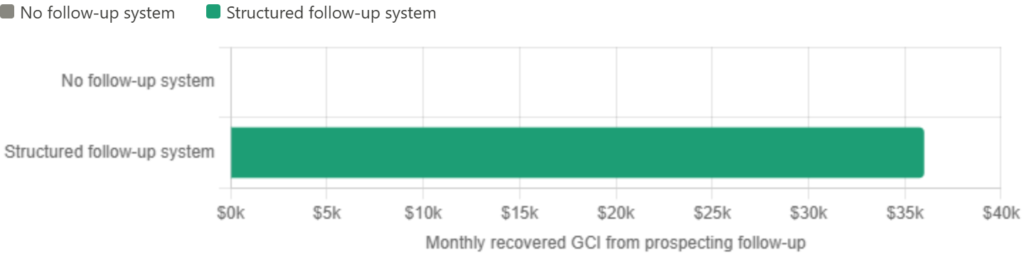
Consider an agent working 300 expired listing contacts a month. Without a follow-up system, roughly 70% of those contacts get one call and nothing more.
That’s 210 contacts a month who never hear from the agent again. At even a conservative 2% eventual listing conversion rate with proper follow-up, that’s about four lost listings a month.
At a median commission of $9,000 per listing side, that’s $36,000 in monthly GCI left on the table. Annually, that’s well over $400,000 in potential commission walking straight to competitors who simply called back.
How This Plays Out in Practice
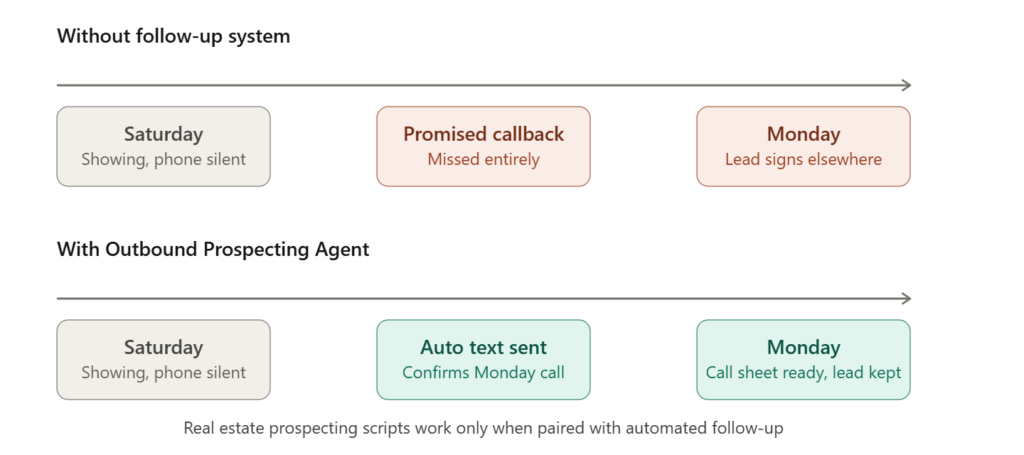
It’s Saturday afternoon. An agent is mid-showing at a three-bedroom townhome in a suburban development, phone on silent in their pocket.
Back at the office — or rather, nowhere, because there is no office today — forty scheduled follow-up calls from last week’s expired listing campaign are sitting untouched. One of those contacts, a seller who said “call me back in two weeks” exactly fourteen days ago, is now actively comparing agents online.
Without a system running, that lead goes cold by Monday. The seller signs with whoever calls first.
Now picture the same Saturday with the Outbound Prospecting Agent active. The seller who said “two weeks” gets a scheduled text that morning confirming the agent will call Monday at 10 a.m., exactly as promised.
The agent finishes the showing, checks a notification, and sees three prospects flagged as “ready to talk” based on their responses. Monday’s call sheet is already built. Nothing fell through during the one afternoon the agent couldn’t answer the phone.
Why This Matters More in 2026 Than Ever
Buyer and seller expectations have shifted toward speed and responsiveness. Most buyers now find their property through a mobile device, and the average online search stretches across roughly 4.7 months — meaning agents need to stay visibly present throughout a long decision window, not just at the moment of first contact. Dealmachineos
At the same time, regulatory changes have raised the stakes for how prospecting calls are made and documented. New FCC consent rules affecting real estate telemarketing took effect in early 2025, requiring agents to obtain direct consumer consent before certain automated calls. That means proper tracking and compliant follow-up sequencing aren’t optional anymore.
Instead, agents need systems that log consent, track outreach history, and keep every script-driven conversation organized. Beyond that, sellers expect agents to remember previous conversations, not start from zero on every call.
Bottom Line
Real estate prospecting scripts work, but only when paired with relentless, organized follow-up. The agents earning the most from cold outreach aren’t better talkers. They simply never let a “not yet” become a “never.”
That means the real advantage comes from systems that track every branch, every objection, and every promised follow-up date automatically. Scripts open the door; structured persistence walks through it.
Ready to put this into practice? Check out the Outbound Prospecting Agent — see how it works, or book a strategy call here to see how AxonEstate fits your team.
Frequently Asked Questions
Do real estate prospecting scripts actually work, or do prospects just hang up?
Yes, they work, but only as a flexible framework. Cold calling converts at roughly 57.1% effectiveness when agents adapt the script to objections instead of reading it verbatim. Calling Agency
How many times should I follow up before giving up on a lead?
At minimum, plan for eight touchpoints. It takes an average of eight cold call attempts to reach a prospect, and most agents quit long before that. Dealmachineos
What’s the biggest mistake agents make with cold calling scripts?
Stopping at the first objection. Top agents treat “not now” as a scheduling opportunity, not a rejection, and immediately set a specific follow-up date.
Can AI really help with something as personal as a sales call?
AI doesn’t make the call for you, but it handles the scheduling, logging, and list-building so you walk into every call prepared and follow up exactly when you said you would.