Real estate drip campaigns have been a staple for decades — but AI-powered 12-month nurture is rapidly making them obsolete. According to the National Association of Realtors, 87% of buyers say they would use their agent again, yet only 12% actually do. The gap isn’t loyalty — it’s follow-up. Agents are losing repeat business and referrals not because they don’t care, but because outdated drip systems can’t keep up with what modern leads actually need.
Why Traditional Real Estate Drip Campaigns Are Failing Agents
For years, agents have relied on drip campaigns to stay in touch with their databases. The idea was simple: set up a sequence of pre-written emails, schedule them weeks apart, and let the system do the work. In theory, it sounds smart. In practice, it has become a liability.
The core problem is that drip campaigns treat every lead the same. A first-home buyer sitting at 18 months from purchase gets the same generic email as someone who just missed out at auction last weekend. There’s no context, no timing intelligence, and no ability to adapt to what’s happening in a contact’s life. According to HubSpot’s 2024 Email Marketing Report, generic email sequences see average open rates below 21% — and real estate campaigns typically sit even lower.
Beyond poor personalisation, most drip platforms are static. Once you build the sequence, it runs on a timer — regardless of whether the lead has gone cold, gone hot, or just bought somewhere else entirely. Agents waste hours every month managing a system that works against them, not for them.
The result is a silent but expensive problem. Leads fall through the cracks. Warm contacts go cold. And the agent who sent seventeen identical “just checking in” emails over six months wonders why their referral rate keeps dropping.
What the Top Agents Actually Do
The agents who consistently convert warm leads into closed deals have quietly abandoned the drip model. They’ve replaced it with something more human — and more intelligent.
Take Sarah Hendricks, a buyer’s agent running a three-person team in Austin, Texas. For years, Sarah used a well-known drip platform and averaged one referral conversion per quarter from her database. In early 2024, she switched to an AI-powered 12-month nurture approach that adapted its outreach based on each contact’s behaviour, property preferences, and where they sat in the buying timeline. Within six months, her database conversions tripled.
The difference wasn’t volume — Sarah wasn’t sending more messages. She was sending better ones, at the right time. When a contact opened an email about three-bedroom homes in a specific suburb twice in one week, the system flagged them as re-engaged and shifted the nurture intensity accordingly. When another contact went quiet for 60 days, the system dialled back frequency and switched to a lighter check-in approach rather than flooding an inbox.
Agents who do this well understand one thing clearly: nurture is not broadcasting. It’s a conversation that changes shape over time. The top performers treat their database like a living document — not a static list of names sitting in a drip queue.
The Research Behind AI-Powered 12-Month Nurture Strategies
The data makes a compelling case for why the shift to intelligent nurture is accelerating across the industry.
According to a 2023 study by Salesforce, personalised communications generate transaction rates significantly higher than generic outreach — in some categories up to six times higher. That kind of gap matters enormously in real estate, where a single transaction can represent tens of thousands of dollars in commission. When an agent’s follow-up system can adapt to individual contacts rather than blast a fixed sequence, the conversion uplift is real and measurable.
Research from the National Association of Realtors also highlights that most buyers take between six and eighteen months from first inquiry to purchase. That’s a long runway — and it’s exactly where AI-powered 12-month nurture proves its worth. A system that can maintain meaningful, contextual contact across that full window dramatically outperforms any static drip sequence built on a 30-day or 60-day timer.
Meanwhile, a 2024 McKinsey report on AI in customer engagement found that businesses using adaptive communication tools reduced lead drop-off rates by up to 35% compared to those using fixed communication sequences. For real estate agents managing databases of hundreds or thousands of contacts, that reduction compounds into significant revenue recovered.
How AI Solves the 12-Month Nurture Problem
The shift from drip to intelligent nurture isn’t just a philosophy change — it’s now a practical reality, thanks to AI tools built specifically for real estate workflows.
The 12-Month Nurture Agent from AxonEstate is designed to do exactly what a human assistant could never do at scale: maintain personalised, timely, context-aware communication with every contact in an agent’s database across a full twelve-month window — automatically.
Here’s what it specifically does:
- Tracks engagement signals — open rates, click patterns, and response history — to identify when a contact is warming up or going cold, and adjusts outreach accordingly
- Segments contacts dynamically based on where they sit in the buying or selling journey, so messaging is always relevant to their current situation
- Personalises message content by drawing on property preferences, suburb interest, and prior conversation context — no two contacts get identical outreach
- Adapts frequency intelligently — increasing touchpoints when a lead shows renewed interest and stepping back when they go quiet, preventing unsubscribes
- Triggers re-engagement sequences automatically when a contact shows buying signals again after a dormant period
- Maintains consistent follow-up across SMS, email, and other channels without the agent needing to manually schedule or review every touchpoint
The result is a nurture system that runs like a dedicated team member — one who never forgets a contact, never sends the wrong message at the wrong time, and never goes on leave.
The Real Cost of Getting This Wrong
Let’s make this concrete.
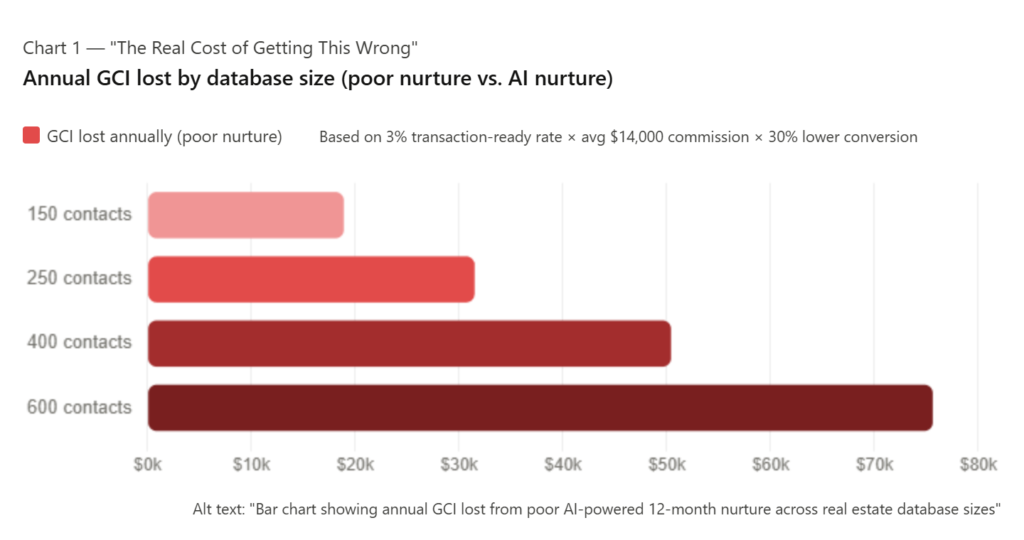
Imagine an agent with a database of 400 contacts. Industry benchmarks suggest that roughly 3% of any real estate database is ready to transact in any given quarter. That’s 12 potential deals sitting in that list right now. If the average commission in that agent’s market is $14,000, those 12 deals represent $168,000 in potential GCI (Gross Commission Income — the total commission earned before splits or expenses).
A poorly maintained drip campaign that fails to re-engage warm leads even at a 30% lower conversion rate costs that agent roughly $50,000 in lost GCI per year — from a single database. Over three years, that’s $150,000 in commissions that went to a competitor who followed up better.
On top of lost commission, there’s the time cost. The average agent spends between four and six hours per week manually managing their CRM and follow-up sequences, according to real estate productivity research. That’s 260 hours per year — over six full working weeks — spent on tasks that an AI-powered 12-month nurture system handles automatically.
The math is straightforward. Staying with a broken drip system isn’t just a missed opportunity — it’s an active, ongoing financial loss.
How This Plays Out in Practice
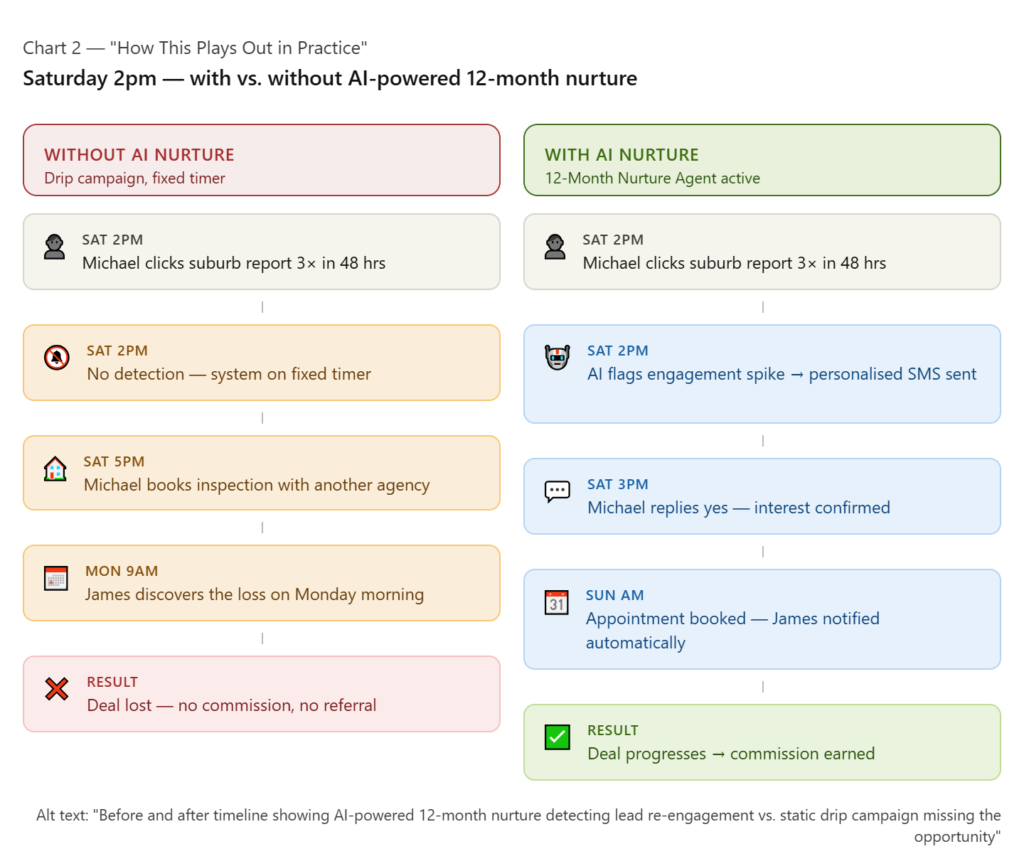
It’s Saturday afternoon. James, a solo agent in Brisbane’s inner west, is in the middle of a showing for a four-bedroom home in Paddington. His phone is on silent. Back in his database, a contact named Michael — who first enquired about property 14 months ago and went quiet after losing a bid — just clicked through on a suburb report for Ashgrove three times in the past 48 hours.
Without AI-powered 12-month nurture, nothing happens. Michael’s renewed interest goes undetected. By Monday morning, Michael has already booked an inspection through a different agency he found on a portal. James never knew he was back in the market.
Now imagine the same Saturday with the 12-Month Nurture Agent running. Michael’s engagement spike triggers an immediate behaviour flag. Within the hour, Michael receives a personalised SMS: “Hi Michael — looks like Ashgrove is on your radar again. I’ve got a couple of properties coming to market next week that might suit what you were looking for. Want me to send through the details?” Michael replies yes. By Sunday, James has a booked appointment — without lifting a finger while he was at that Paddington showing.
That’s the difference between a database and an active pipeline. One sits still. The other never sleeps.
Why This Matters More in 2025 Than Ever
The real estate market in 2025 is not the same market that drip campaigns were built for. Buyer timelines have stretched. Affordability pressures mean more people are in the “watching and waiting” phase for longer than ever before. And the agents they eventually transact with are the ones who stayed relevant and present across that entire window.
According to Zillow’s 2024 Consumer Housing Trends Report, over 60% of buyers spent more than three months actively searching before making an offer — and more than a quarter spent longer than twelve months. That’s a substantial portion of every agent’s database sitting in a long-consideration cycle, waiting to be nurtured well or lost to a competitor who followed up better.
At the same time, consumer expectations around personalisation have never been higher. People have been trained by Netflix, Spotify, and Amazon to expect experiences that adapt to them. A generic drip email about “the importance of pre-approval” sent to someone who’s already pre-approved and actively bidding doesn’t just fail — it actively erodes trust. AI-powered 12-month nurture isn’t a nice-to-have in this environment. It’s rapidly becoming the baseline standard that buyers and sellers expect.
Bottom Line
Real estate drip campaigns had their moment. But the agents who are growing their businesses in 2025 have moved on. They’ve replaced static, timer-based sequences with AI-powered 12-month nurture that adapts, personalises, and responds in real time — at a scale no human team could match manually.
The technology exists. The business case is clear. The only question is how long an agent waits before making the switch — and how many deals fall through the cracks in the meantime.
If your current follow-up system is a drip campaign running on autopilot, it’s time for an upgrade. 12-Month Nurture Agent — see how it works. Or book a strategy call here to find out how AxonEstate can rebuild your nurture system from the ground up.
Frequently Asked Questions
How is AI-powered 12-month nurture different from a regular drip campaign?
A drip campaign sends the same pre-written emails on a fixed timer, regardless of how a lead is behaving. AI-powered 12-month nurture adapts in real time — adjusting message content, frequency, and channel based on what each individual contact actually does. It’s the difference between broadcasting and having a genuine, responsive conversation at scale.
Do I need a big database to make this worthwhile?
Even a database of 150 to 200 contacts can generate meaningful returns with proper AI nurture. The issue isn’t database size — it’s database activation. Most agents have warm leads sitting dormant in their CRM right now who would transact if they received the right message at the right time.
Will AI nurture messaging feel robotic to my contacts?
When it’s built correctly, no. The best AI-powered 12-month nurture tools draw on each contact’s history, preferences, and engagement behaviour to craft messages that feel personal and timely — not like a mass email blast. Many agents find their contacts respond more to AI-personalised messages than to the generic sequences they were sending before.
How long does it take to see results from switching to AI nurture?
Most agents start seeing re-engagement from dormant contacts within the first four to eight weeks of switching. Full conversion impact — new listings, referrals, and buyer commitments sourced from the database — typically becomes measurable within a quarter.