Most agents have AI writing their listing descriptions, scheduling their social posts, and drafting their email blasts. Database reactivation marketing rarely makes that list, even though it sits on the exact spot where the money already lives. According to the National Association of Realtors’ 2025 Technology Survey, 82% of agents now use AI tools in their business, yet only 21% use a CRM with AI-powered insights. The gap between those two numbers is where deals quietly die.
The Pain Point: Your Database Is a Graveyard, Not a Pipeline
Every agent has one. A CRM, spreadsheet, or old phone full of past clients, lukewarm leads, and people who said “not right now” eighteen months ago. Most of it just sits there.
Database reactivation marketing gets ignored because it feels less urgent than chasing fresh leads. New leads show up in real time. Old contacts don’t ping you. Out of sight becomes out of mind, and the database turns into a digital junk drawer instead of a revenue source.
This is expensive. According to NAR’s 2025 Profile of Home Buyers and Sellers, 66% of sellers found their agent through a referral or by working with someone they’d used before, and 43% of buyers did the same. That means most of the industry’s transaction volume is flowing through relationships agents already have, not strangers they’re trying to meet for the first time.
Meanwhile, the typical agent spends real budget on cold lead generation. The 2025 NAR survey found that 19% of agents spend over $500 a month on lead generation alone. They’re paying to meet new people while ignoring hundreds of past clients who already trust them.
Because of this, agents end up running two businesses at once: an expensive one built on strangers, and a free one built on people who already said yes. Only one of those gets attention.
What the Top Agents Actually Do
Maria Chen runs a four-person team in Sacramento. Twice a year, she pulled a list of every past client and “gone cold” lead, then spent a weekend manually checking who might be ready to sell again. It worked, but it ate her Saturdays, and by the time she finished the list, some of those leads had already called a competitor.
Compare that to David Okafor, a solo agent outside Phoenix with a database of roughly 600 contacts. Instead of one manual sweep a year, his system flags movement automatically — a contact who just got a new job listed on LinkedIn, an anniversary date on a past closing, a lead who started browsing listings again after months of silence. He gets a short list of names worth calling this week, not a guess.
This is the contrast that separates top producers from everyone else. The agents winning repeat and referral business aren’t smarter or luckier. They simply never let the trail go cold. Instead of treating the database as a once-a-year chore, they treat it as a daily signal feed. In practice, the difference between Maria’s twice-a-year sweep and David’s daily flag system is the difference between catching a seller before they list and finding out after the sign is already in the yard.
The Research Behind Database Reactivation Marketing
Database reactivation marketing has data behind it, not just anecdote. NAR’s 2025 figures show 88% of buyers purchased through an agent and would use one again, which means the dissatisfaction isn’t with agents — it’s with follow-up. Additionally, separate referral research cited by Jamil Academy found that agents with 16-plus years of experience report 40% of their business from repeat clients alone, with another 28% coming from referrals.
That adds up to roughly two-thirds of an experienced agent’s pipeline coming from people already in their database. In contrast, a brand-new lead from paid advertising converts at a fraction of that rate and costs money up front. RPR’s 2026 survey adds another angle: 82% of agents have adopted AI tools, mostly for writing and content, while far fewer apply that same technology to mining their own contact list for ready-to-move sellers.
How AI Solves Database Reactivation Marketing
The problem isn’t that agents lack data. It’s that nobody has time to read 600 contact records looking for the three people who are actually ready to move. That’s a pattern-recognition job, and pattern recognition is exactly what AI does well.
This is where the Database Reactivation Agent becomes the natural next step, not a sales pitch tacked onto the problem. Instead of an agent manually re-reading old notes, the system continuously scans the database for behavior changes and re-engagement signals, then surfaces who’s worth a call today. Beyond that, the same logic that runs reactivation can plug into the rest of an agent’s workflow through AxonEstate, since reactivation works best when it’s connected to the broader pipeline instead of running in isolation.
Specifically, the agent:
- Flags dormant contacts who show renewed activity, like repeated portal searches or saved listings
- Segments the database by likelihood to transact in the next 90 days, not just alphabetically
- Drafts personalized outreach based on each contact’s history, not a generic blast
- Surfaces life-event signals — job changes, family size changes, anniversary dates — tied to moving decisions
- Tracks which past clients haven’t been contacted in over six months and prioritizes them automatically
- Hands off warm contacts directly to the agent’s calendar instead of leaving them in a spreadsheet
This is why reactivation stops being a once-a-year project and becomes a quiet, ongoing source of warm leads.
The Real Cost of Getting This Wrong
Picture a database of 500 contacts, which is typical for an agent five years into their career. Industry referral data suggests roughly 60% of that group has the kind of relationship that could produce a referral or repeat transaction, meaning around 300 contacts are realistically reachable.
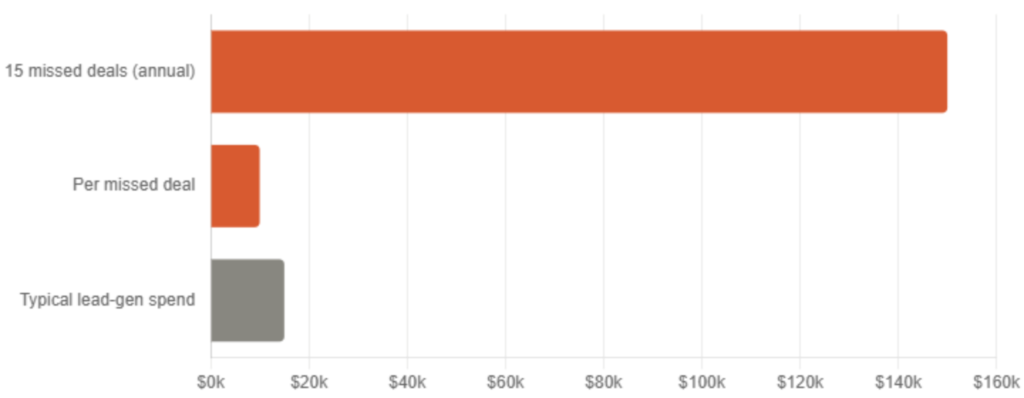
If even 5% of those 300 — fifteen people — are within striking distance of a move this year, and the agent never reaches out, that’s fifteen missed transactions. At a conservative $400,000 average sale price and a 2.5% commission, one missed deal costs roughly $10,000 in gross commission income. Fifteen missed deals is $150,000 left on the table, every single year, from contacts who already know and trust the agent.
That number doesn’t include the referrals those fifteen people would have sent along. Unlike a cold lead that costs money before it produces anything, this is money the agent already earned the right to and simply never collected.
How This Plays Out in Practice
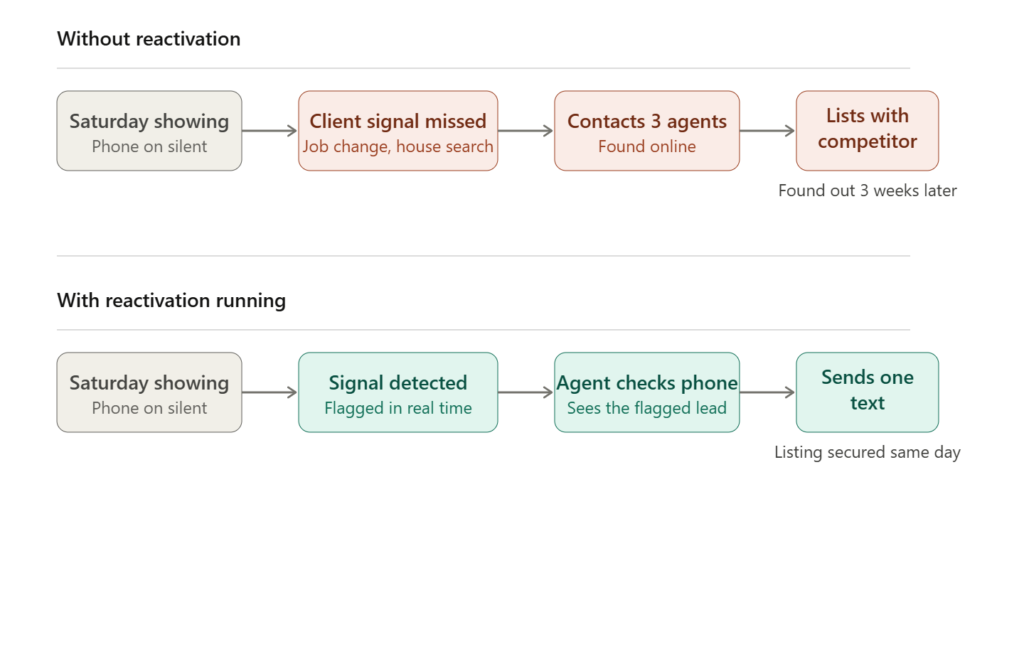
It’s a Saturday afternoon. An agent is mid-showing on a three-bedroom craftsman in a quiet suburb, phone on silent, fully focused on the buyers in front of her. Across town, a former client from two years ago just got a job offer in another state and starts Googling “sell my house fast.” Without a reactivation system, that signal goes nowhere. The former client searches online, finds three agents running ads, and books a call with one of them by Sunday morning. The original agent finds out three weeks later when a “sold” sign goes up on a street she used to work.
Now run the same Saturday with reactivation running in the background. The former client’s online activity — searching home values, browsing moving companies — gets picked up as a signal. By the time the agent finishes her showing and checks her phone, there’s a flagged contact waiting with a short note: past client, sudden search activity, job-change signal detected. She sends one short text between appointments. That’s the whole job. The lead never reaches a competitor’s website because the agent reached out first.
The difference between those two Saturdays isn’t effort. It’s whether someone was watching the signal at all.
Why Database Reactivation Marketing Matters More in 2026 Than Ever
Inventory has tightened, financing has gotten harder, and buyers are taking longer to act. NAR’s 2025 data shows the typical home sale now takes about four weeks instead of the two to three weeks common in prior years, which means agents have less margin for slow follow-up at any stage of the funnel.
At the same time, paid lead costs keep climbing while conversion rates stay flat or drop. That combination makes existing relationships more valuable, not less. A market that moves slower rewards the agent who’s already top of mind over the one still introducing themselves. This is why reactivation isn’t a “nice to have” add-on anymore — it’s become the cheaper, faster path to the same transaction a paid lead would have cost five times as much to produce.
Bottom Line
Most agents have already automated their marketing. Almost none have automated the one list that’s already full of people who said yes to them before. That’s the real gap, and it’s costing six figures a year in deals that walk to a competitor simply because nobody noticed they were ready to move.
Database reactivation marketing isn’t about working harder on outreach. It’s about finally paying attention to the database that’s been sitting there the whole time. Check out the Database Reactivation Agent — see how it works, or book a strategy call here to walk through what’s sitting in your own contact list right now.
Frequently Asked Questions
How is database reactivation different from just emailing my old leads?
Email blasts treat everyone the same. Reactivation tools track individual behavior — searches, life events, engagement — so outreach goes to the right person at the right moment, not the whole list at once.
Do I need a huge database for this to be worth it?
No. Even a database of 200–300 contacts usually has enough dormant relationships to produce several extra transactions a year once you can see who’s actually showing renewed activity.
Won’t my past clients feel weird that I’m reaching out after months of silence?
Most people don’t mind hearing from an agent who helped them buy or sell, especially when the message is timely and specific instead of a generic “checking in.” A well-timed text beats a forgotten relationship every time.
How long before I see results from reactivating my database?
Some signals, like a past client suddenly browsing listings again, can produce a conversation within days. Building consistent, year-round reactivation into your routine typically shows up in your pipeline within one to two quarters.
Sources
- NAR Technology Survey finds AI gaining traction with Realtors — HousingWire
- AI adoption reaches 82% among real estate agents — HousingWire
- Key Takeaways from NAR’s 2025 Profile of Home Buyers and Sellers — Virginia REALTORS®
- NAR 2025 Profile of Home Buyers, Sellers Reveals Market Extremes — NAR
- Real Estate Referral Strategy 2026: 80% Past-Client Business — Jamil Academy
- NAR survey finds Realtors willing to pay for technology tools — Atlanta Agent Magazine