A real estate referral machine sounds like marketing speak until you see the math behind it. According to the National Association of Realtors, 66% of sellers in 2025 found their agent through a referral or by working with someone they’d used before. That means two out of three sellers were already sold on an agent before the first conversation happened. Most agents just never built a system to be that agent twice.
The Real Estate Referral Machine Most Agents Never Build
Most agents treat past clients like a finish line, not a starting point. The moment a deal closes, attention shifts to the next listing, the next buyer consultation, the next inspection. The client who just got keys to their first home drops off the radar by week two.
That gap is where referral business quietly dies. Research from RealScout found that referral leads convert at 14% to 30%, compared to just 0.4% to 1.2% for portal leads like Zillow and Realtor.com. In other words, the highest-converting leads in the entire industry are sitting in agents’ own databases, completely untouched.
Staying in touch consistently is hard to do by hand, though. A birthday card here, a holiday email there — it’s not enough to stay top of mind for the years a typical seller now waits before moving again. Most CRMs only nudge agents to “check in,” leaving the actual follow-through to memory and good intentions.
Meanwhile, that former client’s neighbor starts thinking about selling. Their cousin gets a job offer in another city. Their coworker wants to buy a rental property.
Each of those moments is a referral opportunity. Without a real estate referral machine running in the background, the agent never hears about any of them until the referral has already gone to whoever called first.
What the Top Agents Actually Do
Jordan Pruitt, who runs a two-person team in Charlotte, North Carolina, closed 27 transactions last year. Eleven of those deals came from referrals or repeat clients, without a single dollar spent on paid leads.
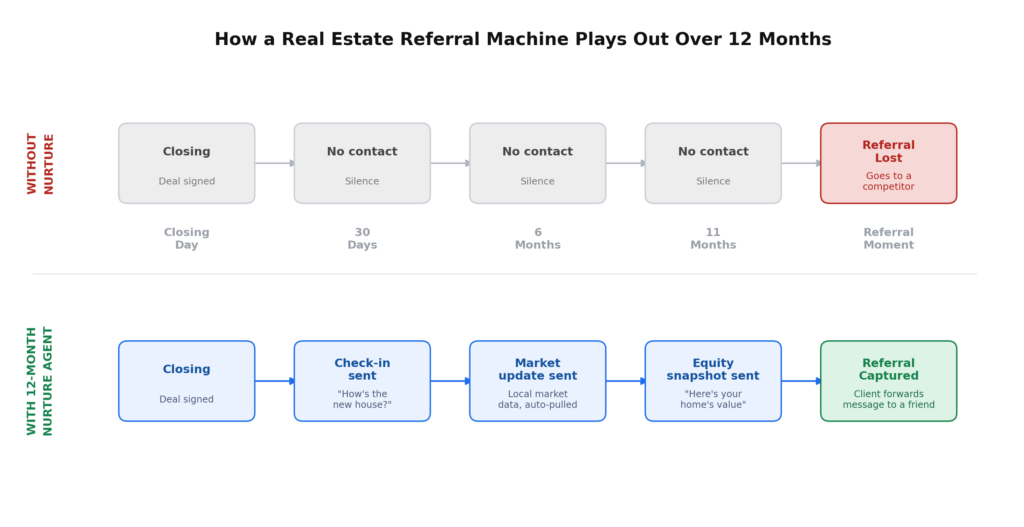
Jordan’s edge isn’t charisma. It’s a structured 12-month follow-up calendar that touches every past client at specific intervals: a 30-day “how’s the new house” check-in, a 6-month market update, an 11-month “here’s what your home is worth now” message timed just before the typical window when people start thinking about moving. Each touch gives the client a reason to think of Jordan, and someone to refer.
Compare that to the agent two blocks over, who closed 22 deals in the same period and got zero referrals from any of them. That agent isn’t worse at real estate. The agent simply stopped showing up in clients’ lives after closing day. As a result, those 22 happy clients — many of whom would gladly recommend the agent — never got asked, never got reminded, and never thought to make the call.
That gap compounds over time. Jordan’s 11 referral deals this year become 15 to 20 referral conversations next year, because every new client enters the same 12-month cycle. The other agent starts from zero again every January.
The Research Behind the Real Estate Referral Machine
The numbers behind referral-driven business hold up across multiple studies. NAR’s 2025 Profile of Home Buyers and Sellers found that 43% of buyers selected their agent through a referral, while more than 9 in 10 buyers said they’d use that same agent again. That second figure matters more than it looks — it represents untapped repeat and referral business sitting dormant in nearly every agent’s database.
Separately, research compiled by RealScout shows referral leads converting at 14% to 30%, compared with 0.4% to 1.2% for portal-based leads. That’s roughly a 20-to-1 advantage in lead quality, yet most marketing budgets still flow toward the lower-converting source.
Industry analysis from Jamil Academy puts it plainly: top-producing agents generate 60% to 80% of their business from referrals and past clients, even though the average agent reaches out to that group only once a year. The agents winning this game aren’t getting lucky. They built a system, and the data backs up why it works.
How AI Solves the Real Estate Referral Machine Problem
Manually running a 12-month touch cycle across 50, 150, or 300 past clients isn’t realistic for most agents. That’s exactly the gap AxonEstate’s 12-Month Nurture Agent was built to close.
Instead of relying on memory or a sticky note, the agent runs a structured outreach calendar automatically for every closed client in the database. It sends personalized check-ins, market updates, and home-equity snapshots on a schedule built around when people actually decide to move or refer someone.
This isn’t a generic drip campaign, either. The agent pulls real, current data for each property and market, so the message landing in a past client’s inbox says something useful instead of “just checking in.”
Specifically, the 12-Month Nurture Agent:
- Sends automated check-ins at the 30-day, 90-day, 6-month, and 11-month marks after closing
- Pulls live home-equity and local market data into each message, so it reads as helpful, not promotional
- Flags clients showing “move-ready” signals, like browsing new listings or asking about their home’s value
- Drafts referral-ready messages clients can forward directly to friends or family who are house-hunting
- Surfaces a daily list of clients due for outreach, so nothing falls through the cracks
- Syncs every touchpoint back into the CRM, so follow-up history stays visible to the whole team
Paired with the broader AxonEstate platform, this turns a one-time closing into a 12-month relationship, and a relationship into the next three deals.
The Real Cost of Getting This Wrong
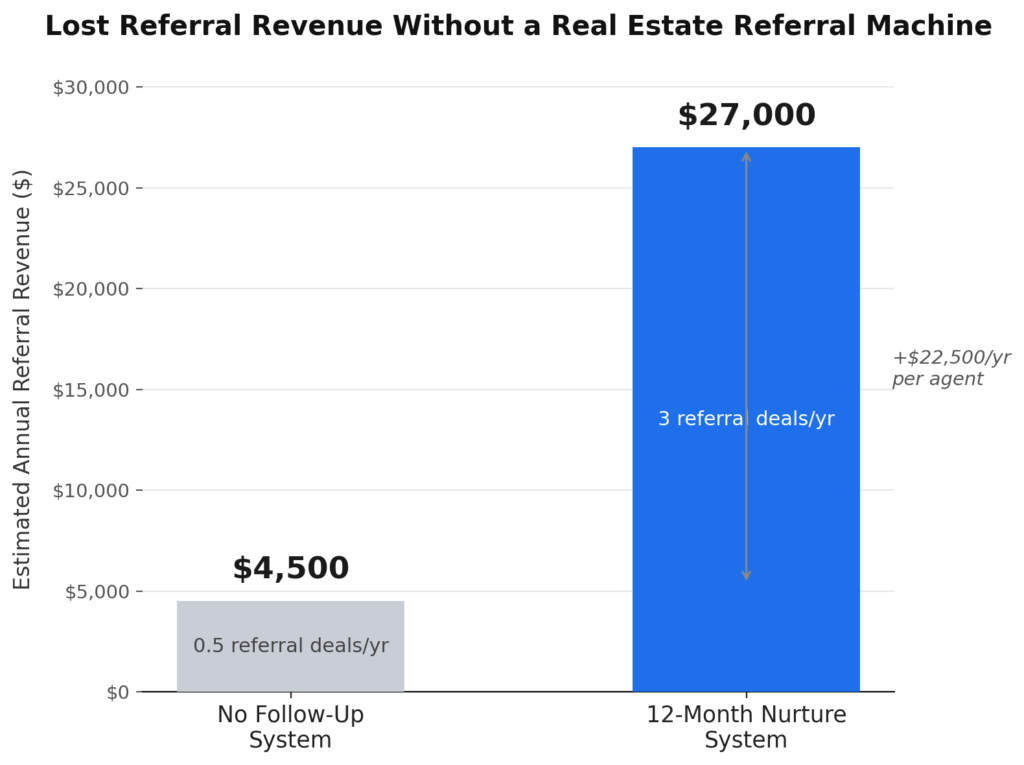
Picture an agent closing 24 transactions a year at an average commission of $9,000 per side. Nationally, nearly 1 in 4 sellers refer their agent four or more times within a year of closing when the relationship is nurtured well. Without consistent follow-up, that number falls close to zero for most agents, because past clients simply forget to ask or don’t think of their agent first.
Say even half of that agent’s 24 past clients would refer a friend or family member if reminded at the right moment. At a 15% to 30% referral conversion rate, that’s two to four additional closings a year, purely from relationships the agent already has. At $9,000 average commission, that’s $18,000 to $36,000 left on the table annually, not from bad service, but from silence after closing day. Multiply that across a five-year career, and the real cost stops looking small.
How This Plays Out in Practice
It’s a rainy Tuesday in October, fourteen months after Jordan helped the Andersons close on their first home, a three-bedroom bungalow in Charlotte’s Plaza Midwood neighborhood. Without a follow-up system, here’s what typically happens: the Andersons’ upstairs neighbor mentions she’s thinking about selling. Mrs. Anderson nods politely.
Even so, she can’t remember her agent’s name off the top of her head, and there’s no recent message in her inbox to jog her memory. The neighbor ends up calling whoever has a sign on the next street over.
Now run that same Tuesday with the 12-Month Nurture Agent active. Three days earlier, Mrs. Anderson received an automated message: “Homes in Plaza Midwood are up 4% this quarter, here’s what that means for your equity.” It included Jordan’s name, his number, and a one-tap “share with a friend” link.
When her neighbor brings up selling, the message is still sitting in her inbox. She forwards it on the spot.
That’s the entire mechanism. Nothing dramatic happens. There’s no missed call, no emergency. It’s just one well-timed, relevant message landing exactly when a referral conversation was already happening anyway.
Multiply that single Tuesday by every past client, every month, for years, and the difference between “good agent” and “the agent everyone refers” stops being about talent. Instead, it becomes about whether someone, or something, kept the relationship warm.
Why This Matters More in 2026 Than Ever
Referral-driven business matters more now than it did even a few years ago. The typical seller in 2025 had lived in their home for 11 years before listing, an all-time high, according to NAR. Longer hold times mean fewer natural touchpoints between agents and clients, and a much bigger gap for memory, and competitors, to fill.
At the same time, lead costs keep climbing. Portal lead costs have risen sharply over the past decade, even as conversion rates on those same leads have stayed flat, according to industry data. That combination, clients staying put longer and cold leads getting more expensive, pushes the math even further in favor of a real estate referral machine built on relationships agents already have.
In a market where commission structures are shifting and buyer-agent agreements face more scrutiny than ever, the agents who win aren’t necessarily the ones spending the most on ads. They’re the ones whose past clients still remember their name eleven years later, and who pick up the phone to refer them without being asked twice.
Bottom Line
A real estate referral machine isn’t a personality trait. It’s a system, one that keeps every past client warm long after the closing gift wears off.
The agents generating 60% to 80% of their business from referrals aren’t smarter or luckier. They just never let the relationship go cold. Every closing becomes the start of the next three deals, not the end of one.
You don’t have to build that system by hand. See how the 12-Month Nurture Agent works — or book a strategy call here to map out what it would look like for your database.
Frequently Asked Questions
How long after closing should I start following up with past clients?
Start within the first 30 days, while the experience is still fresh. Most agents make the mistake of waiting for a “reason” to reach out — a simple “how’s the new place?” message is reason enough. After that, a touch every 60 to 90 days keeps you top of mind without feeling like spam.
Won’t past clients get annoyed if I message them too often?
Not if the messages are useful instead of promotional. A market update, an equity snapshot, or a relevant local news item reads very differently than “thinking of buying or selling? Call me!” The key is value first, ask second.
What’s a realistic number of referrals to expect from a good follow-up system?
Referral leads convert at 14% to 30%, compared to under 2% for cold internet leads. If you stay in consistent contact with 50 past clients, expecting 5 to 10 referral conversations a year is realistic, not 1 or 2.
Can AI really replace the personal touch in client follow-up?
It doesn’t replace it, it makes the personal touch consistent. An AI nurture agent handles the scheduling, the data pulling, and the reminder sending, but every message still goes out under your name. You stay the relationship; the system just keeps it from going cold.
Sources
- Top 10 Takeaways from NAR’s 2025 Profile of Home Buyers and Sellers — National Association of Realtors
- 91% of Sellers Used an Agent in 2025. Here’s What They Value Most — Realty Billings
- Real Estate Lead Generation Strategies That Convert — RealScout
- Real Estate Referral Strategy 2026: 80% Past-Client Business — Jamil Academy