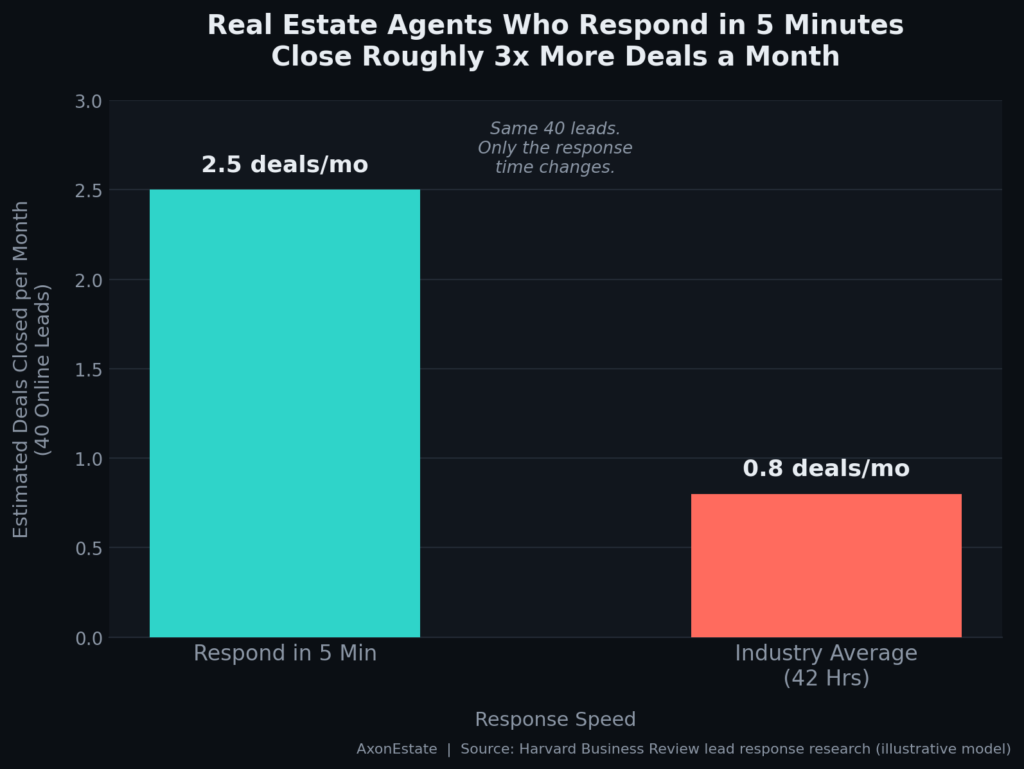
Real estate agents who respond in 5 minutes win the deal before most competitors even open the notification. According to Harvard Business Review, firms that reach a new lead within the first hour are far more likely to hold a real conversation with that prospect than firms that wait even a little longer. In real estate, a single buyer often messages three or four agents in the same afternoon, and that early advantage decides who gets the client — and who gets ghosted. This isn’t about hustle — it’s about whether your business runs on a five-minute clock or a five-hour one.
Why Most Agents Don’t Respond in 5 Minutes (And What It Costs Them)
Most agents don’t lose deals because they’re bad at real estate. Instead, they lose deals because they’re busy doing real estate — showing homes, negotiating contracts, sitting in inspections. Meanwhile, new leads quietly pile up in an inbox nobody’s watching.
That gap matters more than most agents realize. Harvard Business Review found that firms surveyed took an average of 42 hours to make first contact with a new lead. Even so, the same research showed that whoever responds first wins the majority of the business. Meanwhile, the buyer who submitted that inquiry isn’t waiting around; they’re already texting the next agent on the list.
Because of this, speed has quietly become the biggest lever in lead conversion. It matters more than ad spend, more than staging photos, more than a slick listing description. Agents who consistently respond in 5 minutes aren’t smarter or more talented. Specifically, they’ve just removed the human bottleneck between a lead coming in and a conversation starting.
This is why the gap keeps widening. Most agents already know speed matters. However, they can’t be in two places at once — at a showing and glued to their phone. That’s the real problem: not a lack of urgency, but a lack of hands.
More importantly, this isn’t a discipline problem that more willpower can fix. Even the most organized agent can’t watch a phone during a two-hour closing. Because of this, the agents pulling ahead have stopped trying to be faster humans and started building faster systems instead.
What the Top Agents Actually Do
Maria Delgado leads a nine-agent team in Austin, Texas, and she built her business around one simple rule: nobody waits. When a lead comes in from Zillow, Realtor.com, or her own site, someone — or something — reaches out within minutes, not hours.
That habit shows up in her numbers. Competing teams nurse response times of half a day or longer. Meanwhile, Maria’s team turns cold clicks into booked appointments before the buyer has even closed the browser tab.
In practice, her agents aren’t working harder. They’re working inside a system that never lets a lead go cold in the first place.
Contrast that with the agent working solo, checking leads between showings. By the time he calls back, the buyer has already spoken to two other agents and mentally moved on. Same lead quality, same market — completely different outcome, because of this one variable: speed.
Unlike the solo agent, the top producers in every market share the same pattern. Whatever their niche, whatever their marketing looks like, the pattern holds. They treat the first five minutes after a lead arrives as the most valuable five minutes in their entire business. That’s more important than any script, and it costs nothing to start doing.
The Research Behind Responding in 5 Minutes
The original Harvard Business Review study on this topic, conducted by researchers affiliated with MIT and Harvard, tracked thousands of sales leads across industries. Specifically, it found that firms contacting a new prospect within an hour were roughly seven times more likely to hold a meaningful conversation with them. Waiting just one hour longer cut those odds dramatically. Even more strikingly, those fast responders were over sixty times more likely to connect than firms that waited a full day.
That same research found that 78% of web leads end up going to whichever company responds first. In practice, that single number explains why so many “lost” leads were never actually lost — they were just answered too late.
Separate research from the National Association of Realtors backs this up from the buyer’s side. NAR’s Home Buyer and Seller Generational Trends research shows that most of today’s buyers finance their purchase and spend roughly ten weeks searching before committing. That’s a long window — plenty of time for the fastest-responding agent to build a lasting head start.
On top of that, a 2025 breakdown of NAR’s own buyer survey found that 85% of recent buyers rated their agent as the single most useful source of information during the entire search. That’s ahead of listing portals and online search tools combined.
How AI Makes It Possible to Respond in 5 Minutes
Here’s the transition: agents can’t physically watch their phone 24 hours a day, and they shouldn’t have to. That’s exactly the gap AI was built to close. A lead no longer has to sit untouched during a showing, an open house, or the middle of the night. Instead, an AI agent can respond in 5 minutes — usually far faster — every single time.
This is where the Inbound Lead Responder from AxonEstate changes the math entirely. It doesn’t just send a generic auto-reply. Instead, it holds a real conversation, answers questions about the listing, and books the buyer into the next available appointment before the agent even sees the notification. Meanwhile, the agent stays free to keep showing homes, closing contracts, and running the rest of the business.
Specifically, an AI-powered inbound response system typically:
- Responds to every new lead within seconds, day or night, weekends included
- Answers common buyer questions about price, availability, and property details
- Qualifies the lead by asking about budget, timeline, and financing status
- Books a showing or a call directly onto the agent’s calendar
- Hands off a full conversation summary so the agent walks in prepared
- Follows up automatically if the lead goes quiet, instead of letting it die
Beyond the individual conversation, this changes how a whole business runs. That means fewer leads slipping through the cracks and more of them turning into booked appointments. Learn more about how AxonEstate builds an AI-powered team around your business, not just a single chatbot bolted onto your website.
The Real Cost of Getting This Wrong
Let’s do the math most agents never sit down and do. Say your team generates 40 online leads a month, a modest number for many growing Texas teams. Industry benchmarks put average online lead conversion at roughly 2%, which works out to less than one closed deal a month from that entire pipeline.
Now picture what happens once you consistently respond in 5 minutes instead of the industry-average 42 hours. Agents who close that gap routinely see conversion rates two to three times higher, simply because they’re talking to buyers while intent is still fresh. On the same 40 leads, that’s the difference between one closing a month and two or three.
At an average commission of roughly $8,000 per transaction, one extra deal a month adds up to $96,000 a year in GCI left on the table. That’s not from bad leads. That’s from leads nobody called back fast enough.
How This Plays Out in Practice
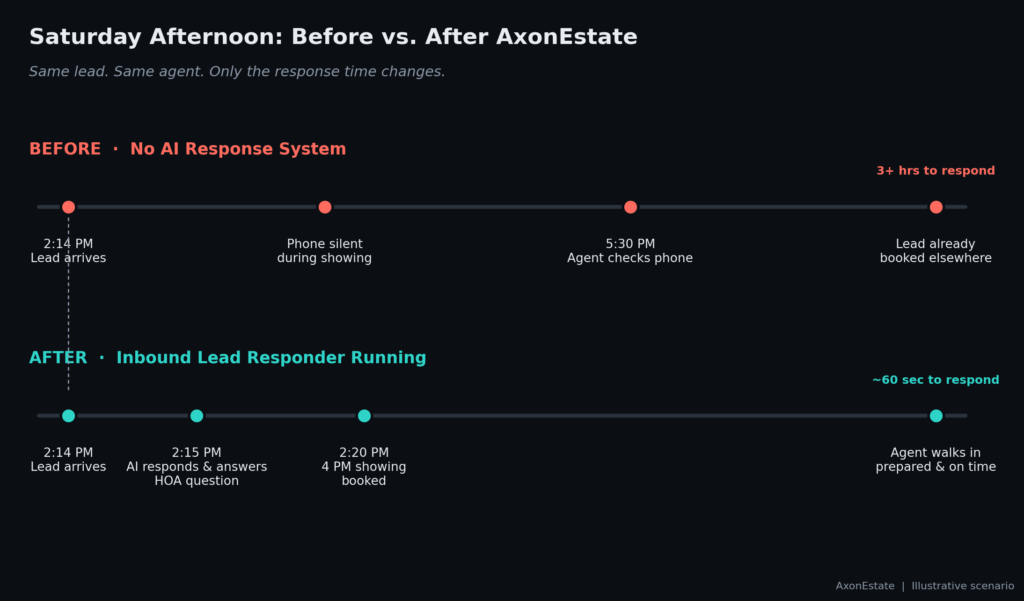
It’s Saturday afternoon. David, a solo agent in Frisco, Texas, is standing in a three-bedroom home walking a buyer through the kitchen, phone on silent in his back pocket. At 2:14 PM, a lead comes in from a listing in a nearby suburb — a young couple, pre-approved and ready to move fast.
Without any system in place, that lead sits untouched until David checks his phone at 5:30 PM, more than three hours later. By then, the couple has already toured two other homes with a different agent and started building a relationship with someone else. David never even gets the chance to compete.
Now picture the same Saturday with AxonEstate running in the background. At 2:15 PM, the AI agent texts the couple back, answers their question about the HOA fee, and books them for a 4 PM showing. All of that happens before David’s current appointment even ends. He walks out of one showing straight into another, with a warm lead already qualified and sitting on the calendar.
Same agent. Same busy Saturday. Completely different outcome — because the lead never had to wait for David to be free.
Why This Matters More in 2026 Than Ever
The stakes here keep rising. First-time buyers now make up just 21% of the market, the lowest share the National Association of Realtors has recorded since it began tracking in 1981. On top of that, today’s buyers plan to stay in their next home for 15 years or longer. That means fewer active buyers overall, and each one who reaches out matters more than ever.
At the same time, buyer expectations keep accelerating. Instant notifications, same-day delivery, and 24/7 customer service have trained today’s buyers to expect a response almost immediately, no matter what industry they’re dealing with. A buyer who doesn’t hear back in a reasonable window doesn’t wait patiently. Instead, they simply move to whoever answers first.
In other words, agents who treat speed as optional are competing for a shrinking pool of buyers with an outdated playbook. Finally, the math only gets less forgiving from here, not more. The ones who respond in 5 minutes, every time, are the ones still standing when the market tightens further.
Bottom Line
Speed isn’t a nice-to-have in real estate anymore. It’s the difference between a lead that becomes a client and a lead that becomes a story about the one that got away.
The agents winning right now aren’t necessarily working harder. Instead, they’ve built a system where every lead gets a response the moment it arrives — whether they’re at a showing, asleep, or off the clock entirely. That’s what it means to respond in 5 minutes at scale, without adding a single hour to the day.
Ready to stop losing leads to slower competitors? Inbound Lead Responder — see how it works, or book a strategy call here to see it running inside your own business.
Frequently Asked Questions
How fast do I actually need to respond to a lead?
Aim for five minutes or less. Research on lead response consistently shows that the odds of connecting with a buyer, and eventually qualifying them, drop sharply after that window. And they keep dropping the longer you wait.
I’m at a showing half the day — how am I supposed to respond that fast?
You don’t have to do it yourself. AI tools like AxonEstate’s Inbound Lead Responder handle the first reply, the questions, and the booking. That means a lead gets attention within minutes, even while you’re with a client.
Won’t buyers know they’re talking to a bot and get annoyed?
Modern AI responders hold natural, specific conversations about the actual listing, not generic scripts. Most buyers care far more about getting a fast, useful answer than about who — or what — sent it.
Does this only help with hot leads, or does it work for older ones too?
It works across the board. The same AI system that handles brand-new inquiries can also work through your existing database. That means reviving leads that went cold months ago and never got a real follow-up.
Sources
- The Short Life of Online Sales Leads — Harvard Business Review
- NAR 2025 Profile of Home Buyers and Sellers Reveals Market Extremes — National Association of Realtors
- Home Buyer and Seller Generational Trends Report — National Association of Realtors
- Key Takeaways from NAR’s 2025 Profile of Home Buyers and Sellers — Virginia REALTORS®