A weak real estate follow-up system is the quiet reason so many deals never make it to closing. According to a survey cited by Inman, the average agent takes more than 15 hours to respond to a new lead, and nearly half never follow up again after that first contact. By the time most agents circle back, the buyer has already signed with someone else. The deal wasn’t lost to a bad lead — it was lost to silence.
Why Weak Follow-Up Sinks More Deals Than Bad Leads
Most agents blame lead quality when a deal falls apart. In reality, the leak is almost always further down the pipeline. A lead comes in, gets a single call or text, and then disappears into a spreadsheet nobody opens again.
This happens because agents are pulled in a dozen directions at once. Showings, closings, paperwork, and new inquiries compete for the same few hours in a day. Something has to give, and follow-up is usually the first casualty.
According to the National Sales Executive Association, most sales happen between the fifth and twelfth contact — yet close to half of agents stop after the very first attempt. That gap is where commissions quietly disappear. A buyer who didn’t answer on day one isn’t necessarily uninterested; they may just be busy, unsure, or waiting for the right nudge.
Without a system tracking every open conversation, that nudge never comes. The lead cools off, starts browsing other listings, and eventually calls an agent who actually followed up. Nothing about the sale was doomed. The process around it simply broke down.
On top of that, most CRMs are only as good as the person updating them. A tagged “hot lead” from three weeks ago means nothing if nobody set a reminder to act on it. That’s how good leads quietly become dead ones.
What the Top Agents Actually Do
Consider Marissa Chen, a broker who leads a six-agent team in Round Rock, Texas. Two years ago, her team’s average lead-to-close rate sat below 1%, in line with the industry norm. Leads came in fast, but nobody had time to keep chasing them past the second or third attempt.
Marissa didn’t hire more agents. Instead, she built a follow-up cadence that ran on a schedule instead of memory: a same-day call, a text within the hour if there was no answer, and scheduled check-ins stretching out over months. Nothing about her lead sources changed.
Within a year, her team’s conversion rate had roughly doubled. The difference wasn’t better leads. It was that no lead fell out of the funnel just because it didn’t convert on the first call. Her agents still spent the same hours prospecting; they just stopped losing what they’d already won.
Contrast that with agents who still run follow-up from memory and sticky notes. A lead goes quiet for a week, gets buried under new inquiries, and is forgotten entirely. That agent isn’t lazy. They’re simply managing more relationships than any person can track by hand.
The agents winning right now aren’t smarter or luckier. They’ve just replaced hope with a repeatable process, one that keeps working long after the excitement of a new lead wears off.
The Research Behind a Real Estate Follow-Up System
The data on this problem is remarkably consistent across the industry. Research from the National Sales Executive Association, cross-referenced by Inman, found that roughly 80% of sales require five or more follow-up touches after the initial inquiry, yet most agents never get past the first one.
Separately, the MIT and InsideSales.com Lead Response Management Study found that a lead contacted within five minutes is more than 20 times more likely to become qualified than one contacted after half an hour. Speed matters at the start, but persistence matters for months afterward.
NAR-sourced research adds another layer: nearly two-thirds of real estate inquiries come in outside normal business hours, meaning a large share of leads are already cooling off before an agent even sees the notification. Put together, this research points to one conclusion. A real estate follow-up system isn’t a nice-to-have add-on. It’s the mechanism that decides which leads actually convert.
How AI Solves the Real Estate Follow-Up Problem
This is exactly the gap AxonEstate’s 12-Month Nurture Agent was built to close. Instead of relying on an agent’s memory or a stack of sticky notes, it runs a structured follow-up cadence for every lead in the database, for as long as it takes to convert or clearly disqualify them.
Because real estate decisions can take months, a real estate follow-up system needs to work on the buyer’s timeline, not the agent’s calendar. The Nurture Agent keeps every conversation alive quietly in the background, checking in with useful, relevant touches instead of generic reminders.
In practice, the agent handles the parts that usually fall through the cracks:
- Sends personalized check-ins by text and email on a rolling schedule, spaced out over the full 12-month window
- Flags leads that show renewed interest, like clicking a new listing or revisiting a saved search
- Adjusts messaging based on where the buyer sits in their search, from early browsing to ready to tour
- Hands off warm leads to the agent the moment a response signals genuine intent
- Logs every touchpoint automatically, so nothing needs to be tracked by hand
- Keeps working through busy weeks, showings, and vacations without missing a scheduled contact
The result isn’t a flood of robotic messages. It’s a follow-up system that never forgets a lead, even the ones that go quiet for a month or two. For a full picture of how AxonEstate’s AI workforce supports every stage of the pipeline, AxonEstate covers the rest of the agent lineup.
The Real Cost of Getting This Wrong
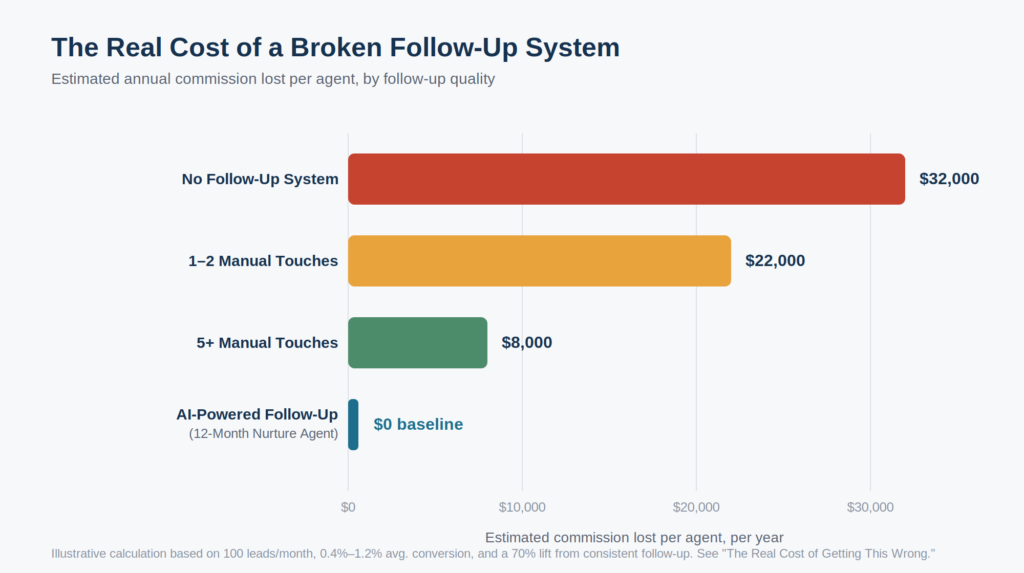
The math on this is not abstract. Say an agent generates 100 leads a month from online inquiries, a modest number for an active team. Industry data puts the average real estate conversion rate between 0.4% and 1.2%, but leads who receive six or more follow-up touches convert at rates roughly 70% higher than those who get fewer.
That gap adds up fast. If poor follow-up costs an agent even three extra closings a year, and the average commission on a $400,000 home runs 2.5-3%, that’s more than $30,000 in lost income from leads that were never actually unqualified, just under-contacted.
Multiply that across a six-person team, and a broken real estate follow-up system can quietly cost a brokerage six figures a year. None of that shows up on a report labeled “bad leads.” It shows up as leads that went cold, got busy elsewhere, and closed with somebody who simply stayed in touch. Even a modest fix to the follow-up gap pays for itself many times over.
How This Plays Out in Practice
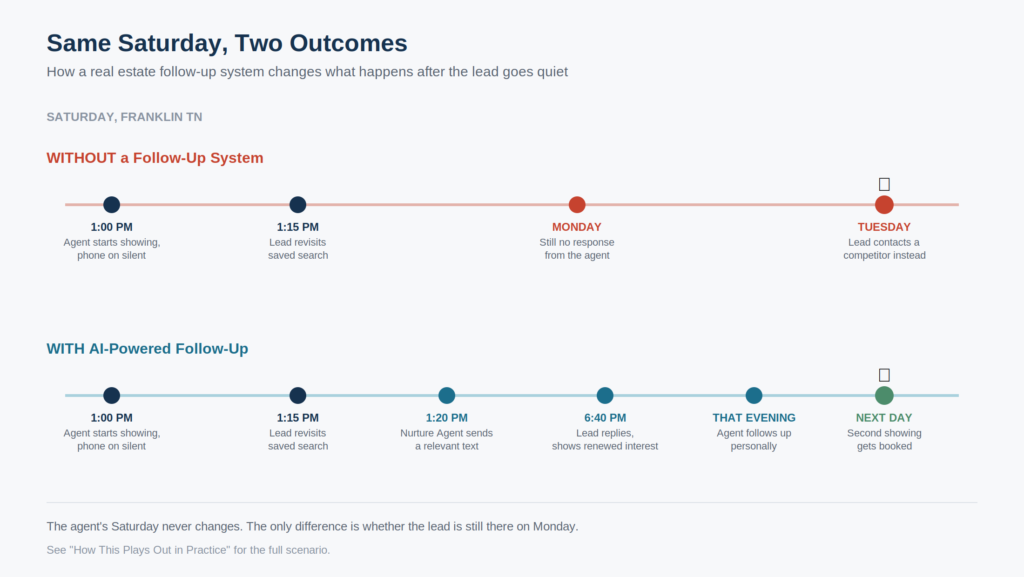
Picture a Saturday afternoon in Franklin, Tennessee. An agent is mid-showing at a three-bedroom colonial, phone on silent, fully focused on the buyers in front of her. Meanwhile, a lead from two weeks ago, a young couple who toured a townhouse but never called back, is scrolling listings again, wondering if anyone still remembers them.
Without a follow-up system running in the background, that couple gets nothing. No text, no check-in, no reminder that an agent is still available. By Monday, they’ve reached out to a competitor whose website chat responded instantly.
Now picture the same Saturday with the Nurture Agent active. The moment the couple revisits a saved search, they receive a short, relevant text: a new listing in their price range, in the neighborhood they liked. It isn’t generic. It references the townhouse they toured and asks whether the layout still feels right.
The agent never touched her phone during the showing. She didn’t need to. By the time she checks her messages that evening, the couple has replied and asked to see the new listing. Her Saturday didn’t change. The only difference is that a lead who would have gone cold is instead booking a second showing.
Why This Matters More in 2026 Than Ever
The stakes on follow-up are rising, not falling. According to NAR’s 2025 buyer research, the median buyer now searches for roughly 10 weeks before purchasing, and rising inventory in many markets means today’s buyers have more listings, and more agents, to choose from than they did two years ago.
That longer runway cuts both ways. It gives agents more chances to stay in front of a lead, but it also gives buyers more room to drift toward whoever shows up consistently. A single missed check-in in a fast market might go unnoticed. Over a 10-week search in a slower, buyer-favorable market, it’s the difference between staying top of mind and getting quietly replaced.
At the same time, buyers now expect the kind of instant, always-on communication they get from every other service they use. A real estate follow-up system that runs automatically, without gaps for vacations or busy weeks, isn’t a luxury anymore. It’s quickly becoming the baseline buyers assume every serious agent already has. Agents who still rely on memory alone are competing against teams that don’t have to.
Bottom Line
Deals rarely die in the first conversation. They die in the silence that follows it: the third call that never happens, the check-in that gets forgotten during a busy week. A real estate follow-up system closes that gap by keeping every lead engaged long after the initial excitement fades, whether that takes three weeks or ten months.
The agents pulling ahead right now aren’t working harder. They’ve just stopped relying on memory to do a job built for a system. 12-Month Nurture Agent — see how it works, or book a strategy call here to talk through what a real follow-up system could look like for your pipeline.
Frequently Asked Questions
How many times should I actually follow up with a real estate lead before giving up?
Most research points to five or more contacts before a lead converts, and some studies show the strongest conversion rates after the sixth touch. Giving up after one or two attempts means walking away from leads that simply needed more time. A structured cadence spread across weeks, not days, tends to outperform a burst of calls up front.
Isn’t automated follow-up going to feel spammy to buyers?
Not if it’s built around relevance instead of volume. Good automation references what the buyer actually looked at, like a specific listing or saved search, rather than sending generic “just checking in” messages. Buyers generally don’t mind hearing from an agent who clearly remembers their situation.
How long should I keep following up with a lead who’s gone quiet?
Real estate decisions can take months, so a lead that’s quiet for a few weeks isn’t necessarily dead. Many teams run nurture sequences for six to twelve months before archiving a lead entirely. The buyers who take longest to respond are often the ones who end up closing.
Can AI follow-up actually replace the CRM I’m already using?
It doesn’t need to replace it. It works alongside your CRM, handling the actual outreach while the CRM stores the history. The AI agent runs the day-to-day check-ins automatically, so leads get consistent attention even when nobody logs in to trigger a task manually.
Sources
- Real Estate Lead Response Statistics: 15 Numbers Every Agent Should Know in 2026 — AgentZap
- Why 70% of Real Estate Leads Are Lost in the First 7 Days — Pinova
- Research and Statistics — National Association of Realtors
- 30 Real Estate Lead Generation Statistics Every Agent Should Know in 2026 — CloseDaily
- Why Your Real Estate Lead Generation Is Failing — REVA Global