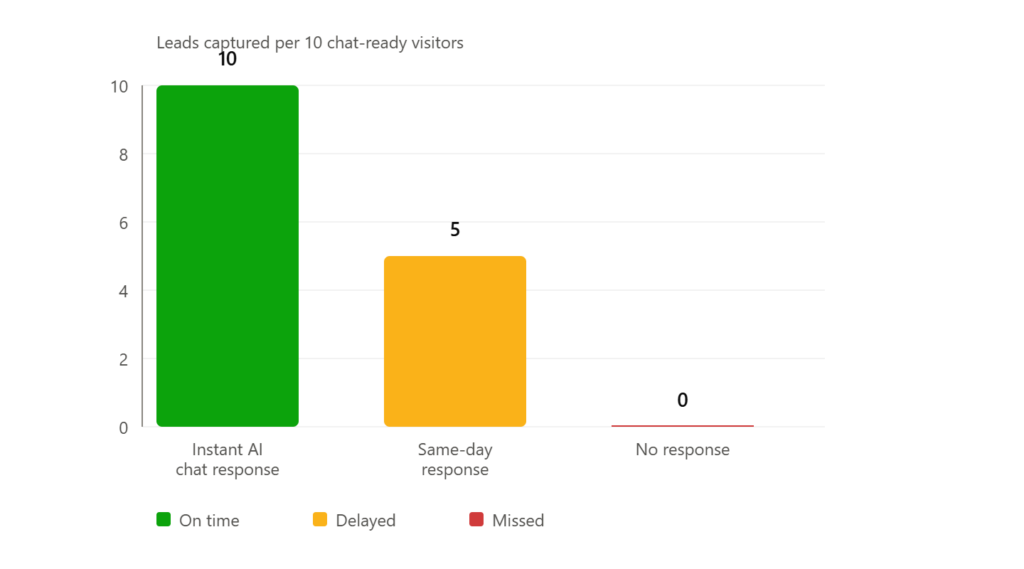
A real estate AI chat agent might be the single fastest fix for the leads quietly slipping off your website every day. According to the National Association of Realtors, nearly half of all buyers — 46% — now start their home search online, often browsing listings late at night or during a lunch break with nobody around to help them. Most of those visitors never call, never fill out a form, and never come back. They simply leave, and you never even know they were there.
Why Your Website Needs a Real Estate AI Chat Agent (And Probably Doesn’t Have One)
Every agent’s website looks busy on paper. Traffic comes in from Zillow, Google ads, and referral links. However, traffic without conversation is just noise.
For example, a visitor lands on a listing page, scrolls for ninety seconds, and closes the tab. No phone number gets captured, no email address is left behind, and no second chance follows. As a result, that single missed exchange never even shows up on a marketing report.
This is why a real estate AI chat agent earns its keep: most agents simply cannot staff a website 24 hours a day. According to a broker responsiveness study from WAV Group and Weichert Real Estate, the average agent takes more than 15 hours to respond to a new online inquiry, and nearly half of inquiries receive no response at all. That gap is not a minor inconvenience. Instead, it is the single biggest reason paid leads feel expensive and unreliable.
Meanwhile, the buyer on the other end of that missed chat is not waiting patiently. They are already opening a second tab, searching for another agent, another brokerage, another listing site that will actually talk to them. Even a friendly, well-designed contact form cannot compete with a real-time reply, because forms feel like homework and a chat feels like a conversation.
In other words, the leak is not a marketing problem. It is a response problem, and it happens in the first sixty seconds, not the first day.
What the Top Agents Actually Do
Consider Marcus Webb, who runs a seven-agent team out of Charlotte, North Carolina. Two years ago, his website generated plenty of clicks but few conversations. Visitors would browse listings after hours, find nothing interactive, and drift away. Consequently, Marcus noticed his cost per lead climbing even as his close rate stayed flat.
Instead of hiring a night-shift assistant, Marcus put an AI chat agent on every listing page. Now, when a buyer asks about square footage or schools at 9 p.m. on a Tuesday, the chat responds immediately, gathers their timeline and budget, and books a showing before the buyer even thinks to check a competitor’s site.
In contrast, a nearby solo agent working the same zip codes with the same ad spend is not so lucky. Her website still routes every question to a contact form that nobody answers until the next morning. Because a missed conversation leaves no trace in a CRM, she loses buyers she never even gets to meet and has no idea how many.
That is the quiet, compounding cost of doing nothing. Top agents like Marcus do not necessarily work harder; they simply make sure nobody who visits their site ever gets ignored, day or night, weekday or weekend.
The Research Behind the Real Estate AI Chat Agent Boom
The research behind the real estate AI chat agent trend is not new — it just took the industry a while to catch up. Specifically, a landmark Harvard Business Review study by Oldroyd, McElheran, and Elkington found that firms contacting a lead within an hour were roughly seven times more likely to have a meaningful conversation than those that waited even one additional hour, and more than sixty times more likely than firms that waited a full day.
Separately, Salesforce’s State of the Connected Customer research found that 64% of consumers now expect companies to interact with them in real time, a bar that keeps rising as messaging apps replace phone calls. On top of that, an early study by Drift found that although only 14% of companies offered live chat on their websites, nearly every one of the fastest-responding businesses used it.
Even so, that gap between adoption and performance has only widened as buyer patience has shrunk. Speed, in other words, is not optional anymore. It is simply the baseline buyers already assume you meet, whether they say so out loud or not.
How AI Solves the Real Estate Lead Response Problem
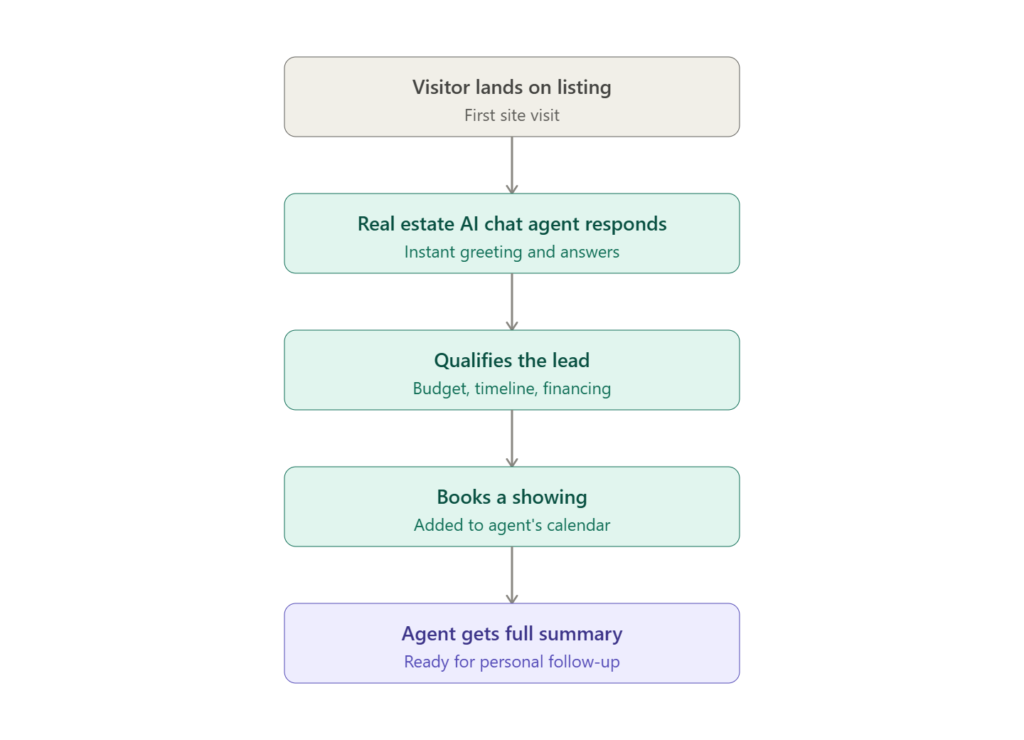
This is exactly the gap a real estate AI chat agent is built to close. Instead of a static contact form that sits untouched overnight, the chat greets every visitor, answers their first questions, and captures the details a human agent needs to follow up with context instead of guesswork. It does not replace the agent; it simply makes sure nobody has to choose between showing a house and answering a website chat at the same time.
AxonEstate’s Inbound Lead Responder was built for exactly this moment. Rather than bolting a generic chatbot onto a listing page, it works as part of a broader AxonEstate AI workforce built specifically for real estate teams. Specifically, the agent:
- Responds to every website chat within seconds, 24 hours a day, including weekends and holidays
- Asks qualifying questions about budget, timeline, financing, and preferred neighborhoods
- Books showings and follow-up calls directly onto the agent’s calendar without any manual back-and-forth
- Flags hot leads for immediate human follow-up while nurturing slower-moving inquiries automatically
- Logs every conversation into the CRM so no context is lost between the chat and the first phone call
- Speaks naturally about listings, pricing history, and neighborhood details pulled straight from the MLS feed
Because it never sleeps, skips lunch, or gets pulled into a showing, the agent turns a website from a static brochure into a conversation that is always open for business.
The Real Cost of Getting This Wrong
Here is what the math looks like for a mid-sized team. Say a brokerage website draws 400 unique visitors a month, and industry benchmarks suggest roughly 2% to 3% of visitors would engage if someone were actually there to talk to them — call it ten real conversations. If half of those go unanswered because they land at 10 p.m. or on a Sunday, that is five lost conversations every month.
Even a conservative 20% of those converting to an appointment, combined with a typical close rate on booked appointments, works out to roughly one lost transaction per month. At a median home price of $425,000 and a standard 2.5% buy-side commission, that single missed deal costs more than $10,000 in gross commission income.
Multiply that across twelve months, and a leaking website is not a minor inefficiency. Instead, it is a five- or six-figure hole in the pipeline that never shows up on a marketing report, because a lead that never spoke to anyone was never counted as a lead at all.
How This Plays Out in Practice
Picture a Saturday afternoon. An agent is standing in a three-bedroom townhome in a fast-selling suburb, walking a buyer through the kitchen renovation, phone silenced in her pocket. Meanwhile, a different buyer opens her listing for a similar townhome two neighborhoods over, has a question about HOA fees, and finds only a contact form. That visitor waits, gets no answer, and by dinner has already messaged two other agents from the same search page.
Now picture the same Saturday with a real estate AI chat agent running in the background. The moment that second buyer lands on the listing, the chat greets her by name, answers the HOA question instantly using data pulled from the listing sheet, and asks whether she would like to see the property this week. It even mentions a similar three-bedroom townhome two streets over that just came on the market, something the buyer had not even searched for yet.
As a result, a showing is on the calendar for both properties within minutes, and a summary lands in the agent’s inbox, ready the second she steps out of the first showing. Nothing about her Saturday changed. What changed is that the website kept working the whole time, turning one curious click into two scheduled showings before dinner.
Why This Matters More in 2026 Than Ever
This matters more in 2026 than it did even two years ago, because buyer expectations have not slowed down while inventory and competition have both tightened. Specifically, NAR’s 2025 Profile of Home Buyers and Sellers found that 70% of buyers now search primarily on a phone or tablet, meaning most first contact happens in short, mobile bursts rather than long desktop sessions. A missed reply is not a delayed conversation anymore; it is a closed tab that never reopens.
At the same time, Salesforce’s connected-customer research shows that instant response has moved from a competitive edge to a baseline expectation, especially among younger, mobile-first buyers who now make up a growing share of first-time purchasers. Agents competing for the same listings and the same buyer pool cannot out-market a slow website. Instead, they can only out-respond one, and that is precisely the advantage a real estate AI chat agent is designed to deliver.
Bottom Line
A leaking website is not a traffic problem. It is a response problem, and it is fixable. Every visitor who lands on a listing page and leaves without a conversation is a lead a competitor eventually gets instead, no matter how much you spent to bring them there.
A real estate AI chat agent closes that gap by making sure every question gets answered and every hot lead gets captured, day or night, whether you’re at a showing, at closing, or asleep. It will not replace the relationships you build in person; it just makes sure fewer of those relationships are lost before they even start. See how it works with AxonEstate’s Inbound Lead Responder — see how it works, or book a strategy call here.
Frequently Asked Questions
Will an AI chat agent sound robotic to buyers? No. Modern real estate chat agents are trained on natural, conversational language and pull real listing data, so responses feel specific rather than scripted. Most buyers simply experience it as a fast, helpful answer.
Do I still need to follow up personally after the chat? Yes, and that is the point. The chat agent handles the instant response and qualification so you follow up with context, not cold. As a result, you spend your time on conversations that are already warm.
What happens if a lead asks something the chat can’t answer? The conversation gets flagged and routed to you or your team with full context, so the buyer never hits a dead end. You pick up exactly where the chat left off.
Is this only useful for high-traffic teams? No. Solo agents often benefit the most, since they cannot staff a website around the clock on their own. A chat agent covers the hours you are showing homes, at closings, or simply asleep.