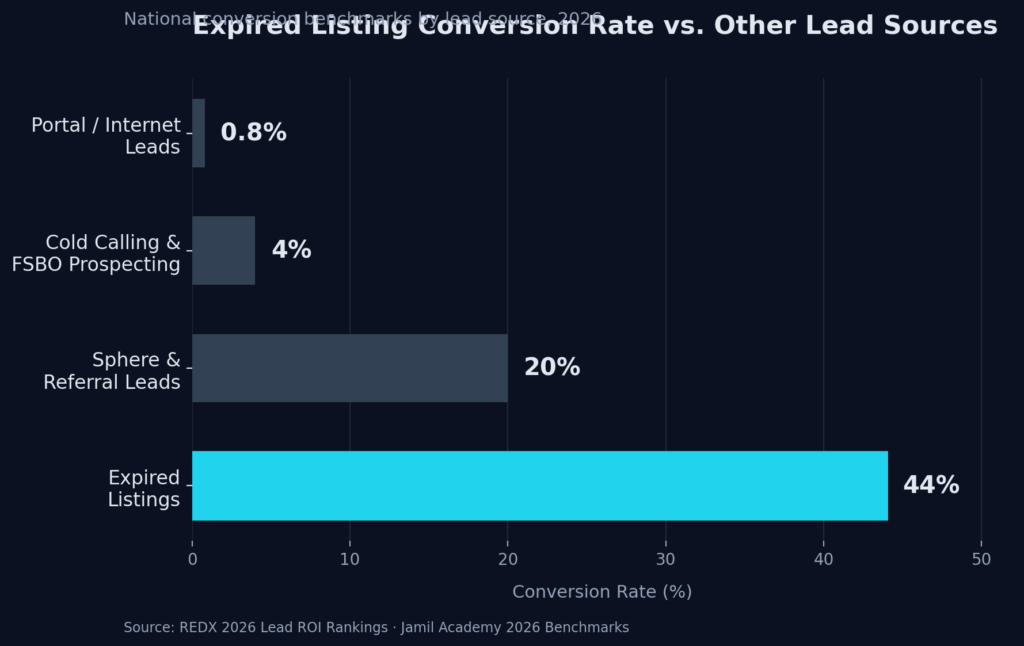
According to REDX’s 2026 lead-source analysis, the expired listing conversion rate sits at a 44% list rate and a 20.7% sold rate. That makes it the highest-performing lead type in real estate today. Even so, most agents skip past expired listings entirely.
Instead, they chase portal leads that convert at a fraction of a percent. That gap between the data and agent behavior is where the real opportunity sits. If you’ve never worked expired listings systematically, you’re leaving one of the most reliable revenue sources in the business untouched.
Why the Expired Listing Conversion Rate Doesn’t Match Agent Behavior
Every year, hundreds of thousands of listings expire without a sale. Some sellers relist with the same agent. In fact, most don’t, and that adds up to a massive, mostly untapped pool of motivated sellers.
According to Landvoice’s 2026 market data, roughly 44.6% of these sellers relist within 30 to 35 days. Most choose a different agent when they do. That single fact should make expired listings one of the most competitive targets in any market. Instead, the opposite happens.
Vulcan7 reports that fewer than 5% of U.S. agents actively phone-prospect at all. In other words, the vast majority never call an expired seller in the first place. Cold calling feels uncomfortable, and rejection stings.
Because of this, agents default to buying portal leads instead, even though those leads convert at a fraction of the rate. This isn’t a data problem. Agents already know expired listings convert well; the numbers get shared in nearly every coaching call.
It’s an execution problem instead. Tracking down accurate contact information takes work. Timing outreach correctly takes a system. Meanwhile, the expired listing conversion rate keeps climbing while agent participation stays flat.
What the Top Agents Actually Do
Mara Ellison runs a four-person team out of Round Rock, Texas, just north of Austin. Two years ago, her business ran almost entirely on referrals and open house walk-ins. As a result, growth had stalled.
On a coach’s advice, she built a simple weekly habit. Every Monday morning, she pulled that week’s expired listings from the MLS and worked through them first, before anything else on her calendar.
She didn’t do anything exotic. Instead, she called, and she left specific voicemails referencing the property’s actual days on market. Then she followed up again three days later if she didn’t hear back.
As a result, expired listings became her single largest source of new listing agreements within four months. That put them ahead of referrals for the first time in her business. Meanwhile, she never spent a dollar on paid leads to get there.
Contrast that with the agent down the street who checks expired listings occasionally but never builds a routine around them. That agent still closes deals, mostly from repeat clients and the occasional portal inquiry. However, the pipeline stays unpredictable. One slow referral month, and the whole quarter goes quiet.
The difference between these two agents isn’t talent. It isn’t market knowledge, either. Instead, it’s whether working expired listings is a weekly habit or an occasional afterthought. Consistency, not charisma, turns a strong lead source into predictable income.
The Data Behind Expired Listing Conversions
The 44% figure isn’t an isolated stat. REDX’s most recent analysis draws from millions of records across expired, FSBO, and foreclosure leads. It found that expired sellers relist at a 44% rate nationally and sell about 20.7% of the time.
On top of that, the average cycle from first contact to signed agreement runs just 30 days. That’s a strikingly short runway compared to most other lead types agents work today. For example, an agent working just five conversations a week can realistically expect that 30-day cycle to produce a signed agreement.
Separate research from Jamil Academy’s 2026 benchmarks backs this up from a different angle. Sphere and referral leads convert highest overall, in the 15% to 25% range. Even so, expired listings aren’t far behind. They also dramatically outperform anything paid or portal-based, which typically closes under 2%.
NAR’s Profile of Home Buyers and Sellers adds useful context here. As Deal Machine OS’s summary of that research notes, most sellers only interview a single agent before signing. In practice, that means whichever agent reaches an expired seller first, with the strongest plan, usually wins the listing.
How AI Solves the Expired Listings Problem
Working expired listings well is mostly a discipline problem. That’s exactly where software helps. AxonEstate’s Outbound Prospecting Agent was built for this gap.
It doesn’t replace an agent’s phone skills or listing presentation. Instead, it removes the reasons agents skip prospecting in the first place: forgetting to check the MLS, losing track of who was contacted, and letting a warm lead go cold after one unanswered call.
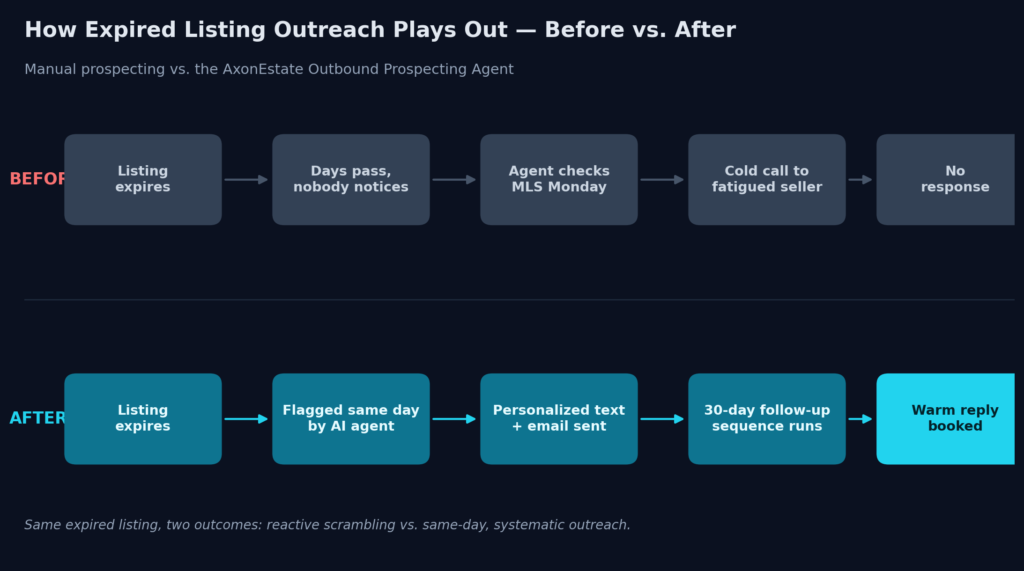
Because the agent runs continuously as part of the broader AxonEstate platform, expired listings get flagged the same day they hit the market. Nobody has to remember to check manually.
That timing matters enormously. Specifically, the expired listing conversion rate research consistently shows that early contact wins more listings than late contact, no matter how polished the pitch is.
In practice, the agent handles:
- Monitoring MLS feeds daily for new and aged expired listings in an agent’s coverage area
- Drafting personalized first-touch messages that reference the property’s actual listing history
- Sequencing follow-up outreach across calls, text, and email over a 30-day window
- Flagging warm responses so the agent can take the conversation over personally
- Logging every touchpoint so nothing falls through after a missed call
- Surfacing old expired listings, six months or older, that most agents have already forgotten
None of this replaces an agent showing up prepared and building trust on the call. It just makes sure that call actually happens, every single time.
The Real Cost of Getting This Wrong
Consider a mid-sized suburban market where roughly 10 listings expire every month. In fact, that’s a realistic number for many metro submarkets. If an agent ignores that pool entirely, real income walks past them every month.
Applying REDX’s national 20.7% sold rate to 10 expired listings works out to roughly two closed transactions a month going to someone else. At an average commission of $8,500 per deal, a reasonable figure for a $340,000 median-priced home, that’s about $17,000 in monthly GCI left on the table.
Annualized, that gap grows to roughly $204,000 a year. That’s more than many full-time agents earn from their entire business. This figure doesn’t even include the referrals those two clients would likely generate later. Beyond that, the math only gets worse in markets with higher median home prices.
In short, skipping expired listings isn’t a neutral choice. It’s a recurring, compounding cost that quietly caps an agent’s income year after year.
How This Plays Out in Practice
Picture a Saturday afternoon in early spring. An agent is mid-showing on a three-bedroom bungalow, phone on silent, focused on the buyers in front of her. Three miles away, a listing just crossed its expiration date.
Meanwhile, without a system in place, nobody notices until Monday. By then, four other agents have already left voicemails, and the seller’s inbox is full of near-identical pitches.
Now picture that same Saturday with the Outbound Prospecting Agent running in the background. The moment the listing status changes, the system logs it and checks it against do-not-call compliance. It then queues a first-touch text and email referencing the property’s actual time on market.
As a result, the seller sees a specific, relevant message within hours, not days. By Monday morning, the agent doesn’t start from zero. She has a short list of sellers who already opened a message, and one even replied asking about their options.
Instead of combing the MLS and drafting cold outreach, she spends her morning on the one call that matters: the seller who’s ready to talk. That shift, from reactive scrambling to a pre-qualified list, is the entire value of running this process on autopilot. The agent still closes the deal; the system just makes sure she gets the chance to.
Why This Matters More in 2026 Than Ever
Inventory has shifted meaningfully over the past two years. Expired listings are becoming a larger share of the available pool in many markets, as homes sit longer before selling. At the same time, buyers have grown more price-sensitive.
As a result, more sellers are ending up back at square one. At the same time, seller expectations around communication have gone up, not down.
NAR’s own research shows that most sellers interview a single agent before signing. That means agents rarely get a second chance to make their case. Being first, and being prepared, decides who gets the listing far more often than it used to. Specifically, agents who show up prepared and fast are winning a larger share of listings than they did even two years ago.
Against that backdrop, the expired listing conversion rate isn’t a niche prospecting tactic anymore. It’s one of the clearest, most measurable ways to build a predictable pipeline in a market where buyer leads keep getting more expensive.
Bottom Line
The math isn’t complicated. The expired listing conversion rate beats almost every other lead source in real estate, and most agents still aren’t working these leads consistently.
That gap is the opportunity. Agents willing to build a system around expired listings, instead of treating them as an occasional side project, capture an outsized share of a genuinely high-converting pipeline.
If you want to see how this looks inside your own business, check out the Outbound Prospecting Agent — see how it works, or book a strategy call here to walk through your market’s numbers.
Frequently Asked Questions
How long does it take to see results from working expired listings?
Most agents who commit to a consistent weekly process start seeing appointments within the first month. REDX’s data points to an average 30-day cycle from initial contact to a signed listing agreement, so early results are realistic if you stay consistent with follow-up.
Is it even legal to contact expired listings?
Yes, as long as you follow Do Not Call Registry rules, TCPA guidelines, and your MLS’s specific policies around expired listing data. Always verify a seller isn’t on the national DNC list before calling, and check your local MLS rules on how the data can be used.
What’s the difference between expired, withdrawn, and canceled listings?
An expired listing reached its contract end date without selling. A withdrawn or canceled listing was pulled from the market early by the seller or agent, often for similar underlying reasons. All three groups can be worked with a similar outreach approach, though messaging should reflect the specific situation.
Do I need a dialer, or can I just call from my own phone?
You can absolutely start with your own phone and a spreadsheet. That said, a dedicated system becomes valuable once your list grows past what you can track manually, since missed follow-ups are what kill most agents’ results with expireds. Instead, many agents start manually and add automation once volume increases.
Sources
- Best Real Estate Leads 2026: ROI Rankings & Conversion Data — REDX
- Expired Listing Market Statistics 2026 — Landvoice
- Success With Expired Listing Leads Begins January 1 — Vulcan7
- Real Estate Lead Conversion Rate Benchmarks 2026 — Jamil Academy
- 75+ Real Estate Lead Generation Statistics 2026 — Deal Machine OS
- Old Expired Listing Strategy: A Hidden Opportunity for Savvy Agents — REDX