Fair Housing and AI collided head-on in 2024. That’s when HUD confirmed that federal fair housing law fully applies to AI-generated real estate content. According to NAR’s 2025 Technology Survey, 46% of real estate professionals now use AI to generate marketing content, including listing descriptions. AI models trained on decades of real estate copy tend to reproduce exactly the language HUD has spent years warning agents to avoid.
The Fair Housing and AI Problem Hiding in Your Listing Descriptions
Most agents don’t set out to write a discriminatory listing. The real problem is simpler than that. AI can’t tell a compliant compliment from a fair housing violation, because it was never trained to know the difference.
Ask a general AI tool to punch up a description, and it reaches for familiar phrases. “Perfect for young professionals.” “Ideal for a growing family.” “Walking distance to the synagogue.” Each one reads like marketing. Each one also signals a preference tied to age, familial status, or religion.
Under the Fair Housing Act, that signal alone is enough. Section 3604(c) prohibits any ad that “indicates” a preference based on a protected class, whether or not a buyer was actually turned away. In fact, intent doesn’t matter at all. The words do, and that’s exactly where fair housing risk starts to compound quietly in the background.
Despite that risk, few agents have a review process in place. A recent Realtors Property Resource survey found that 28% of agents already name fair housing as a top concern with AI, yet most still publish AI-generated copy without a second look. They generate, they paste, they publish. That workflow holds up fine, right until the day it doesn’t.
What the Top Agents Actually Do
Danielle Ruiz leads a five-agent team outside Columbus, Ohio. She treats every AI-written listing as a first draft, never a final one. Before anything goes live, someone on her team checks it against a short internal list built from HUD’s guidance. It adds roughly ninety seconds per listing, and it has kept her team violation-free for three straight years.
Contrast that with agents who treat AI output as finished copy the moment it’s generated. One broker nearby found out the hard way when a buyer’s agent flagged her listing for describing a condo building as “ideal for empty nesters.” She hadn’t written that line — her AI tool had, and she published it without a second read. By the time anyone caught it, the listing had already synced to two other portals.
That’s the real difference between agents who get this right and agents who don’t. It isn’t AI literacy. It’s discipline.
Danielle doesn’t avoid AI, and she isn’t slower for using it carefully. She just refuses to let it publish anything unsupervised. That single habit keeps her team out of HUD’s inbox, while agents who skip it are quietly outsourcing a legal decision to a tool that has no idea it’s making one. In the end, that’s the real gap between a team that scales safely and one that’s one listing away from a complaint.
The Research Behind Fair Housing and AI Risk
The research on Fair Housing and AI is consistent, and none of it is new. HUD’s 2024 guidance made clear that the Fair Housing Act applies to content generated by AI and algorithms. That’s true even when no human typed the language directly. The guidance followed HUD’s 2023 settlement with Meta, which found that AI-driven ad-targeting tools had effectively enabled housing discrimination through demographic filtering, without any explicit intent behind it.
Legal analysis of the statute backs this up further. Fair housing law doesn’t test for discriminatory intent — instead, it tests for discriminatory signal. A phrase like “perfect for empty nesters” can violate the law without rejecting a single buyer. It only has to indicate a preference, and that’s a much lower bar than most agents assume.
Meanwhile, adoption keeps outpacing awareness. NAR’s own research shows nearly half of agents now generate marketing content with AI. Separate industry surveys confirm that compliance concerns are rising right alongside that curve, not falling behind it.
How AI Solves the Fair Housing and AI Compliance Gap
Here’s the shift that actually fixes this. Instead of using a general AI tool and hoping nothing slips through, agents are moving to AI built specifically to screen real estate content. That’s the gap AxonEstate’s Compliance & Disclosure Agent was built to close.
Rather than generating persuasive copy and treating compliance as an afterthought, this agent works as a checkpoint. It sits inside your existing workflow. It reviews content the way a broker-in-charge would, if that broker-in-charge had time to read every single listing twice before it went live.
Specifically, the agent:
- Scans listing descriptions for protected-class language before publication, including age, familial status, religion, and national origin references
- Flags coded terms tied to historical steering, such as “quiet neighborhood” or “exclusive community”
- Suggests compliant rewrites that keep the persuasive tone while removing the legal risk
- Checks virtual staging and photo edits against current state disclosure requirements
- Logs a compliance record for every listing, so agents have documentation if a complaint is ever filed
- Applies MLS-specific rules automatically, since requirements vary from market to market
That last point matters more than it sounds. A phrase that’s fine in one state can be a violation in another. Keeping track of that manually isn’t realistic for a working agent juggling a full pipeline. This is one part of the broader AxonEstate AI workforce, built to handle the marketing and compliance work agents don’t have hours in the day to double-check themselves.
The Real Cost of Getting This Wrong
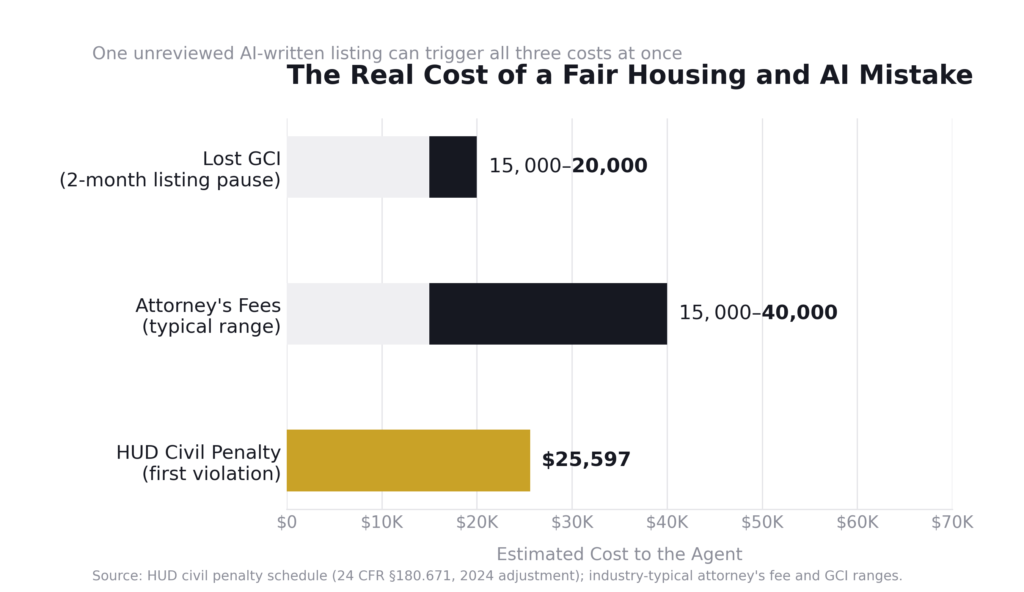
Run the numbers on a single mistake. A first-time Fair Housing Act violation can carry a civil penalty of up to $25,597, under HUD’s current inflation-adjusted schedule. That figure doesn’t include the private lawsuit that often follows, where attorney’s fees alone commonly run $15,000 to $40,000, even before any damages get awarded. In practice, agents rarely budget for either one.
Then add the operational cost, which agents rarely factor in ahead of time. A brokerage under investigation frequently pulls the flagged listing and pauses related marketing while the complaint gets reviewed. For an agent averaging three active listings at a $400,000 price point, even a two-month pause can mean $15,000 to $20,000 in delayed GCI. That figure doesn’t count the referrals that quietly dry up once a listing picks up a reputation locally.
Stack the fine, the legal fees, and the lost commission together. One careless AI-written sentence can cost more than a full year of any compliance tool. That math only moves in one direction, and it moves fast.
How This Plays Out in Practice
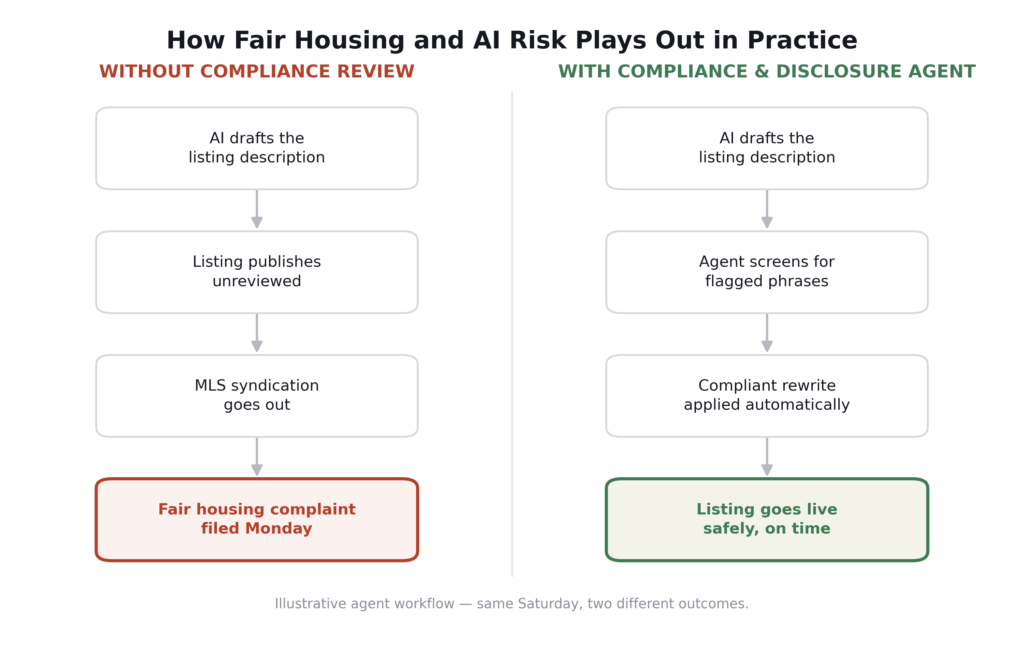
It’s a Saturday afternoon in a Maplewood Heights craftsman. The listing agent is mid-showing, phone on silent. Back at the office, an AI tool she used that morning has already queued a description for a bungalow across town. It calls the home “perfect for a young family starting out.” Nobody reviews it before the MLS feed picks it up that evening.
By Monday, a fair housing advocacy group has flagged the listing. Her broker is asking questions she doesn’t have good answers to. What felt like a harmless line on Saturday is now a formal complaint on Monday, and the buyer who might have loved that bungalow never even got the chance to see it.
Now picture the same Saturday with a compliance layer running quietly in the background. The AI still drafts the description while she’s at the showing. But before it ever reaches the MLS, the system screens it, catches the flagged phrase, and swaps in language that describes the actual home: two bedrooms up, a fenced yard, the elementary school a five-minute walk away. In practice, the whole review takes under a minute.
The listing goes live Saturday night exactly as planned. The only difference is what happens Monday morning, and that difference is the entire point.
Why This Matters More in 2026 Than Ever
Regulatory pressure around Fair Housing and AI is intensifying this year, not easing off. California’s AB 723, effective January 2026, requires agents to disclose AI-altered listing photos, and several other states are drafting similar rules for AI-written text. Colorado’s AI Act, effective June 2026, goes even further, requiring formal impact assessments for AI used in housing-related decisions. Even before that, New York’s Department of State had already issued a formal warning to agents about AI-generated listing content that could run afoul of state law.
At the same time, adoption keeps accelerating. A February 2026 survey from Realtors Property Resource found that 82% of agents now use AI in their daily business, up sharply from the year before. More agents publishing more AI-written content means more exposure across the board, unless compliance keeps pace with that growth.
That combination, rising regulation paired with rising AI use, is exactly why this can’t wait until a complaint forces the issue.
Bottom Line
AI can write a faster listing. It cannot tell you whether that listing is legal. That gap is where agents get hurt, both financially and professionally. Waiting for a complaint to force the issue is the expensive way to learn that lesson.
The agents protecting themselves aren’t avoiding AI. Instead, they’re pairing it with a compliance layer that catches Fair Housing and AI risk before it ever reaches a buyer’s screen. See how AxonEstate’s Compliance & Disclosure Agent screens every listing before it goes live, or book a strategy call here to walk through your current workflow.
Frequently Asked Questions
Can AI-generated listing descriptions actually get me in legal trouble?
Yes. HUD confirmed in 2024 that the Fair Housing Act applies to AI-generated advertising the same way it applies to anything you write yourself. You’re liable for what gets published, regardless of who or what drafted it.
What words should I tell my AI tool to avoid?
Avoid anything describing the ideal occupant instead of the property itself. That includes “perfect for families,” “empty nesters,” “walking distance to church,” or “quiet neighborhood.” Describe the home’s features, not the person you picture living there.
Do I still need to review AI listings if I’m already using a compliance tool?
Yes, always give it a final read before it publishes. A compliance tool dramatically lowers your risk, but you’re still the one who hits publish. A quick human check catches anything market-specific the tool might miss.
What about AI-generated listing photos, not just the description text?
Those carry separate rules. California’s AB 723 now requires disclosure when listing photos have been digitally altered. Most MLS systems also require a “virtually staged” label on any AI-enhanced image before it goes live.
Sources
- HUD Issues Fair Housing Act Guidance on AI Use
- Fair Housing Act — Penalty Amounts (NAR)
- NAR Technology Survey Finds AI Gaining Traction with Realtors — HousingWire
- AI Adoption Reaches 82% Among Real Estate Agents, RPR Reports — HousingWire
- Before You Paste AI Copy Into the MLS, Run This Checklist — HousingWire
- Fair Housing Act Listing Description Rules — Montaic