AI agents for real estate have moved from novelty to necessity — and the numbers prove it. According to NAR’s 2024 Profile of Home Buyers and Sellers, 67% of buyers interviewed only one agent before signing, meaning the first agent to respond, engage, and impress is almost always the agent who earns the commission. The full real estate transaction — from first enquiry to settlement — is now too complex and too fast-moving to manage without automated support. Agents who understand this are closing more deals from the same lead volume.
Why Most Real Estate Agents Lose Deals Before They Even Begin
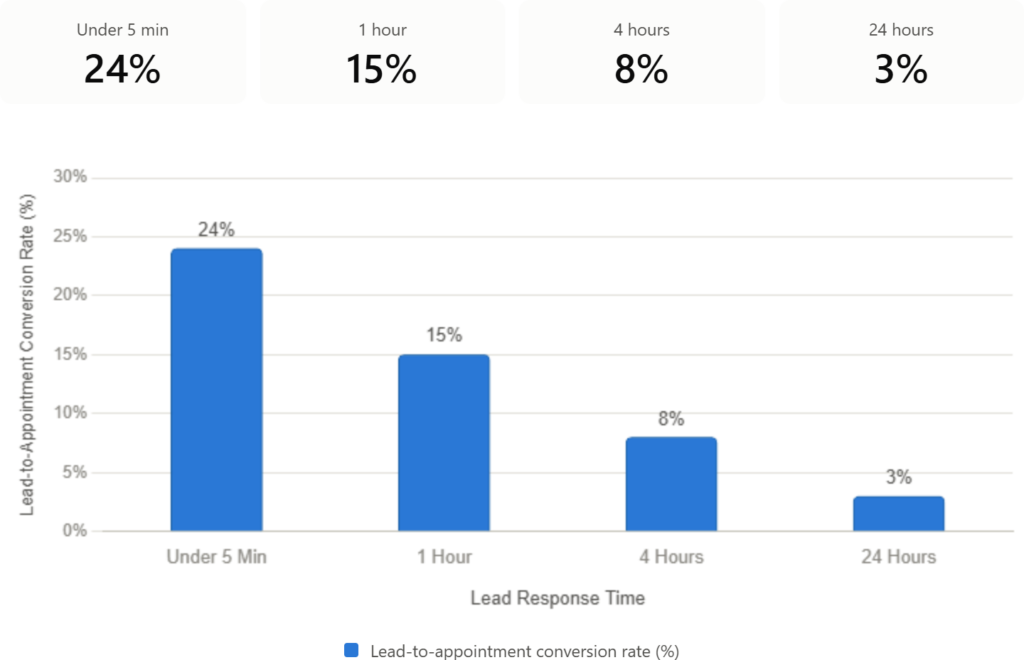
Every agent knows the feeling: a lead comes in over the weekend, you’re mid-showing, your phone is on silent, and by Monday the prospect has already moved on. That single missed response costs more than one commission. According to research published in the Harvard Business Review, leads contacted within the first hour are seven times more likely to convert than those reached after 24 hours. Most agents, working solo or with small teams, simply cannot sustain that response window consistently.
The real estate transaction is not a single event. It’s a pipeline that spans weeks or months — from the moment a lead makes first contact, through qualification, inspection bookings, vendor updates, compliance filings, and finally, closing. Each step demands timely communication, accurate information, and personalised follow-through.
When any single stage slips — a delayed vendor report, an unbookable inspection, a cold lead left without nurture — the entire deal can unravel. Many agents recognise these gaps. However, without dedicated staff or a scalable system, managing every touchpoint manually isn’t just inefficient. It’s impossible. That’s the problem AI agents for real estate exist to solve.
What the Top Agents Actually Do
Take Marcus Webb, a principal running a seven-person team in Brisbane, Queensland. Three years ago, his team managed around 80 active leads per month manually — spreadsheets, sticky notes, and a CRM nobody used consistently. Response times averaged six hours. Lead-to-inspection conversion sat at roughly 9%.
Marcus didn’t hire more staff. Instead, he mapped the full transaction from first enquiry to close and identified exactly where leads were slipping: the first-response window, the post-inspection follow-up, and the 60-day nurture gap for buyers who weren’t ready to move yet.
Once he systematised each touchpoint, conversion climbed to 24%. The difference wasn’t his team’s skill — they were already strong. The difference was that every lead received a personalised response in under five minutes, every buyer was followed up within 30 minutes of an inspection, and every long-term prospect stayed in an active nurture sequence. Nothing fell through.
Meanwhile, agents on his team spent more time face-to-face with clients and less time chasing admin. In contrast, comparable teams in his area that continued managing manually saw lead conversion stay flat as buyer expectations rose. The gap between systematised agents and reactive ones is growing every quarter.
The Research Behind AI Agents in Real Estate Transactions
The evidence for faster, smarter lead handling is consistent across multiple research bodies. The Lead Response Management study — widely referenced in the HBR article “The Short Life of Online Sales Leads” — found that the odds of reaching a lead drop by over ten times in the first hour after enquiry. An agent who responds at hour six is working with a fraction of the opportunity of one who responds at minute four.
Additionally, NAR’s 2024 buyer survey found that 67% of buyers committed to the first agent they had a meaningful conversation with. Speed and personalisation together are the deciding factor — not marketing spend or brand recognition.
Research from Salesforce’s State of the Connected Customer report reinforces this further: 80% of customers across industries now rate the experience a company provides as equally important as the product itself. Real estate is no exception. Buyers and vendors judge agents on responsiveness, follow-through, and communication quality across the entire transaction — not just at the listing presentation. This full-pipeline expectation is exactly why AI agents for real estate have moved from competitive edge to standard expectation.
How AI Agents for Real Estate Solve the Full Transaction Pipeline
The problem is clear: every lead needs an immediate, personalised response, and every stage of the pipeline needs active management — whether the agent is present or not. The solution is a system that acts at the right moment, every time, without manual input.
That’s what AxonEstate has built. The platform deploys 14 specialist AI agents, each covering a specific function within the real estate transaction. The entry point is the Inbound Lead Responder — the agent that fires the moment a new lead arrives, whether from a portal, a website form, or a paid ad campaign.
Here’s what the Inbound Lead Responder specifically does:
- Responds to every new lead in under five minutes via SMS, email, or both — written in the agent’s own voice and scripts
- Sends pre-qualifying questions to identify buyer timeline, budget, and property intent before the human agent gets involved
- Routes hot leads (ready to transact now) to the agent with a real-time alert, while placing warm leads into tailored nurture sequences
- Books inspection times directly from the first conversation, without any agent input required
- Logs all conversation data into the CRM automatically, with full message history and lead status
- Triggers downstream agents — including the Buyer Qualification Agent and 12-Month Nurture Agent — based on the lead’s responses
The result is a transaction pipeline that never misses a lead, never lets a follow-up fall through, and never drops a prospect between stages.
The Real Cost of Getting This Wrong
Let’s make this concrete with numbers. If your team receives 60 leads per month and your average first-response time is four hours, research benchmarks suggest you’re converting around 10% of those leads to qualified buyers — roughly six appointments per month.
Apply a five-minute response window to the same 60 leads. Conservative industry data shows conversion climbing to 20–25%, or 12–15 appointments — roughly double. At a 40% appointment-to-deal conversion rate, and an average GCI of $15,000 per closed transaction in a mid-tier market, the compounded difference adds up to approximately $90,000 in additional annual GCI from the exact same lead volume.
And that’s just the first stage. Across the full pipeline — missed vendor reports, stalled buyer nurtures, unbooked inspections, and compliance delays — the compound cost of a leaky system can exceed $150,000 annually for a mid-sized team. The cost of a fully automated lead operations system, by comparison, is a fraction of a single closed deal. The math is not close.
How This Plays Out in Practice
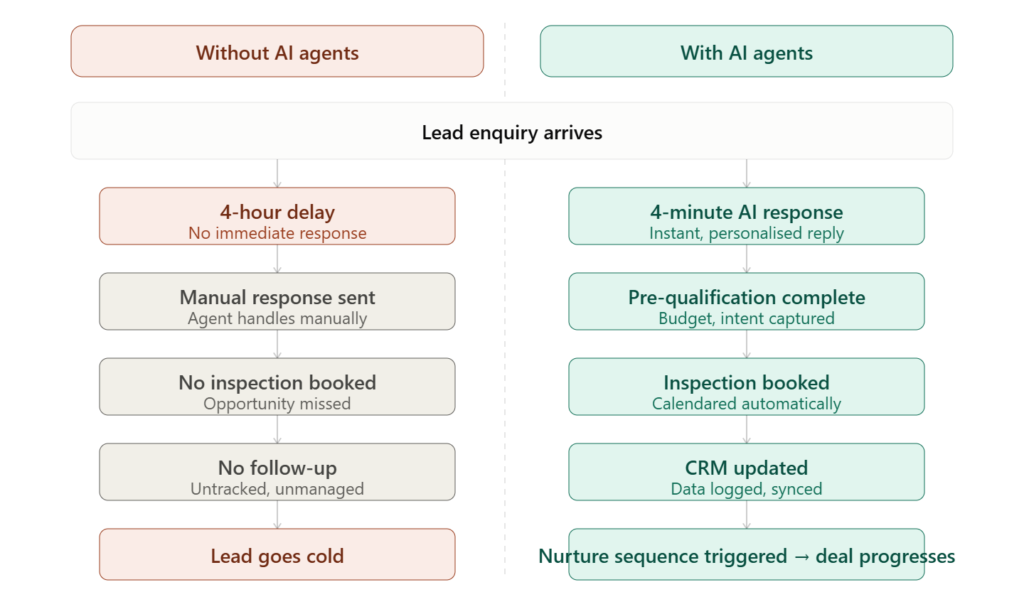
Without the system: It’s Saturday afternoon. A motivated buyer submits an enquiry on a three-bedroom townhouse in Kellyville, New South Wales — asking about price, availability, and when they can inspect. The listing agent is mid-showing in Rouse Hill, phone on silent. The enquiry sits unread until 6 PM. By then, the buyer has booked an inspection with a competing agent on an adjacent listing. They’re gone.
With AxonEstate running: The same enquiry arrives at 1:47 PM. Within four minutes, the buyer receives a personalised SMS — written in the agent’s voice — acknowledging their message, answering the price and availability question, and offering two Sunday inspection windows. The buyer selects a time. Confirmation goes out automatically. By 6 PM, the agent sees a notification: a pre-qualified lead with a booked inspection and full conversation history in the CRM.
Same agent. Same listing. Same Saturday afternoon. Completely different result. AI agents for real estate don’t replace what the agent does well — they handle everything the agent physically cannot be present for.
Why This Matters More in 2026 Than Ever
The Australian residential property market is moving faster than at any point in recent years. According to CoreLogic’s 2024 Housing Market Review, buyer competition intensified significantly across most capital city corridors, with inventory levels tightening in key growth suburbs throughout the year.
At the same time, agent workloads are at historic highs. Compliance requirements have increased. Vendor communication expectations are stricter. Buyers — shaped by instant-gratification standards in every other area of their lives — won’t wait 24 hours for a response before moving on to the next listing.
In this environment, the margin for error at each transaction stage is shrinking fast. A missed call, a delayed report, an unbooked inspection — each carries a measurable financial cost. The agents building durable businesses in 2025 are treating operational infrastructure as a core competitive asset. Beyond that, AI agents for real estate are that infrastructure, and the window to get ahead of this shift is narrowing.
Bottom Line
Real estate success has never been about working harder alone. It’s about being in the right place at the right moment — responding when leads are hot, following through when buyers are warm, and staying visible to long-term prospects over months. The modern transaction demands an agent who is simultaneously at a showing, following up on a vendor report, and nurturing a cold database. That’s not humanly possible without infrastructure.
AI agents for real estate close that gap — not by replacing the relationship, but by making sure every lead is covered, every touchpoint is managed, and every deal has the strongest possible chance of reaching close.
See how the Inbound Lead Responder works, and discover what your pipeline could look like with zero missed leads. Or book a strategy call here to walk through the full AxonEstate agent suite with our team.
Frequently Asked Questions
Can the AI actually respond in my voice, or does it sound like a bot?
AxonEstate agents are built on your scripts and communication style — not a generic template. Every response uses your language, your tone, and your typical phrasing. Most leads don’t know they’re talking to an AI until the agent discloses it, because the conversation reads like you wrote it.
What happens when a lead is ready to move right now?
Hot leads — those indicating immediate intent to transact — are routed to the agent in real time with a direct alert. The AI handles first contact and pre-qualification, so by the time the agent calls, they already know the buyer’s budget, timeline, and property criteria.
Will this work with my current CRM and property portals?
AxonEstate integrates with the major Australian and US real estate portals and most leading CRMs. All lead data, conversation history, and status updates are logged automatically. Setup typically takes less than a week from sign-up to live.
Do I need a full team, or can I use this as a solo agent?
AxonEstate works for both. Solo agents benefit most from the first-response and nurture functions, which cover the windows they can’t physically be available. Teams gain the coordination layer that prevents leads from falling between agents or missing a handoff.