Every agent knows the feeling: a lead comes in, you drop everything to respond, and forty minutes later you find out they’re six months from even talking to a lender. AI buyer qualification exists to catch that problem before it eats your afternoon. According to NAR and Real Trends, internet leads convert into closed transactions at only 2 to 3 percent industry-wide, meaning roughly 1 in 40 leads ever becomes a paycheck. That math doesn’t lie, and it’s why so many agents feel busier than ever while closing fewer deals.
Why Lead Qualification Is Breaking Real Estate Agents
The problem isn’t that agents lack leads. It’s that they can’t tell which ones matter until they’ve already spent time finding out. Industry research shows agents waste 60 to 80 percent of their working hours on leads who will never close, chasing people who are still “just looking,” don’t have financing lined up, or are six to twelve months out from being ready.
Meanwhile, the agents who do respond quickly often respond to the wrong people first. Inman’s 2025 Real Estate Technology Survey found the average agent takes over 15 hours to reply to a new inquiry. That delay isn’t always about laziness. It’s about triage. When every lead looks the same on a spreadsheet, agents have no way to know which ones deserve the five-minute response and which ones can wait.
This creates a brutal cycle. A hot buyer texts in in the middle of a Tuesday showing. So does someone who filled out a form for a free home valuation and has no intention of selling for two years. Both land in the same inbox, get the same urgency, and compete for the same limited hours. Without a filter, agents end up treating noise and signal identically, and the noise usually wins because there’s simply more of it.
What the Top Agents Actually Do
Consider two agents working the same lead source in the same Nashville suburb. Marcus runs a five-person team and answers every inbound lead himself, in the order they arrive. He’s diligent, but his calendar is a mess of callbacks to people who never respond and showings booked for buyers who turn out to be pre-approved for nothing.
Down the road, Priya runs a similar-sized team but built a simple qualification layer into her intake process. Before a lead ever reaches a human, it’s asked about financing, timeline, and motivation. The buyers who are pre-approved and ready to move this quarter get flagged and routed straight to her calendar. Everyone else gets nurtured automatically until they’re ready.
The difference shows up in the numbers, not the effort. Marcus works longer hours and closes fewer deals. Priya’s team spends its energy on people who are actually going to buy. This is the real distinction between agents who scale and agents who burn out: it’s rarely about who works harder. It’s about who stops treating every lead like it deserves equal attention. Top performers close at 15 to 20 percent, not because they’re more charming on the phone, but because they qualify before they invest time, not after.
The Research Behind AI Buyer Qualification
The data on what actually predicts a closing is consistent across multiple sources. Pre-approval status is the single strongest signal: prospects who already have a pre-approval letter in hand are three to five times more likely to close than those without financing sorted out, according to lead-qualification research from NextPhone. That single data point does more to sort hot from cold than almost anything else an agent can ask.
Persistence matters too, but most agents get it backward. Research compiled by HeyRosie shows 80 percent of sales happen between the fifth and twelfth contact, yet the average agent gives up after just two attempts. That’s not a motivation problem. It’s a system problem: without a way to separate a slow-moving qualified buyer from a dead lead, agents can’t tell who’s worth a ninth touchpoint and who isn’t. AI buyer qualification solves exactly that sorting problem by scoring intent automatically instead of leaving it to guesswork.
How AI Solves Buyer Qualification for Real Estate Agents
This is exactly the gap the Buyer Qualification Agent was built to close. Instead of an agent manually working through every inbound inquiry to figure out who’s serious, the agent handles that triage automatically, in real time, before a human ever picks up the phone. It’s one of several specialized agents inside AxonEstate built to remove the repetitive work that eats an agent’s week.
In practice, that means:
- Asking every new lead about pre-approval status, timeline, and budget within minutes of first contact, not days later
- Scoring each lead as hot, warm, or cold based on actual buying signals, not just how the lead was captured
- Routing hot, pre-approved buyers straight to the agent’s calendar for same-day follow-up
- Automatically nurturing warm and cold leads on a longer cadence so they aren’t abandoned, just deprioritized
- Flagging financing red flags early, before an agent spends a Saturday showing homes to someone who can’t yet qualify for a mortgage
- Logging every qualification detail in the CRM so agents walk into every call already knowing who they’re talking to
Because this happens before a lead ever competes for an agent’s attention, the agent’s day fills up with people who are actually ready to transact. That’s the practical shift: less time spent finding out who’s serious, more time spent closing the ones who are.
The Real Cost of Getting This Wrong
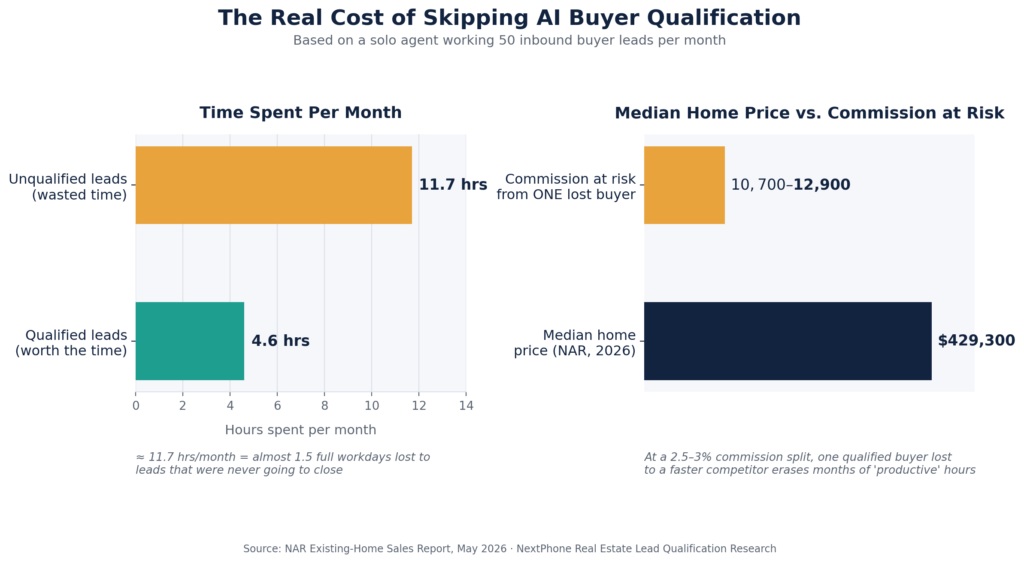
Run the numbers on a fairly typical solo agent working 50 inbound buyer leads a month. If 70 percent of those leads are unqualified, that’s 35 leads a month that need a call, a text exchange, or a follow-up just to rule them out. At roughly 20 minutes per unqualified conversation, that’s over 11 hours a month, nearly a full workday and a half, spent on people who were never going to close.
Now factor in what gets missed while that time is spent. NAR’s May 2026 data puts the median existing-home price at $429,300. At a typical 2.5 to 3 percent commission split, a single qualified buyer represents roughly $10,700 to $12,900 in commission. If even one genuinely ready buyer gets buried under unqualified noise and closes with a faster-responding competitor instead, that single miss wipes out months of the “productive” hours spent chasing dead ends. Multiply that across a five-agent team, and the annual cost of poor qualification easily runs into six figures.
How This Plays Out in Practice
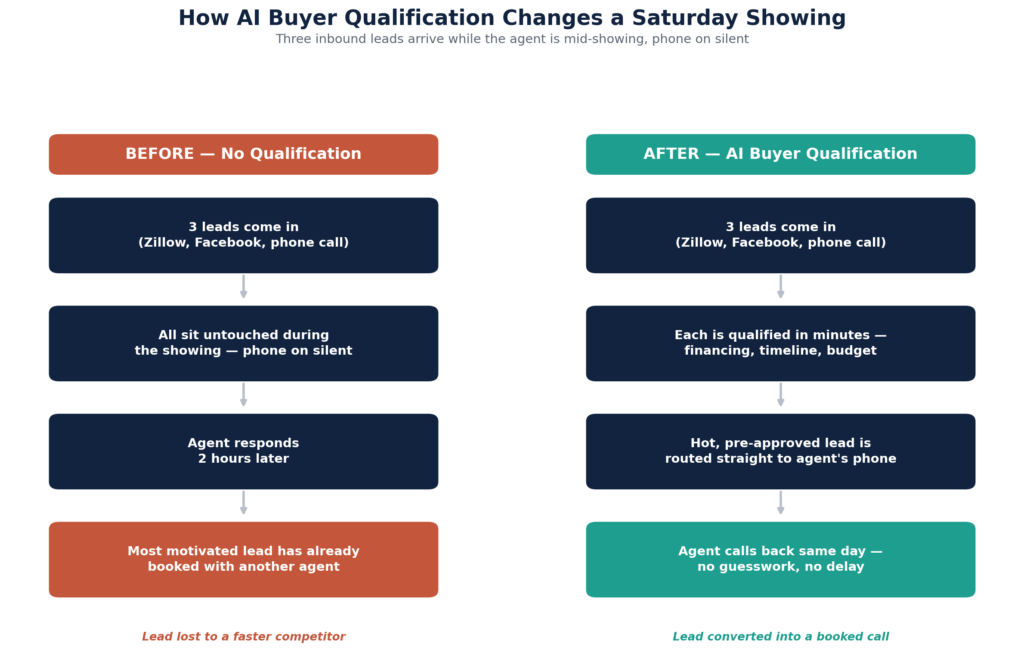
It’s a Saturday afternoon. An agent is mid-showing on a three-bedroom townhome in a growing suburb, phone on silent, fully focused on the buyer standing in front of them. Meanwhile, three new inquiries land: one from a Zillow ad, one from a Facebook lead form, and one direct call that goes to voicemail. Without a qualification layer, all three sit untouched until the agent resurfaces two hours later, by which point the most motivated of the three has already booked a showing with someone else.
Now picture the same Saturday with AI buyer qualification running in the background. The Zillow lead gets asked about financing and timeline within minutes; it turns out they’re not pre-approved and six months out, so they’re routed into a nurture sequence. The Facebook lead has cash in hand and wants to see homes this week; that one gets flagged as hot and texted straight to the agent’s phone as a priority callback. The voicemail caller gets a text back immediately confirming someone will follow up shortly.
By the time the agent finishes the showing and checks their phone, there’s no guesswork. One clear, qualified lead is waiting, already scored and ready for a same-day call, while the rest are being handled automatically. The agent spends their evening on the one buyer who matters instead of triaging three unknowns.
Why This Matters More in 2026 Than Ever
Buyer expectations have shifted, and agents are competing on speed more than they realize. NAR’s most recent Home Buyers and Sellers research shows 78 percent of buyers end up working with whichever agent responds to them first, a number that’s held steady for years even as the housing market has changed around it. In a market where mortgage rates are still elevated and buyers are more cautious about committing, that first response has to also be the right response, aimed at the leads who are genuinely ready to move.
At the same time, NAR’s data shows the median home search now takes ten weeks, longer than it did just a few years ago. Buyers are browsing more, comparing more, and taking longer to commit, which means agents’ pipelines are more crowded with early-stage lookers than ever. AI buyer qualification isn’t a luxury in that environment. It’s the difference between spending 2026 chasing browsers and spending it closing the buyers who were ready all along.
Bottom Line
Lead volume was never the problem. Lead sorting was. Agents who treat every inquiry as equally urgent burn their best hours on people who were never going to buy, while genuinely ready buyers slip away to whoever answers faster.
AI buyer qualification fixes that at the source, scoring intent before an agent ever picks up the phone. The agents who adopt it aren’t working harder. They’re just finally spending their time on the leads that pay.
See how it works with the Buyer Qualification Agent, or book a strategy call here to talk through what it would look like for your pipeline.
Frequently Asked Questions
How is AI buyer qualification different from a regular CRM lead score? Most CRM scores are based on activity, like how many emails someone opened. AI buyer qualification asks direct questions about pre-approval, timeline, and budget, so the score reflects actual buying intent instead of just engagement.
Will leads feel like they’re talking to a robot? The qualification conversation is short and conversational, focused on a handful of practical questions agents would ask anyway. Most leads answer without ever feeling like they’ve been handed off to a script.
What happens to the leads that aren’t qualified yet? They’re not dropped. They’re moved into an automated nurture cadence so they stay warm until their timeline changes, at which point they get flagged again as their answers evolve.
Can this work alongside leads I already have in my CRM, not just new ones? Yes. It can run against an existing database to re-score older leads based on updated answers, which often surfaces buyers who were mistakenly written off months ago.
Sources
- Real Estate Lead Response Statistics: 15 Numbers Every Agent Should Know in 2026 — AgentZap
- Real Estate Lead Qualification 2026: AI Phone Screening — NextPhone
- Real Estate Lead Qualification: Turn Inquiries Into Clients — HeyRosie
- What conversion rate should real estate agents expect when they purchase leads? — HousingWire
- NAR Existing-Home Sales Report Shows 3.2% Increase in May — National Association of REALTORS®
- Research and Statistics — National Association of REALTORS®