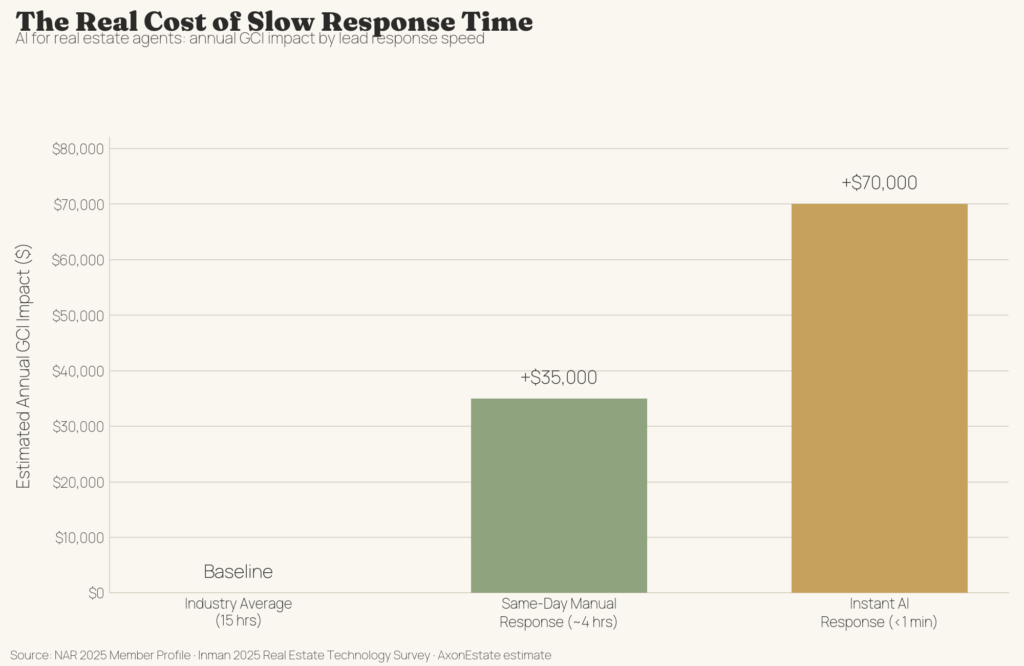
AI for real estate agents has turned into one of those categories every broker mentions and almost no one has actually priced out against their own commission numbers. According to NAR’s 2025 Member Profile, the median REALTOR gross commission income (GCI) — the total commission earned before splits and expenses — sits at $58,100 a year, which means a $200-a-month tool has to earn its keep against a paycheck that’s already tighter than most agents admit out loud. Do the math wrong, and it looks like another expense. Do it right, and one recovered listing pays for the tool for the next several years.
Why AI for Real Estate Agents Still Gets Filed Under “Nice to Have”
Most agents don’t skip AI for real estate agents because they doubt it works. They skip it because the pain it solves is invisible until a deal is already gone.
Here’s the problem hiding inside every pipeline: leads don’t wait. According to Inman’s 2025 Real Estate Technology Survey, the average agent takes 917 minutes — more than 15 hours — to respond to a new lead. Meanwhile, NAR’s Home Buyers and Sellers research found that 78% of buyers end up working with whichever agent responds first.
That gap between 15 hours and instant is where GCI quietly leaks out of a business. It doesn’t show up on a spreadsheet as a lost deal. It shows up as a lead who stopped texting back, a name that went cold in the CRM, a Saturday open house visitor who signed with someone else by Tuesday.
Solo agents feel this the hardest. There’s no team member catching overflow, no assistant screening inbound messages at 9 p.m. Every missed text is a missed commission check, and there’s rarely time to notice the pattern until year-end numbers come in soft.
The tools to close that gap already exist. What’s missing for most agents isn’t awareness — it’s a clear-eyed look at what the investment actually returns.
What the Top Agents Actually Do
Consider Danielle Marsh, a solo agent working a mid-size suburb outside Nashville with roughly 18 closings a year. Two years ago, she handled Zillow leads and Facebook inquiries the way most agents do: checking her phone between showings, replying when she had a free minute, often hours later. Her numbers were fine — not great. She estimates she was closing about 1 in every 45 online leads, in line with typical industry conversion.
Now compare that to Ray Thornton, who leads a four-person team in Louisville. Ray still works his sphere the old-fashioned way — calls, handwritten notes, client dinners — but he automated the first response to every inbound lead the moment it lands, day or night. Ray isn’t necessarily a better closer than Danielle. He’s simply never the third agent to call back.
The difference between agents who handle this well and agents who don’t rarely comes down to talent or work ethic. It comes down to whether the first response happens in minutes or in hours. Ray’s team isn’t spending more time on leads than Danielle does — they’re spending it earlier, before a prospect has three other agents’ numbers saved in their phone.
That’s the entire gap. Not effort. Timing.
The Research Behind AI Adoption in Real Estate
The data backs up the anecdotes. A February 2026 survey from Realtors Property Resource found that 82% of agents now use AI in some form, up from roughly 15% in 2023, according to reporting from Inman.
But adoption isn’t the same as impact. NAR’s 2025 Technology Survey found that only 17% of agents reported AI having a significant positive effect on their business, while 46% saw no noticeable difference at all.
That gap matters more than the adoption number itself. Research from Real Trends and InsideSales.com shows leads contacted within five minutes are roughly 21 times more likely to qualify than those contacted after thirty. Most agents aren’t failing because they lack a tool. They’re failing because the tool they picked never touches the moment that actually determines whether a lead converts: the first response.
How AI for Real Estate Agents Actually Closes the Gap
This is exactly the gap AxonEstate built its Inbound Lead Responder to close. Instead of asking an agent to be faster than physically possible, the agent handles the first response the moment a lead comes in — 2 a.m., mid-showing, on vacation, it doesn’t matter.
Real, working AI for real estate agents isn’t about replacing the relationship-building part of the job. It’s about making sure that relationship gets the chance to start before a competitor gets there first. The Inbound Lead Responder is built specifically around that first-response window, and it plugs into the broader AxonEstate workforce so leads flow straight into nurture without a manual handoff.
Here’s what it actually does, concretely:
- Texts and emails every new lead within seconds of submission, any hour of the day
- Asks qualifying questions about timeline, budget, and financing to separate real buyers from browsers
- Books showings directly onto the agent’s calendar without a back-and-forth
- Flags hot leads for an immediate personal call while cold leads move into automated nurture
- Logs every conversation into the CRM so nothing gets asked twice
- Hands off a fully qualified lead summary before the agent ever picks up the phone
None of that replaces the agent. It just means the agent’s first conversation with a lead happens while that lead is still actively looking — not three competitors later.
The Real Cost of Getting This Wrong
Here’s the math, using industry-standard numbers rather than best-case assumptions. A typical agent generating 40 online leads a month, converting at the widely-cited industry average of 2%, closes roughly 9-10 deals a year from that pipeline alone.
Now factor in NAR’s finding that 78% of buyers work with whoever responds first, against Inman’s data showing the average agent takes over 15 hours to do that. If even half of those 40 monthly leads are getting scooped up by a faster competitor before this agent replies, that’s not a small leak — it’s the majority of the pipeline.
Cutting response time from 15 hours to under a minute, even modestly doubling conversion to 4%, adds roughly 9-10 more closings a year. At a conservative $7,000 average commission per transaction — based on NAR’s reported $2.5 million typical annual sales volume across 10 transactions — that’s an additional $63,000-$70,000 in annual GCI. Against $2,400 a year in tool cost, the math isn’t close.
How This Plays Out in Practice
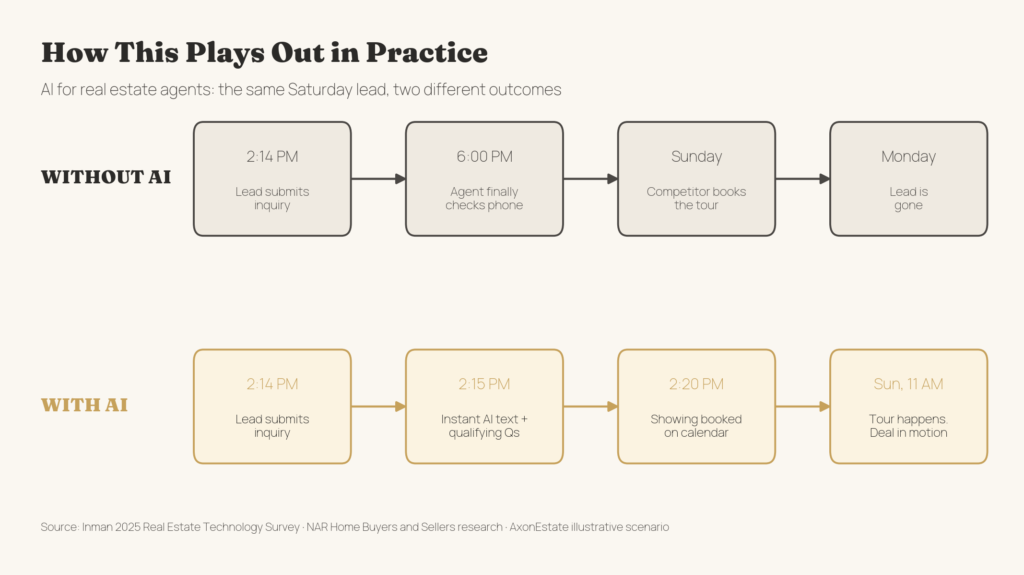
Picture a Saturday afternoon in early spring. An agent is mid-showing on a three-bedroom colonial in a growing suburb, phone silenced in her back pocket. At 2:14 p.m., a lead fills out a form on a Zillow listing for a similar home two subdivisions over — a young couple, pre-approved, ready to tour this week.
Without any automated response, that lead sits untouched. The agent finishes her showing, drives to the next appointment, and doesn’t check her phone until almost 6 p.m. By then, the couple has already heard back from two other agents. One of them booked a Sunday morning tour. By Monday, this lead is gone — not because the agent did anything wrong, just because she was busy doing her job somewhere else.
Now run the same Saturday with the Inbound Lead Responder active. At 2:15 p.m., the couple gets a friendly text confirming interest and asking about their timeline and lender status. By 2:20 p.m., they’ve answered, been qualified as serious buyers, and picked a Sunday 11 a.m. slot straight off the agent’s calendar. She sees the notification during a break between showings, glances at the qualifying answers, and walks into that Sunday tour already knowing exactly what this couple needs.
Same lead. Same busy Saturday. Completely different outcome — because the response happened in minutes instead of days.
Why This Matters More in 2026 Than Ever
This isn’t a hypothetical arms race. According to HousingWire’s coverage of RPR’s February 2026 survey, 82% of agents already use AI in their business — meaning the agent who skips it isn’t staying neutral, they’re falling behind a majority that’s already moved.
The market backdrop makes the gap sharper. Post-settlement buyer representation agreements mean today’s buyers are more selective about who they sign with upfront, and NAR’s data shows they lean heavily toward whichever agent shows up first and fastest. In a slower sales environment, where the typical REALTOR closed just 10 transactions in 2024 according to NAR’s Member Profile, there’s less room to absorb a lost lead than there was in a hotter market.
AI for real estate agents stopped being a novelty around the same time buyer expectations shifted toward instant, always-on communication. The agents pulling ahead in 2026 aren’t necessarily working harder. They’re simply never the slowest one to respond.
Bottom Line
The real math behind AI for real estate agents isn’t complicated once it’s laid out: a $200-a-month tool only needs to save one deal a year to pay for itself several times over, and the data suggests most agents are losing far more than that to slow response times alone.
This isn’t about replacing the relationship side of the business. It’s about making sure that relationship gets a fair shot at starting before someone faster gets there first.
See how the Inbound Lead Responder handles this — or book a strategy call here to talk through what it would look like inside your specific pipeline.
Frequently Asked Questions
Is AI for real estate agents actually worth $200 a month?
For most agents generating even a modest number of online leads, yes. Recovering just one deal a year from faster response times typically covers the annual cost several times over.
How fast does an AI agent actually respond to a new lead?
Tools like the Inbound Lead Responder text or email a new lead within seconds of submission, any time of day, rather than waiting for the agent to have a free moment.
Will this replace my personal touch with clients?
No. It handles the first response and qualifying questions so the agent’s time goes toward the calls and showings that actually close deals, not toward being the fastest typist in the market.
What if I already use a CRM — do I still need this?
Most CRMs store leads; they don’t respond to them in real time. The Inbound Lead Responder plugs into that gap so leads get an immediate reply instead of sitting in a queue until someone logs in.
Sources
- Income Steady, Even as Market Slows: 2025 Member Trends — NAR
- Two Types of Realtors Are Emerging in the AI Era — Inman
- AI Adoption Reaches 82% Among Real Estate Agents, RPR Reports — HousingWire
- Real Estate Lead Response Statistics: 15 Numbers Every Agent Should Know — AgentZap
- Speed-to-Lead for Real Estate Websites — IDX Broker