An AI lead qualification script decides, in the first two minutes of contact, whether a lead deserves a callback or a spot in your long-term nurture list. According to NAR lead data, 78% of homebuyers end up working with the first agent who responds to their inquiry, so every minute spent chasing the wrong lead is a minute a ready buyer spends waiting on someone else. Most agents still eyeball a new lead and guess. The agents pulling ahead right now let a script handle that triage before they ever pick up the phone.
The Real Problem: Every New Lead Looks the Same
Open your CRM on a Monday morning and you’ll see the problem immediately. A dozen new names sit in your inbox — some texted a listing at midnight, some downloaded a home valuation guide, some clicked an ad on a whim. On paper, they all look identical.
In practice, they’re not. One person is closing on a rental in three weeks and just wants pricing. Another has a pre-approval letter, a firm timeline, and a house they’ve already driven past twice. A third filled out the form by accident while scrolling Facebook.
Without a qualification step, you can’t tell which is which until you’ve already spent 15 or 20 minutes on the phone finding out. Multiply that across dozens of leads a month, and the math turns brutal. Speicher Group’s research on agent time use found that prospecting and lead follow-up can consume up to half of a full-time agent’s working day. Club Wealth’s productivity research puts the hidden cost even higher, estimating that inefficiencies — much of it spent on the wrong conversations — cost agents 10 to 20 hours a week.
That’s not a hustle problem. It’s a triage problem, and it shows up just as often on four-person teams as it does for solo agents working every lead alone. Because of this, the agents who protect their calendars aren’t working harder than everyone else. They’re simply refusing to spend prime hours guessing.
What the Top Agents Actually Do
Consider two agents working the same lead source in Greenville, South Carolina. Marcus runs a three-person team and still answers every inbound lead personally. When a new inquiry lands, he calls within the hour, asks about timeline, budget range, and financing status, then sorts the lead into “hot,” “warm,” or “long-term” before he hangs up. He spends real time only on leads that clear that bar, and he tells new agents on his team the same thing every week: a fast no is better than a slow maybe.
Down the street, another agent takes the opposite approach. Every lead gets the same 45-minute phone call, the same full pitch, and the same follow-up sequence — whether the person is three weeks from closing or three years from browsing seriously. By Thursday, that agent has burned an entire afternoon on conversations that led nowhere, and the one buyer who was actually ready went five hours without a callback.
Marcus isn’t smarter. He isn’t working more hours, either. He just built a qualification step into his very first conversation and trusts it enough to act on what it tells him, instead of treating every inbound name as equally urgent.
That single habit compounds. Over a year, it means dozens of extra hours spent on people who can actually close, instead of people who were only ever going to waste an afternoon. This is the gap an AI lead qualification script is built to close for agents who can’t personally screen every inquiry themselves.
The Research Behind AI Lead Qualification
The data backs up what Marcus already knows instinctively. Research compiled by Pinova, drawing on NAR and Real Trends figures, puts the industry-wide conversion rate from initial inquiry to closed transaction between just 0.4% and 1.2%. In other words, even a well-run team closes only a handful of deals out of every thousand leads it touches.
Follow-up habits make the gap worse. Data tracked by the National Sales Executive Association, and cited widely across the industry, suggests roughly 80% of sales require five or more follow-up contacts — yet most agents stop reaching out after one or two attempts. A separate dataset of 400,000 leads, compiled by sales trainer Greg Harrelson, found that 95% of eventual conversions happened only after the sixth point of contact. That gap between where most agents quit and where deals actually happen is where the real money quietly disappears.
Put together, this research points to one conclusion: agents aren’t losing deals because they lack leads. They’re losing deals because they can’t tell, quickly enough, which leads are worth that sixth call.
How AI Solves Lead Qualification for Real Estate Agents
This is exactly the gap AxonEstate’s Buyer Qualification Agent was built to close. Instead of asking an agent to personally screen every inquiry, the agent lets an AI lead qualification script handle that first conversation automatically — by text, chat, or phone — within minutes of a lead coming in, at any hour of the day.
It doesn’t replace an agent’s judgment. It just makes sure that judgment only gets used on leads that have already earned it. The system asks the same questions a sharp agent would ask on a first call, then hands off a clean, scored summary instead of a raw name and phone number.
In practice, the Buyer Qualification Agent, part of the broader AxonEstate AI workforce, typically:
- Contacts new leads within minutes of a form submission, before interest cools
- Confirms budget range, pre-approval status, and purchase timeline in the first exchange
- Identifies renters, browsers, and out-of-area inquiries and routes them to long-term nurture instead of an agent’s calendar
- Scores each lead as hot, warm, or long-term based on real answers, not guesswork
- Books a live call directly on the agent’s calendar once a lead clears the qualification bar
- Logs every answer in the CRM, so the agent walks into the first live conversation already briefed
The result isn’t more leads. It’s fewer wasted conversations and a calendar that only fills up with people worth calling, which matters just as much for a solo agent as it does for a growing team.
The Real Cost of Getting This Wrong
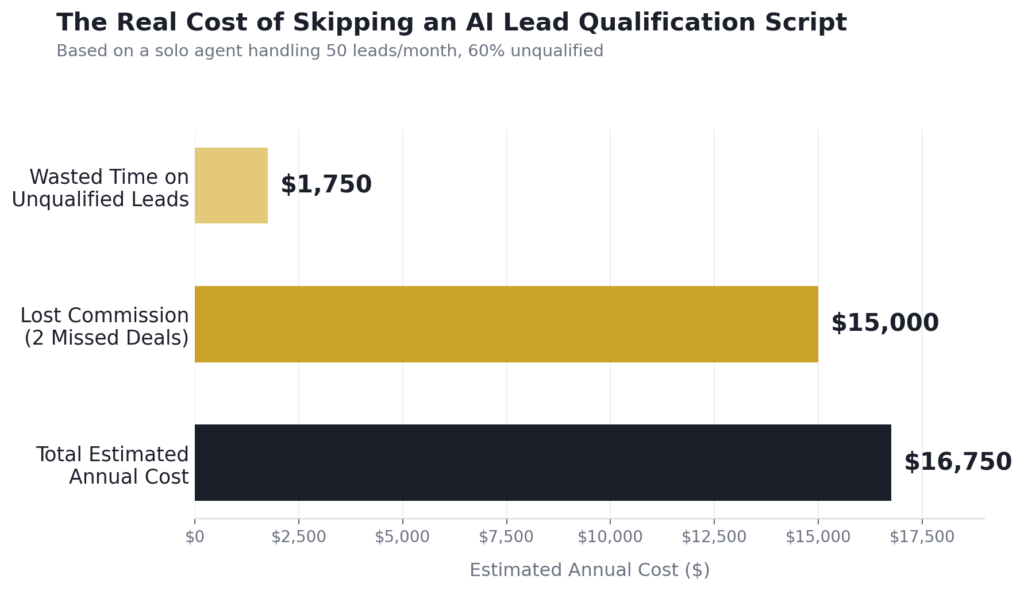
Run the numbers on a typical solo agent pulling in 50 leads a month from ads, referrals, and an aging database. Spend even 10 minutes triaging each one by phone or text, and that’s over 8 hours a month — nearly 100 hours a year — just figuring out who’s serious.
If 60% of those leads turn out to be renters, tire-kickers, or people years from buying, roughly 60 of those hours go toward conversations that were never going to close. Meanwhile, Real Trends’ commission analysis, built on NAR’s median home price data, estimates that a single missed or poorly handled lead represents a lost commission of $7,500 or more.
It only takes two genuinely qualified leads slipping through the cracks — because the agent was busy on a dead-end call — to erase $15,000 or more in commission a year. That’s not a hypothetical. It’s the direct, calculable cost of not knowing, quickly enough, which lead deserves the next hour of your day, and it’s the kind of loss that never shows up on a monthly expense report.
How This Plays Out in Practice
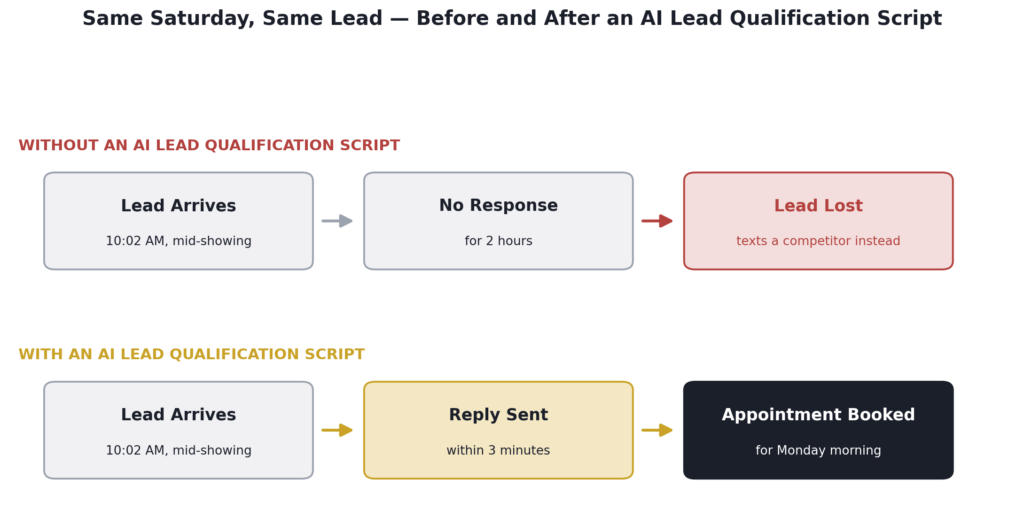
Picture a Saturday afternoon in early spring. An agent is mid-showing on a three-bedroom colonial in a quiet suburb, phone on silent, client asking questions about the roof. Back at the office, two new leads hit the CRM within ten minutes of each other: one is someone whose lease ends in eight months and is “just looking,” the other has a pre-approval letter, a pet-friendly must-have list, and a mortgage rate lock expiring in three weeks.
Without any qualification system, both leads sit untouched until the showing wraps up two hours later. By then, the serious buyer has already texted two other agents from the same listing site, and one of them called back in nine minutes. The showing agent finds out only later, scrolling messages after dinner, that the better lead got away.
Now picture the same Saturday with an AI lead qualification script running in the background. Both leads get a reply within minutes. The casual browser gets a friendly response and a spot in a monthly nurture campaign. The serious buyer gets a handful of qualifying questions, a confirmed budget and timeline, and an appointment already booked for Monday morning — sitting on the agent’s calendar before the showing even ends.
Same Saturday. Same two leads. Completely different outcome, because the qualification happened the moment the lead came in, not two hours later.
Why This Matters More in 2026 Than Ever
Buyer and seller expectations have shifted fast, and patience hasn’t shifted with them. Research from Real Trends and InsideSales.com found that agents who respond to a new lead within five minutes are 21 times more likely to qualify that lead than agents who wait half an hour. In a market where buyers casually message three or four agents from the same listing, that gap decides who gets the appointment.
At the same time, lead volume keeps climbing while agent headcount per lead source hasn’t. More inquiries arrive outside business hours, on evenings and weekends, when most agents are with family or at a showing. Tight inventory in many markets means qualified buyers move fast once they find something they like, and they rarely wait around for a callback. Because of this, speed alone isn’t enough anymore — a fast reply to the wrong lead still wastes the moment that mattered.
This is why an AI lead qualification script matters more in 2026 than it did even a couple of years ago. It’s not just about answering quickly. It’s about answering quickly and correctly, so the fastest response also goes to the right person.
Bottom Line
Every agent already knows speed matters. Fewer realize that speed without qualification just means wasting time faster, on the wrong conversations, at the exact moment a real buyer needed a reply.
An AI lead qualification script fixes that by sorting serious buyers from casual browsers the moment a lead arrives, before it ever costs an agent an afternoon or a commission check.
Ready to stop guessing which leads deserve your time? See how the Buyer Qualification Agent works — see how it works — or book a strategy call here.
Frequently Asked Questions
Is an AI lead qualification script the same thing as a chatbot?
Not quite. A basic chatbot just answers questions. A qualification script actively asks them — confirming budget, timeline, and motivation — then scores the lead so an agent knows who to call first.
Will leads know they’re talking to AI first?
Most systems, including AxonEstate’s, are built to be upfront about that. In practice, buyers care more about getting a fast, useful reply than about who or what sent it.
What happens to the leads that don’t qualify?
They don’t get deleted. A good system routes them into a long-term nurture sequence, since a “not ready yet” lead today can easily become a client a year from now.
Do I still need to know how to qualify leads myself?
Yes. The script handles the first pass so you’re not spending an hour on every inquiry, but you still need your own instincts for the leads that make it through.