Almost every agent now believes AI will reshape real estate, but the AI ROI real estate agents can point to is a different story. According to NAR’s 2025 Technology Survey, adoption has climbed to 68%, yet only 17% of agents report AI having a significant positive impact on their business, and 46% notice no difference at all. That gap between belief and results is not a technology problem. It’s a deployment problem, and it’s costing agents deals every single week.
The AI ROI Real Estate Agents Expected — and the Wall They Hit Instead
Most agents didn’t adopt AI because they were bored. They adopted it because everyone told them to, from brokers to coaches to every LinkedIn post promising an unfair advantage.
So they signed up for a chatbot, a listing description generator, or a CRM add-on. They expected more showings, faster follow-up, and a fatter pipeline by the end of the quarter.
Instead, most agents got a tool that writes decent captions and not much else. The AI answers a few questions on the website, but it doesn’t qualify a buyer or book a showing. It drafts a listing description, but someone still has to fact-check it, tweak it, and post it themselves.
That’s the disconnect. According to RPR’s February 2026 survey of NAR members, 82% of agents have now integrated AI into their business, yet 63% say accuracy is still their top concern with the outputs. Trust that low doesn’t translate into leads.
Meanwhile, the leads keep coming in through the same channels they always have: web forms, portal inquiries, sphere referrals. Those leads don’t wait around while an agent decides whether to trust the new tool. They call the next name on the list.
This is where the AI ROI real estate agents actually need starts to diverge from the AI ROI real estate agents are being sold. One is about content. The other is about response, follow-up, and conversion — the parts of the job that were always the hardest to automate, and the parts most AI tools never touch.
What the Top Agents Actually Do
Maria Chen runs a four-agent team out of Franklin, Tennessee. Eighteen months ago, her team looked like most others: a handful of marketing tools, a CRM nobody updated consistently, and leads that sat in an inbox until someone had time.
Chen didn’t add more AI tools. She replaced the ones that only produced content with one that handled response and qualification. Every new lead now gets a reply within a minute or two, day or night, with follow-up questions about budget, timeline, and financing built in.
The result wasn’t dramatic overnight, but it compounded. Showings booked from online leads roughly doubled within two quarters, not because the leads got better, but because nobody beat her team to the first conversation anymore.
Contrast that with a twelve-agent brokerage in the same market that added AI tools to nearly every part of its marketing stack last year. Listing descriptions write themselves now. Social captions too. But leads still sit for hours before a human responds, and the brokerage’s per-agent closing rate hasn’t moved.
The difference isn’t budget or team size. Chen’s team is smaller and spends less on technology overall. It’s where the AI sits in the workflow. Agents getting real AI ROI put it at the first point of contact, where speed decides who gets the appointment.
The Research Behind the AI Results Gap in Real Estate
The gap between AI adoption and the AI ROI real estate agents actually see isn’t unique to one survey. It shows up everywhere researchers have looked.
NAR’s 2025 Technology Survey, based on responses from a large national sample of Realtors, found adoption near 68%, alongside strikingly modest reported impact: fewer than one in five agents saw a significant business benefit.
RPR’s February 2026 survey pushed adoption even higher, to 82%, while confirming that trust and accuracy concerns remain the biggest barrier agents cite for not using AI in more of their workflow.
Separately, decades-old but still-relevant Harvard Business Review research on online sales leads found that response speed, not lead volume or lead quality, is the single biggest driver of whether a sale gets qualified at all. Firms that responded within an hour qualified leads far more often than those that waited even slightly longer.
Put together, the research tells a consistent story: agents are investing in AI broadly, but the investment isn’t landing where it would actually move a deal forward.
How AI Solves the AI ROI Problem in Real Estate
The fix isn’t more AI. It’s the right AI, in the right place in the workflow.
Since speed to first contact is what actually predicts conversion, the highest-leverage place to apply AI isn’t content creation — it’s the moment a lead comes in. That’s precisely the gap an Inbound Lead Responder is built to close.
Instead of a generic chatbot bolted onto a website, this kind of agent works as a dedicated first responder across every channel a lead might use. It’s one piece of a broader system — AxonEstate builds a full AI workforce for agents and teams, with each agent handling a specific part of the pipeline instead of one tool trying to do everything.
In practice, an Inbound Lead Responder:
- Replies to every new lead within a minute or two, at any hour, across text, email, or web chat
- Asks qualifying questions about budget, timeline, financing, and motivation before any human gets involved
- Books showings directly onto the right agent’s calendar once a lead confirms real interest
- Flags high-intent, after-hours leads for a same-night personal callback instead of a next-morning one
- Logs every message and qualification detail into the CRM automatically, with nothing typed twice
- Hands off a short, ready-to-act summary so the agent starts the call already knowing the buyer’s situation
That’s what turns AI ROI real estate agents can bank on into something real. Not a faster caption. A faster conversation.
The Real Cost of Getting This Wrong
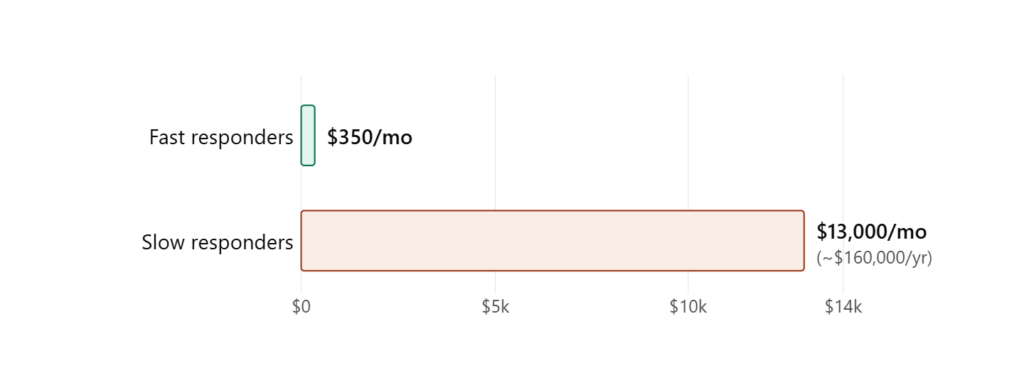
Here’s what slow response actually costs, in plain numbers.
Say a team generates 60 online leads a month, a realistic volume for a busy Tennessee-market team running paid and organic lead sources. Industry data puts average online lead-to-close rates between 0.4% and 1.2%, so on volume alone, that’s roughly one closed deal a month if nothing else changes.
Now factor in response speed. Harvard Business Review’s research on online sales leads found that firms responding within an hour qualified leads dramatically more often than firms that waited even a little longer, with qualification odds dropping fast after that window closes. If half of those 60 monthly leads go to whichever agent responds first, and a slow team consistently loses that race, that’s roughly 30 leads a month effectively handed to competitors.
At a conservative 5% conversion rate on properly worked, quickly answered leads, and a typical Tennessee-market commission of around $9,000 per closed deal, that’s over $13,000 a month — more than $160,000 a year — in commission income lost purely to response speed.
How This Plays Out in Practice
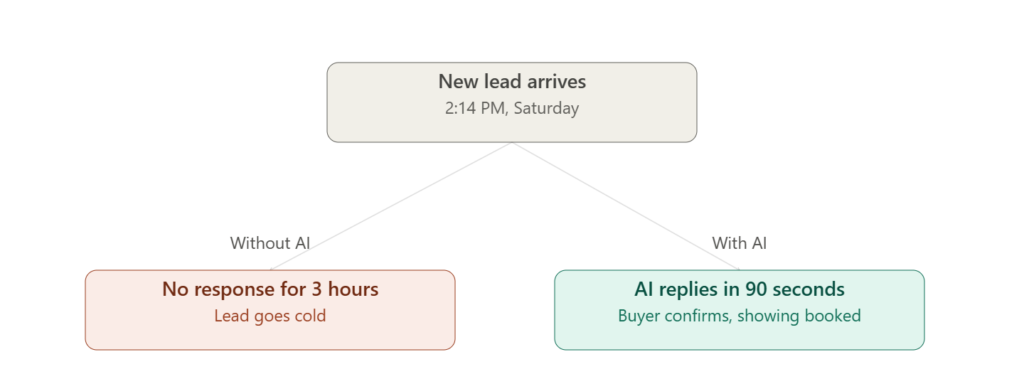
It’s a Saturday afternoon in Brentwood, Tennessee. An agent is walking a young couple through a four-bedroom colonial, phone silenced, fully present with the buyers in front of her.
Without an AI system running lead response, a new inquiry comes in on a $650,000 listing across town while she’s mid-showing. Nobody reads it for three hours. By the time she checks her phone that evening, the lead has gone cold, and the buyer has already scheduled a Sunday tour with someone else.
With an Inbound Lead Responder running in the background, that same Saturday looks different. The lead comes in at 2:14 PM. Within ninety seconds, the buyer gets a personalized reply about the listing, along with two quick questions about timeline and financing.
By 2:20 PM, the buyer has confirmed they’re pre-approved and want to see the home this weekend. The agent’s calendar gets a new showing request for Monday morning, along with a short summary: pre-approved, motivated, relocating for work, hoping to close before school starts.
She doesn’t see any of this until she’s done with her current showing. But when she checks her phone, there’s already a booked appointment and full context waiting, instead of a missed opportunity and a guessing game.
Same market. Same lead. Same Saturday. The only difference is what happened in the first two minutes.
Why This Matters More in 2026 Than Ever
This matters more now than it did even a year ago. Buyers have less patience for slow follow-up because they’re used to instant answers everywhere else in their lives, from food delivery apps to customer service chats.
At the same time, competition for every lead has increased. According to RPR’s February 2026 survey, AI adoption among agents has reached 82%, up sharply from 68% less than a year earlier. That means more of the agent down the street’s leads are now getting an instant, well-qualified response, whether or not yours are.
Meanwhile, mortgage rates hovering in the mid-6% range have made buyers more selective and slower to commit, which raises the value of a fast, confident first conversation even further. A hesitant buyer who gets a quick, helpful response is far more likely to keep talking than one left waiting.
In a market where adoption is no longer optional, doing AI badly is now riskier than not doing it at all. Agents who get the deployment right aren’t just ahead of the agents doing nothing — they’re pulling away from the agents doing AI wrong.
Bottom Line
AI adoption isn’t the problem in real estate. Deployment is.
Most agents added AI to the parts of their business that were never the bottleneck — content, captions, market reports — while the moment that actually decides who gets the deal, the first response to a new lead, stayed exactly as slow as it’s always been. The agents pulling ahead this year aren’t smarter or better funded. They just put AI where the deal actually gets decided.
Real AI ROI real estate agents can measure comes from closing that gap, not adding another tool to ignore.
See how Inbound Lead Responder works — see how it works, or book a strategy call here.
Frequently Asked Questions
Why isn’t my AI actually helping my real estate business?
Most agent-facing AI tools handle content, not conversion. They write captions or descriptions, but they don’t answer, qualify, or book the leads that actually turn into closings. If your AI isn’t touching your response time, it isn’t touching your revenue either.
How fast do I really need to respond to a new lead?
As close to instantly as possible. Research on online sales leads has consistently found that response speed inside the first hour, and ideally the first few minutes, is the strongest predictor of whether a lead ever gets qualified.
Will an AI lead responder feel robotic to buyers and sellers?
Not if it’s built for real estate conversations specifically. A well-built Inbound Lead Responder asks the same qualifying questions a good ISA would, personalizes replies to the actual property, and hands off to a human the moment the conversation needs one.
Do I need a big team to make this worth it?
No. Solo agents and small teams often see the biggest relative jump, since they have the least capacity to answer every lead manually. The agent picks up exactly the coverage a human can’t provide alone, at 11 PM or during a Saturday showing.
Sources
- NAR Technology Survey Finds AI Gaining Traction With Realtors — HousingWire
- REALTORS® Embrace AI, Digital Tools to Enhance Client Service — National Association of Realtors
- 82% of Real Estate Agents Use AI — But the Real Gap Is Confidence — RPR
- The Short Life of Online Sales Leads — Harvard Business Review
- Real Estate AI Adoption Report 2026 — Pinova