AI voice agents for real estate are changing who wins the lead — and who loses it. According to the National Association of Realtors, 78% of buyers choose the agent who responds first, yet the average agent takes over 2 hours to reply to a new enquiry. That gap — between the moment a lead calls and the moment an agent picks up — is where deals are won and lost. The agents closing the most transactions in 2025 aren’t necessarily the most skilled; they’re simply the fastest.
Why Missed Calls Are Killing Your GCI (Even When You’re Busy)
You’re at a listing presentation. Your phone buzzes three times. You silence it. By the time you check it an hour later, the caller has already booked an inspection with the agent who picked up on the second ring. This isn’t a rare scenario — it’s Tuesday.
The real estate industry runs on speed-to-lead. However, the nature of the job makes constant availability almost impossible for a single agent. Showings, negotiations, appraisals, and client calls already fill every hour. No agent can realistically answer every inbound enquiry within minutes — not without help.
A report by Zillow found that leads contacted within 5 minutes are 21 times more likely to qualify than those contacted after 30 minutes. Yet most agents aren’t hitting anywhere near that window. The result is a quiet but devastating revenue leak — one that doesn’t show up on any dashboard until the commission statements come in thin.
Beyond the speed problem, there’s a consistency problem. Some leads get a callback the same day. Others wait until after the weekend. Some get a follow-up voicemail. Others get nothing. That inconsistency means a significant portion of the marketing budget spent generating those leads simply evaporates.
In other words, it’s not a lead generation problem for most agents — it’s a lead response problem. And until recently, the only solutions were hiring a receptionist or missing the call.
What the Top Agents Actually Do
Consider Sarah Chen, a solo agent in Austin, Texas, who manages a database of over 900 contacts with no team support. Twelve months ago, her conversion rate on inbound leads was around 11%. Today it sits at 28%. The difference wasn’t a new CRM, a new marketing strategy, or a new brand. It was a voice agent that picked up every call she missed.
Sarah’s setup is straightforward. When she’s unavailable, an AI voice agent answers in her name, asks the caller a series of qualifying questions, and immediately logs the responses to her CRM. By the time Sarah checks her phone after the presentation — or the dinner, or the 10 pm bedtime — she has a prioritised list of who to call back and exactly what they’re looking for.
In contrast, her former colleague at the same brokerage still handles everything manually. He’s an excellent agent. But he openly admits to losing three or four solid leads per month to agents who simply replied faster. At $12,000 average commission per transaction, that’s close to $50,000 in annual GCI quietly walking out the door.
The difference between these two agents isn’t talent — it’s systems. Top producers build infrastructure that keeps working when they can’t. That infrastructure now includes AI voice agents for real estate, running 24 hours a day, every day of the week.
The Research Behind AI Voice Agents for Real Estate
The data consistently shows that speed-to-lead is the single highest-leverage variable in real estate conversion. Research from Harvard Business Review found that the odds of contacting a lead drop by over 10 times if a first attempt is made after the first hour versus within the first five minutes. For real estate, where a buyer might enquire with four agents simultaneously, that window closes even faster.
Additionally, a study by InsideSales.com found that 35–50% of sales go to the vendor who responds first. In a competitive property market, that figure climbs even higher as buyers and sellers alike interpret responsiveness as a proxy for competence and reliability.
Meanwhile, research from NAR’s Real Estate in a Digital Age report highlights that 97% of buyers use the internet during their home search — and most expect near-instant responses when they reach out. The gap between consumer expectations and agent capacity is widening every year. AI voice technology is the most scalable way to close it.
How AI Solves the Lead Response Problem for Real Estate Agents
This is exactly the gap that AxonEstate‘s Inbound Lead Responder is built to close. Rather than replacing the agent relationship, it acts as an always-on first point of contact — capturing, qualifying, and routing leads the moment they come in, regardless of the time or day.
The agent doesn’t need to change their workflow. The AI voice agent runs in the background, and the agent simply receives a prioritised, pre-qualified lead summary. Here’s what the Inbound Lead Responder specifically does:
- Answers inbound calls instantly — no hold times, no voicemail, no delay — even at 2 AM or during a Saturday open house.
- Asks structured qualifying questions to determine buyer readiness, budget range, timeline, and preferred suburbs.
- Logs all conversation data directly to the agent’s CRM with tags and lead scores applied automatically.
- Sends the lead an immediate SMS confirmation so they know their enquiry was received.
- Prioritises callbacks for the agent based on lead quality — so the agent always calls the hottest prospect first.
- Triggers follow-up sequences for lower-priority leads so no enquiry falls through the cracks.
Because of this, AI voice agents for real estate don’t just improve response times — they make the entire lead pipeline more predictable and more profitable.
The Real Cost of Getting This Wrong
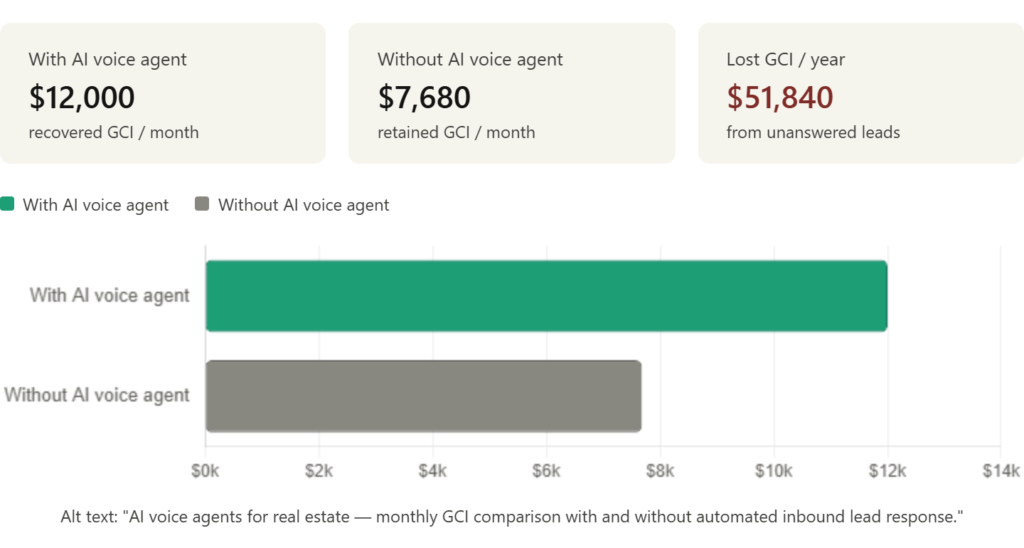
Let’s run the numbers. The average real estate agent receives around 60 inbound lead enquiries per month across portals, referrals, and direct calls. If 20% of those come in outside business hours or during unavailable periods — that’s 12 leads per month going unanswered or to voicemail.
Industry benchmarks suggest a qualified lead-to-appraisal conversion of around 15–20% with timely follow-up. Without timely follow-up, that drops to roughly 5%. On 12 missed leads per month, the difference is approximately 1.2 qualified appraisals per month versus 0.6.
At a conversion rate of 60% from appraisal to listing, and an average commission of $12,000 per transaction, that 0.6 appraisal gap translates to roughly $4,320 in lost GCI every single month. That’s $51,840 per year — from leads that were already arriving, already interested, and simply not answered fast enough.
This is why the ROI conversation on AI voice agents for real estate is so straightforward. The cost of the technology is a fraction of what a single recovered transaction is worth. The question isn’t whether agents can afford to use it — it’s whether they can afford not to.
[CHART 1 — Insert here. Alt text: “AI voice agents for real estate — monthly GCI comparison with and without automated inbound lead response.”]
How This Plays Out in Practice
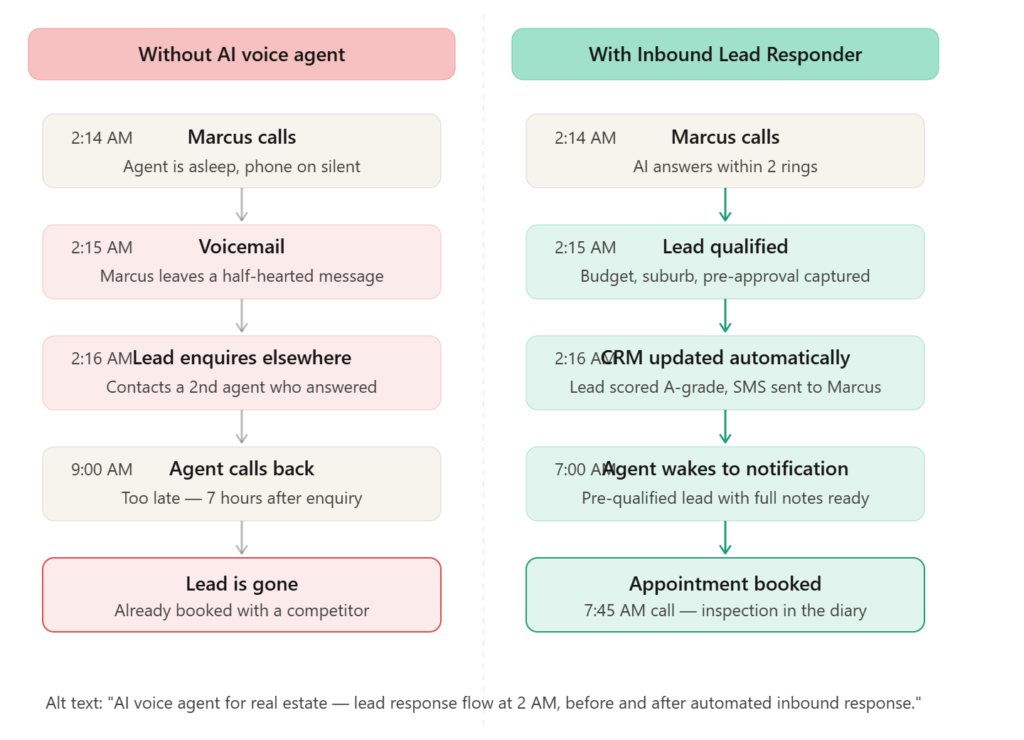
It’s 2:14 AM on a Saturday. A first-home buyer named Marcus has just finished scrolling through a listing for a two-bedroom apartment in Surry Hills. He taps the “enquire” button and calls the listed number. The agent — who has two open houses tomorrow morning and went to bed at 10:30 — doesn’t pick up. Marcus leaves a half-hearted voicemail, then keeps scrolling. By 9 AM, he’s booked an inspection with a different agent whose call was answered immediately.
That’s the world without an AI voice agent.
Now the same scenario, with the Inbound Lead Responder running. Marcus calls at 2:14 AM. The AI picks up within two rings, introduces itself as part of the agent’s team, and asks Marcus a few simple questions — what he’s looking for, his budget, whether he’s already been pre-approved. Marcus answers. The agent wakes up at 7 AM to a CRM notification: one new A-grade lead, pre-qualified, with full notes and a contact preference logged.
At 7:45 AM the agent calls Marcus directly. Marcus is surprised — and impressed. By the time the open home starts at 10 AM, the appointment is already in the diary. That’s the world with AI voice agents for real estate running in the background.
[CHART 2 — Insert here. Alt text: “AI voice agent for real estate — lead response flow at 2 AM, before and after automated inbound response.”]
Why This Matters More in 2025 Than Ever
Buyer and seller expectations have shifted permanently since 2020. Consumers now expect instant digital responses in every category — banking, food delivery, healthcare bookings. Real estate is no exception. In fact, because a property decision is among the highest-stakes purchases a person makes, the bar for responsiveness is arguably higher, not lower.
According to a 2024 survey by REA Group, 64% of property enquirers contact more than one agent simultaneously. That means the race to respond has become a race between agents — and the consumer often can’t tell the difference in quality until much later in the process. Response speed becomes a stand-in for competence.
Additionally, the current market environment — with elevated interest rates and cautious buyers taking longer to commit — means lead volume may be lower than in prior boom years. Because of this, every inbound enquiry carries more weight. Letting one slip through is more costly than it was in 2021 when enquiries were abundant. That’s precisely why AI voice agents for real estate have become less of a “nice to have” and more of a baseline competitive requirement.
Bottom Line
The best agents in 2025 don’t answer more calls — they make sure every call gets answered. AI voice agents for real estate make that possible without adding a single hour to the agent’s workday or a receptionist to the payroll.
The lead generation costs are already sunk. The leads are already coming in. The only question is whether they’re being captured — or whether they’re quietly converting with a competitor.
If you’re ready to stop losing leads to the clock, see how the Inbound Lead Responder works — or book a strategy call here to see it set up for your business.
Frequently Asked Questions
Will callers know they’re talking to an AI, not me?
The Inbound Lead Responder introduces itself as part of your team, so it’s transparent without being off-putting. Most callers are far more focused on getting their question answered quickly than on who — or what — picks up. The quality of the interaction matters more than the label.
Can AI voice agents for real estate actually qualify leads properly?
Yes — and often more consistently than a human. The AI asks the same structured questions every time, without getting distracted or forgetting to capture a key detail. You get a standardised, comparable lead profile for every caller, which makes prioritising callbacks straightforward.
What happens if a caller wants to talk to a real person right away?
The system can be configured to escalate or transfer specific call types. For most enquiries — especially after hours — capturing the lead information and promising a prompt human callback is the best outcome for both the caller and the agent. Callers generally prefer this to voicemail.
How long does it take to set this up?
For most agents, the Inbound Lead Responder can be configured and live within a single session. The AxonEstate team handles the setup, connects it to your existing CRM or portal, and tests it before going live. There’s no technical skill required on the agent’s side.