The cost per real estate lead is now eating a bigger share of every agent’s marketing budget than at any point in the last decade. According to a 2026 industry report from Real Estate Agent Leads, average lead costs across all channels now range from $416 to $480, with competitive metro leads regularly crossing $500. That means the $503 figure in this article’s headline isn’t an outlier — it’s close to the new normal in busy markets. The real problem isn’t the price tag. It’s what happens, or doesn’t happen, in the minutes after that lead lands in an agent’s inbox.
Why the Cost Per Real Estate Lead Keeps Climbing
Every year, more agents compete for the same pool of online buyers and sellers, and paid platforms respond the way any auction does. Google and Meta simply raise the price when more bidders show up in a market. That pushes the cost per real estate lead higher for everyone bidding in that ZIP code, whether the lead ever picks up the phone or not.
Portal leads compound the problem. Zillow and Realtor.com frequently sell the same inquiry to three to five competing agents at once, so agents aren’t just paying a premium price for a lead. They’re racing other paid subscribers to be the first voice that lead hears.
According to Harvard Business Review’s audit of more than 2,000 companies, the average business takes 42 hours to respond to a new inquiry, and nearly a quarter never respond at all. In real estate, that gap is where the money disappears. A lead purchased for hundreds of dollars, then left untouched for even a few hours, has often already been given away to whichever agent called first.
Meanwhile, the traditional safety net of referrals is thinning. First-time buyers, who historically became easy repeat clients and referral sources, made up the smallest share of the market on record last year. That pushes more agents toward paid lead channels just to keep a full pipeline.
What the Top Agents Actually Do
Derek Halloway sells homes solo in Plano, Texas, and buys roughly 20 Google leads a month at close to $450 each. He’s a strong agent with a solid close rate once he’s actually talking to someone, but he checks new leads between showings, which usually means a reply lands three to six hours after the inquiry comes in.
Twenty minutes away in Frisco, Priya Nair runs a three-person team buying leads from the same platforms at similar prices. The difference isn’t the marketing. It’s what happens in the first sixty seconds after a lead comes in.
Every inquiry her team buys gets an instant text confirming the listing, two qualifying questions about timeline and financing, and a same-day showing offer, all before a human ever touches the conversation. By the time one of her agents calls, the lead is already warm and half-qualified.
Derek and Priya spend almost identical amounts to generate a lead. Priya’s team simply keeps more of what that spend buys, because the lead never has time to go cold or call someone else first.
The Research Behind the Cost Per Real Estate Lead Crisis
Three data points explain why speed matters more than most agents assume. The Lead Response Management Study conducted by Dr. James Oldroyd at MIT, in partnership with InsideSales.com, found that contacting a lead within five minutes instead of thirty makes it roughly 21 times more likely to qualify, and close to 100 times more likely to result in an actual conversation.
Harvard Business Review’s follow-up research, published as “The Short Life of Online Sales Leads,” audited over 2,000 firms and found that companies contacting a lead within an hour qualified it about seven times more often than those that waited even a little longer, and more than 60 times more often than firms that waited a full day.
On the cost side, that same 2026 industry benchmark from Real Estate Agent Leads puts the average cost per lead across all channels between $416 and $480, with Google search leads alone averaging $53 to $66 per click before factoring in how many clicks it takes to produce one usable lead in a competitive market.
How AI Solves the Cost Per Real Estate Lead Problem
None of this means an agent needs to outspend competitors to fix the problem. It means the lead needs a response before its interest fades, and that’s not something most solo agents or even small teams can staff around the clock.
That’s the specific gap the Inbound Lead Responder is built to close. Instead of a new lead sitting in an inbox until an agent finishes a showing, it responds within seconds, at any hour, and keeps the conversation moving until the lead is booked or clearly disqualified. It’s one of 14 specialist agents inside AxonEstate, each built to own a single piece of the real estate workflow instead of trying to be a jack-of-all-trades assistant.
Specifically, it:
- Sends a personalized text and email reply within seconds of a new lead entering the CRM, including nights, weekends, and mid-showing
- Asks qualifying questions about timeline, budget, and financing status, then logs every answer straight to the agent’s CRM
- Books a showing or call directly onto the agent’s calendar the moment a lead is ready, with no manual back-and-forth
- Automatically flags cold or unqualified leads so agents stop burning call time on dead-end inquiries
- Keeps following up over several days if a lead goes quiet, instead of letting the conversation die after one unanswered text
- Hands the agent a full conversation summary the instant a lead is warm enough for a human to take over
The Real Cost of Getting This Wrong
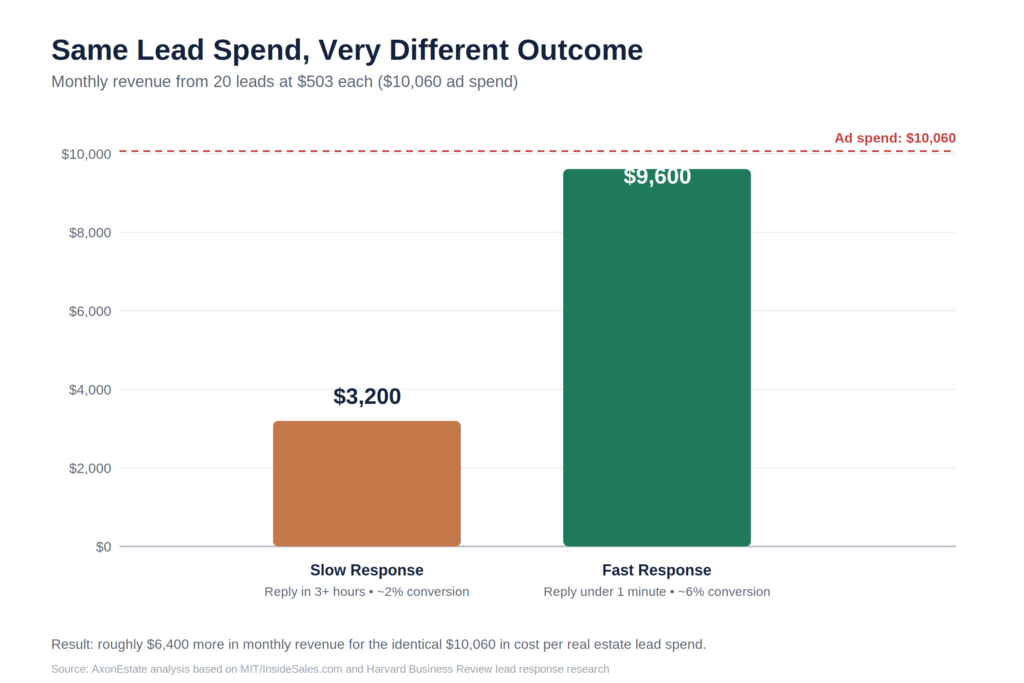
Run the numbers on a single month of cost per real estate lead spend. An agent buying 20 leads at $503 each spends $10,060 in ad budget alone. Without fast follow-up, raw internet leads convert to closed transactions at roughly 2%, which lines up with what agents report when leads sit for hours. That’s 0.4 closings a month.
At an average commission of about $8,000 per transaction after a brokerage split, that’s roughly $3,200 in revenue against $10,060 in spend. Respond within minutes instead of hours, and that same conversion rate typically climbs toward 5–6%, consistent with the qualification gains MIT and Harvard’s research documented. At 6%, 20 leads produce 1.2 closings, or about $9,600 in revenue — roughly $6,400 more every month for the identical ad spend. Multiply that gap across a year, and slow follow-up alone can cost an agent more than $75,000 in commission they already paid to generate.
How This Plays Out in Practice
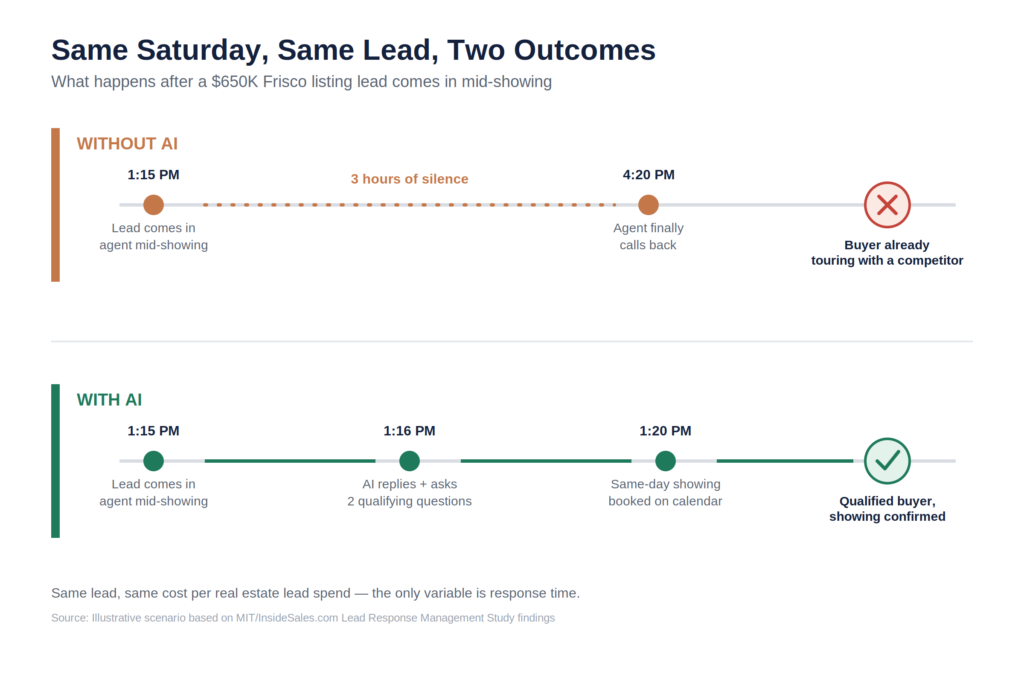
Picture a Saturday afternoon in a Plano subdivision. Derek is midway through a showing on a three-bedroom bungalow, phone on silent. A Google Ads lead comes in from a buyer who just got pre-approved and wants to see a $650,000 listing in Frisco that same weekend.
Derek finishes the showing, checks his phone two hours later, and calls back three hours after the inquiry came in. The buyer already toured a comparable listing with a competitor who texted back in minutes and is now writing an offer.
With the Inbound Lead Responder running instead, that same lead gets a reply in under a minute — a text confirming the listing is still available, two quick qualifying questions, and a same-day showing booked directly onto the agent’s calendar before the open house even wraps up. Derek walks out of one showing into a second one already booked, with a qualified buyer waiting, and he never touched his phone.
Why This Matters More in 2026 Than Ever
NAR’s 2026 forecast expects existing-home sales to climb roughly 14% this year, the strongest rebound in several years, which means more inventory moving and more agents chasing the same buyers at once. At the same time, first-time buyers made up just 21% of purchases in NAR’s most recent survey, an all-time low, so a shrinking share of transactions come from an agent’s personal network alone.
More of the pipeline has to come from paid channels, and NAR’s own research found 43% of buyers now start their home search online before ever calling an agent. That combination — rising transaction volume, more competition per lead, and buyers who expect a fast digital response — means agents who reply first are positioned to win a growing share of a growing market. The ones who don’t are simply funding their competitors’ pipeline.
Bottom Line
The cost per real estate lead isn’t going down anytime soon, and chasing cheaper leads rarely fixes the real problem. Response time, not lead price, is what decides whether that spend turns into commission.
Agents who reply in minutes instead of hours consistently close more of the same leads for the same money. The fix isn’t more hustle. It’s making sure no lead ever waits.
Inbound Lead Responder — see how it works. Or book a strategy call here to walk through what it would look like for your pipeline.
H2: Frequently Asked Questions
Is $503 really a normal cost per lead in real estate?
In competitive metro markets, yes. Industry benchmarks put average costs across all channels between $416 and $480, and Google leads in hot ZIP codes regularly land above $500. Rural and lower-competition markets run far cheaper.
Why does response time matter more than lead quality?
Because even a great lead goes cold fast. Research from MIT and Harvard Business Review both show qualification odds drop sharply once more than a few minutes pass, regardless of how strong the original inquiry looked.
Can I just hire an ISA to handle this instead of AI?
You can, but an ISA still sleeps, takes days off, and handles one lead at a time. An AI responder works every lead simultaneously, at 2 a.m. or during a showing, without adding payroll.
Will an automated response feel robotic to a real buyer or seller?
Not if it’s built well. The goal isn’t to replace the agent’s voice — it’s to confirm interest and gather details fast, then hand a warm, qualified conversation back to the agent to close.
H2: Sources
- Real Estate Lead Generation Statistics 2026 — Real Estate Agent Leads
- The Short Life of Online Sales Leads — Harvard Business Review
- Lead Response Management Study — MIT / InsideSales.com
- 2026 Market Outlook: What NAR Members Should Watch Right Now — NAR
- NAR Profile of Home Buyers and Sellers — National Association of REALTORS®