Facebook ads for real estate have become one of the most popular ways to fill a pipeline. According to the National Association of Realtors, 92% of agents now use Facebook for lead generation — and it’s easy to see why. The platform’s targeting is precise, the cost per lead is low, and inquiries can come in fast. But here’s the painful truth: most of that ad spend is going straight to waste.
The Follow-Up Problem Nobody Talks About with Facebook Ads for Real Estate
Running Facebook ads for real estate feels productive. You set a budget, choose an audience, watch the leads roll in — and then life gets in the way. You’re at a showing. You’re in a listing presentation. Your phone is on silent.
Meanwhile, that lead you just paid for is already moving on.
Research from Inman’s 2025 Real Estate Technology Survey found that the average real estate agent takes 917 minutes — over 15 hours — to respond to a new lead inquiry. That number is staggering on its own. However, it gets worse when you layer in what NAR’s research has consistently shown: 48% of agents never follow up with a lead after the first contact attempt. Nearly half. One try, then silence.
On top of that, only 12% of agents make a third follow-up call, according to data tracked across agent sales performance research. The leads aren’t dead. The systems are. Buyers and sellers don’t always jump at the first message — they often need several touches before they’re ready to talk. When agents disappear after one attempt, they’re handing that commission to someone else.
This isn’t about effort or intention. Most agents care deeply about their clients. The problem is structural — Facebook ads for real estate generate volume that a solo agent, or even a small team, simply cannot keep up with manually.
What the Top Agents Actually Do
The agents who consistently convert Facebook leads into closed transactions aren’t necessarily running better ads. They’re running better systems. Speed and consistency separate the top 10% from everyone else — and the difference is visible in how fast they respond and how long they stay in the game.
Take Marcus Webb, a solo agent based in Nashville, Tennessee. Marcus spent $1,200 a month on Facebook lead ads targeting first-time buyers in the suburbs. His click-through rate was solid and his cost per lead sat around $14. The problem was his schedule. On a typical Tuesday, he might not see a lead notification until he came up for air between showings at 3 PM. By then, the buyer had already booked an appointment with another agent.
Marcus’s counterpart across town — a two-person team using automated lead response — pulls from the same ad audiences, spends less per month, and closes roughly three times more Facebook leads. The difference isn’t talent. It’s that when a lead submits their info at 11:42 AM on a Wednesday, someone — or something — responds within 60 seconds.
Top-performing agents treat lead response as a non-negotiable system, not a best-effort activity. They build infrastructure that handles the first contact automatically, so the human conversation starts when they’re actually available. That shift, from reactive to systematic, changes everything.
The Research Behind Facebook Lead Response Rates
The data on speed-to-lead is overwhelming, and it directly shapes how well Facebook ads for real estate actually perform.
The MIT/InsideSales.com Lead Response Management Study, which analyzed over 1.25 million sales leads, found that responding to a lead within five minutes makes you 21 times more likely to qualify that lead compared to waiting just 30 minutes. The gap between a five-minute response and a 30-minute response isn’t minor — it’s generational in conversion terms.
A Harvard Business Review study reinforced this, finding that firms responding within one hour of a query were seven times more likely to qualify the lead than those who waited even 60 minutes. Companies that waited 24 hours or more were 60 times less likely to qualify. These are not edge cases. These findings have held across millions of sales interactions and multiple industries, including real estate specifically.
NAR’s 2025 Home Buyers and Sellers Generational Trends Report adds another layer: 78% of homebuyers end up working with the first real estate agent who responds to their inquiry. That means before the conversation even starts — before the relationship, before the tour, before the offer — the deal has often already been won or lost by response time alone.
How AI Solves the Facebook Ads Follow-Up Problem
The math here is simple. Facebook ads for real estate can deliver strong leads at a low cost per inquiry. But that value evaporates if no one responds quickly enough to convert those leads into conversations. The solution isn’t hiring a full-time ISA on day one. It’s automation.
The Inbound Lead Responder from AxonEstate is built specifically to solve this gap. The moment a lead submits through a Facebook form or landing page, the agent gets instant response coverage — no lag, no missed windows, no leads cooling off in a notification queue.
Here’s what the Inbound Lead Responder does in practice:
- Responds to new Facebook leads instantly, within seconds of form submission, via SMS and email
- Sends a personalized, branded first message that sounds like it came directly from the agent
- Qualifies the lead with follow-up questions about timeline, budget, and location preferences
- Logs all responses directly to the agent’s CRM for organized, prioritized follow-up
- Re-engages leads who don’t respond initially, with timed follow-up sequences across multiple channels
- Notifies the agent only when a lead is warm and ready for a live conversation
This means the agent stays focused on high-value activities — showings, negotiations, listings — while the Inbound Lead Responder handles the critical first window that makes or breaks Facebook ad ROI.
The Real Cost of Getting This Wrong
Agents often frame follow-up as a productivity issue. In reality, it’s a financial one — and the numbers are sharp.
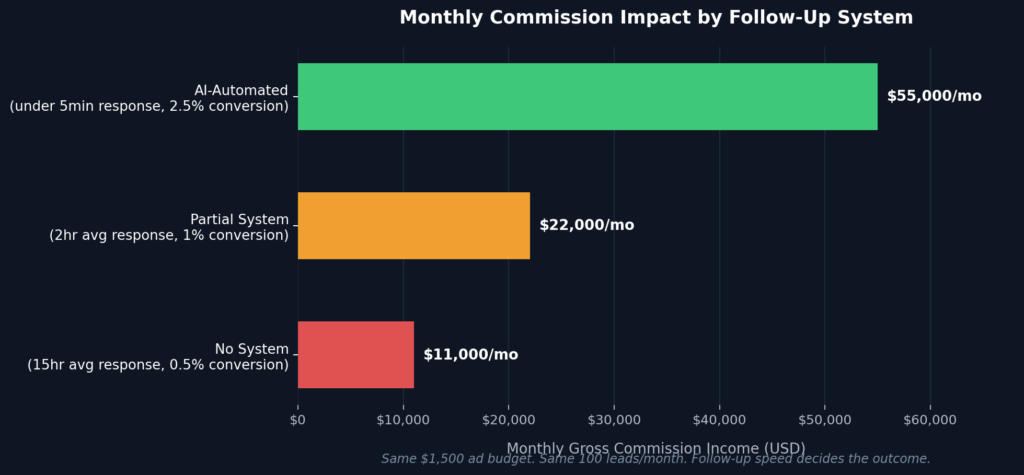
Say an agent spends $1,500 a month on Facebook ads for real estate, generating roughly 100 leads at an average cost of $15 per lead. Industry-wide, internet leads convert at 2–3% from inquiry to closing. That means the agent should close two to three deals per month from that spend — if every lead gets a fast, consistent follow-up.
At a median U.S. home price of around $400,000 and a 2.75% buyer’s agent commission, each converted lead is worth roughly $11,000 in gross commission.
However, if response time averages 15 hours — which Inman’s research puts at the national norm — and 48% of leads never get a second contact attempt, the actual conversion rate drops closer to 0.5%. That’s one closing per month instead of two or three. At $11,000 per deal, the agent is losing $11,000 to $22,000 in commission every single month. Annually, that’s $132,000 to $264,000 in preventable losses — all from leads they already paid for. The ad budget isn’t the problem. The follow-up gap is.
How This Plays Out in Practice
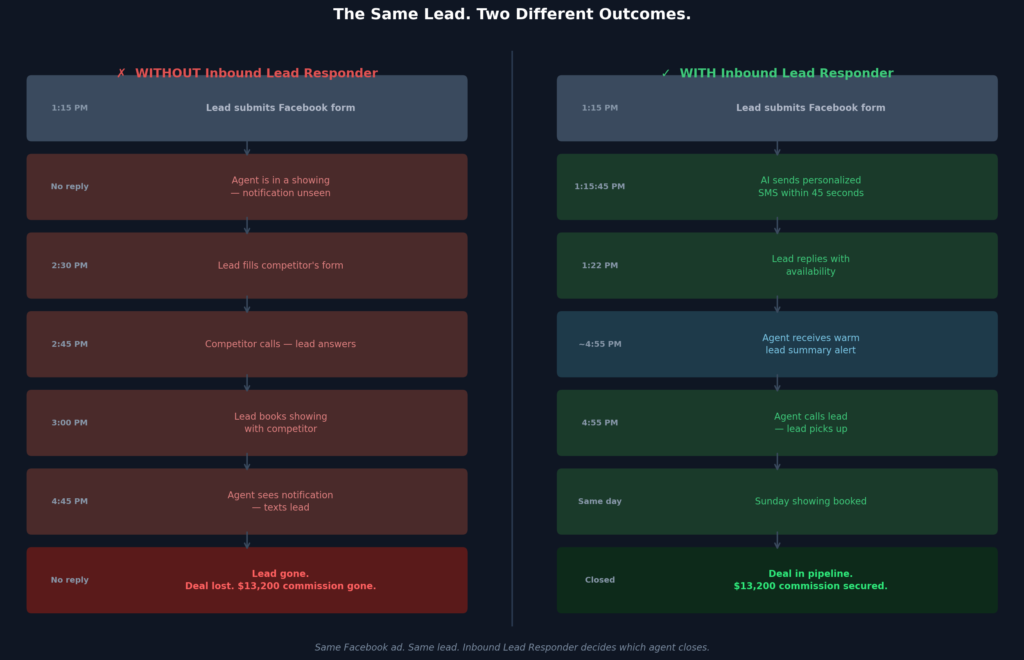
Here’s what Saturday afternoon looks like for an agent without a system.
Ryan Nguyen is a solo agent in Scottsdale, Arizona. At 1:15 PM, a buyer named Jessica fills out a Facebook Lead Ad form asking about three-bedroom homes under $480,000 in Chandler. Ryan is in the middle of showing a luxury listing and his phone is in his jacket pocket. Jessica waits. At 2:30 PM, she fills out a similar form on a competing agent’s site. By 3 PM, she’s already on a call with that agent, touring homes on Sunday.
Ryan sees Jessica’s form submission at 4:45 PM. He texts. No reply. He tries again Monday morning. Still nothing. He spent $15 to acquire that lead. Jessica would have been a $13,200 commission. Both the lead and the deal are gone.
Now picture the same Saturday with the Inbound Lead Responder running.
Jessica submits the form at 1:15 PM. Within 45 seconds, she receives a personalized text from Ryan: her inquiry is confirmed, her preferences are noted, and she’s asked when she’s available to tour homes this weekend. She replies at 1:22 PM. The agent is notified with a warm lead summary as soon as the showing wraps up. Ryan calls Jessica at 4:55 PM — and she picks up, because she already trusts the process. They book a Sunday tour. That $13,200 commission stays in Ryan’s pipeline.
Same agent. Same ad. Completely different outcome.
Why This Matters More in 2026 Than Ever
The real estate market has shifted in ways that make lead response more critical than ever before. Inventory remains tight in many metro areas, which means buyers are moving faster and making decisions with less deliberation than they did in slower markets. When a buyer finally raises their hand, they’re often ready to act quickly — and agents who hesitate lose the relationship before it begins.
At the same time, buyer expectations around response time have been shaped by every other digital experience they have. Same-day delivery. Instant customer service chat. On-demand everything. According to NAR’s 2025 Home Buyers and Sellers Generational Trends Report, responsiveness is now the top quality buyers look for in an agent — outranking local market knowledge and negotiation skills.
Meanwhile, the competition for Facebook ad leads has intensified. More agents are running campaigns, which means every lead is receiving outreach from multiple sources. The agent who responds first frames the entire relationship. Those who wait don’t just lose the deal — they fund a competitor’s business with every dollar they spend on ads.
Bottom Line
Facebook ads for real estate can be one of the highest-ROI tools in an agent’s marketing mix. The targeting is powerful, the cost per lead is manageable, and the reach is enormous. But none of that matters if the follow-up isn’t there.
The data is clear. The agents who win are the ones who respond fast, stay consistent, and never let a lead go cold because they were busy. That’s not a willpower problem — it’s an infrastructure problem.
The Inbound Lead Responder is built to close that gap and turn ad spend into actual conversations. See how it works — and book a strategy call here to find out what it would mean for your pipeline.
Frequently Asked Questions
How quickly should I respond to a Facebook real estate lead?
Within five minutes is the gold standard. Research from MIT and InsideSales.com found that responding within five minutes makes you 21 times more likely to qualify the lead compared to waiting 30 minutes. After that window closes, conversion odds drop sharply with every passing hour.
Why am I getting Facebook leads but not converting them into clients?
Speed and follow-up consistency are almost always the culprits. If your average response time is measured in hours rather than minutes, most leads have already moved on by the time you reach out. Additionally, NAR data shows 48% of agents never attempt a second follow-up — meaning leads that didn’t respond to one touch are simply abandoned.
How many times should I follow up with a Facebook real estate lead?
Research consistently shows most conversions happen after the fifth contact attempt, and top-performing agents follow up 8 to 12 times over the first 30 days before shifting to a monthly long-term nurture cadence. One or two attempts isn’t persistence — it’s just the beginning.
Is it worth spending money on Facebook ads if my follow-up is weak?
No — and the math makes this stark. At a typical cost of $15 per lead, poor follow-up that cuts conversion rates in half means you’re effectively doubling your cost per closing without increasing your ad spend at all. Fix the follow-up system first, then scale the ad budget.
Sources
- Real Estate Lead Response Statistics: 15 Numbers Every Agent Should Know — AgentZap
- Lead Response Time: Every Study (Harvard, MIT, More) — AInora
- Real Estate Lead Follow-Up: How to Convert More Prospects — AgentZap
- Why Real Estate Agents Lose Leads by Responding Too Slowly — HyperLeap AI
- 89+ Real Estate Marketing Statistics & Trends to Watch in 2025 — REsimpli
- Real Estate Lead Follow-Up Strategies That Work — Espresso Agent