More agents are firing their ISA every quarter, and the reason is not cost. According to NAR’s 2025 Home Buyers and Sellers Generational Trends Report, 78% of homebuyers end up working with the first agent who responds to their inquiry. That single statistic is rewriting how top-producing teams staff their lead response function, and it is why the inside sales agent role is under more scrutiny than ever.
The Problem With Relying on an ISA for Lead Response
An ISA sounds like the obvious fix for slow lead response. In practice, the role has a structural flaw: humans cannot work 24 hours a day, and leads do not arrive on a schedule. A lead that comes in at 9 p.m. on a Tuesday sits untouched until morning, and by then the buyer has likely already spoken to someone else.
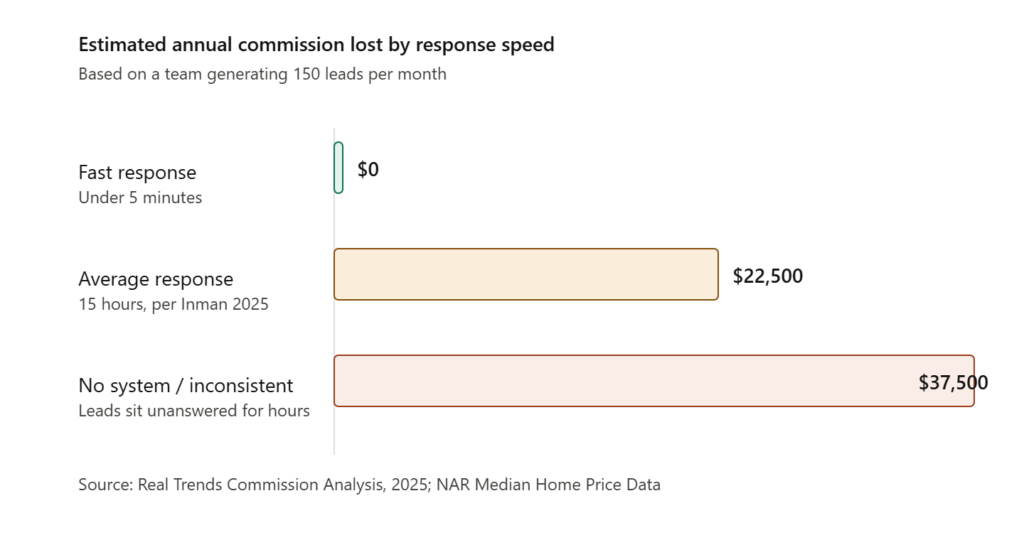
The data backs this up. Inman’s 2025 survey found that the average real estate agent takes over 15 hours to respond to a new lead inquiry. Even teams with a dedicated ISA struggle once volume climbs, because one person can only make so many calls, send so many texts, and check so many inboxes in a day.
Turnover compounds the problem. ISAs burn out fast, training a replacement takes weeks, and every gap in coverage is a window competitors walk through. Meanwhile, the lead keeps coming in regardless of whether anyone is staffed to answer it. Because of this, teams that depend entirely on one or two ISAs are exposed every time someone calls in sick, quits, or simply gets buried.
What the Top Agents Actually Do
Marcus Webb runs a six-person team in Charlotte, North Carolina, and he made the switch eighteen months ago. His old ISA was good — when she was online. Nights, weekends, and the gaps between her other tasks were dead zones, and Marcus estimates he lost a dozen solid leads a month to competitors who simply called back first.
Now an AI system answers every inbound lead within seconds, qualifies them with a natural conversation, and books anyone ready to move straight onto his calendar. Marcus still talks to every serious buyer. He just no longer talks to the ones who are still six months out, since the system nurtures those automatically until they are ready.
Contrast that with agents still doing this manually. They check their phone between showings, return calls in batches at lunch, and lose the leads who already moved on by then. The agents pulling ahead are not working harder. They have simply removed the gap between inquiry and response, and that gap is exactly what determines who wins the deal.
The Research Behind Firing Their ISA for AI
The numbers explain why this shift is accelerating. Research cited by Real Trends and InsideSales.com shows that agents who respond to web leads within five minutes are roughly 21 times more likely to qualify that lead than agents who wait thirty minutes. A separate Harvard Business Review study found that companies contacting a prospect within an hour were nearly seven times more likely to qualify them compared to firms that waited even slightly longer.
Inman’s 2025 Real Estate Technology Survey adds more context: the average agent response time sits at over 15 hours, against an ideal window of under five minutes. That is a massive gap, and it is precisely the gap AI-based response systems are built to close. As a result, the agents who close that gap first are capturing leads their slower competitors never even get a chance to speak with.
How AI Solves the Speed-to-Lead Problem
This is where an AI agent changes the math entirely. Instead of a human checking a queue between tasks, an AI system reads every inbound inquiry the moment it lands and responds immediately, day or night. That is the function the Inbound Lead Responder was built to handle inside the broader AxonEstate AI workforce platform.
Unlike a scripted chatbot, it carries a real conversation. It asks the right qualifying questions, picks up on intent, and routes the lead exactly where it needs to go. Specifically, the agent:
- Responds to every new lead within seconds, across web forms, portals, and texts
- Asks qualifying questions about timeline, budget, and motivation in natural conversation
- Flags hot leads and pushes them straight to the agent’s phone in real time
- Books showings and calls directly onto the agent’s calendar without back-and-forth
- Logs every conversation and qualification detail into the CRM automatically
- Keeps working nights, weekends, and holidays without a shift schedule
In other words, it does the part of the ISA job that depends entirely on speed and consistency, which happens to be the part humans struggle with most.
The Real Cost of Getting This Wrong
Run the numbers on a team generating 150 internet leads a month. Industry data puts internet lead conversion at 2-3%, meaning a team converting at the low end closes roughly 3 to 4 deals from that pool. Real Trends calculates that each missed or poorly handled lead represents a potential loss of $7,500 or more in commission income.
Now factor in response time specifically. If half those 150 leads sit for hours instead of minutes, and that delay costs even a modest portion of qualification odds, a team is realistically forfeiting 3 to 5 deals a year to slow response alone. At $7,500 per transaction, that is $22,500 to $37,500 in commission walking out the door every year, not because the leads were bad, but because nobody answered fast enough.
How This Plays Out in Practice
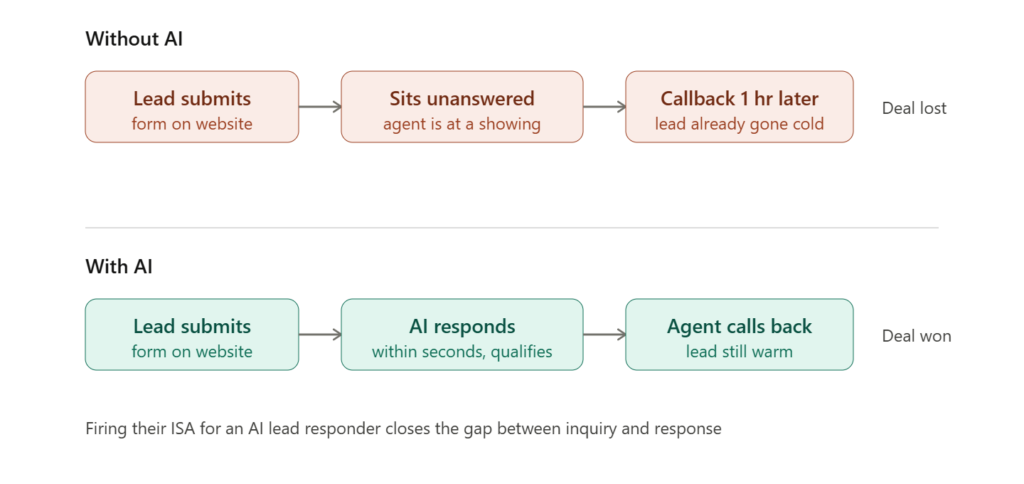
Picture a Saturday afternoon. An agent is mid-showing on a three-bedroom colonial in a quiet suburb, phone on silent because she is walking buyers through the kitchen. At the same time, a seller lead fills out a contact form after browsing her listings for twenty minutes. Without a system in place, that form sits in an inbox until she checks her phone an hour later, by which point the seller has already messaged two other agents.
Now picture the same Saturday with an AI agent running in the background. The moment the form is submitted, the system replies within seconds, asks a few natural questions about the property and timeline, and learns the seller wants to list within sixty days. It flags the lead as hot and texts the agent a summary between showings.
She glances at her phone during a five-minute gap, sees a qualified seller ready to talk, and calls back herself within the hour while the moment is still warm. The form never went cold. Nothing depended on her checking her phone at the exact right second, and the seller never even noticed the gap.
Why This Matters More in 2026 Than Ever
Buyer and seller expectations have shifted hard toward instant communication, and real estate has not caught up. NAR’s 2025 Home Buyers and Sellers Generational Trends Report found that 95% of buyers rate responsiveness as “very important” when choosing an agent, and most only interview one agent before committing. That means there is rarely a second chance to make a strong first impression.
At the same time, lead volume keeps climbing as more business moves through portals and websites instead of phone calls. A study of 74 top brokerages found that 41% never responded to website inquiries at all, and only 9% responded within the critical five-minute window. Beyond that, buyers are comparing multiple agents simultaneously online, often before an agent even knows the lead exists. In a market this competitive, response speed has stopped being a nice-to-have and become the deciding factor in who gets the deal.
Bottom Line
The agents firing their ISA and replacing it with AI are not cutting corners. They are recognizing that speed and consistency are the actual job, and that a human checking a phone between showings cannot compete with a system that responds in seconds, every time, around the clock.
This is not about removing the human from real estate. It is about making sure every lead gets a fast, qualified response so the agent only spends time on the conversations that matter. The agents making this switch now are building a structural advantage that compounds every month they keep it.
See how it works with the Inbound Lead Responder — see how it works, or book a strategy call here to walk through it for your team.
Frequently Asked Questions
Will an AI lead responder sound robotic to my leads? No. The system is built to carry a natural, conversational exchange rather than reading from a rigid script. Most leads do not realize they are not texting a human until well into the conversation, if at all.
What happens to my ISA’s other responsibilities if I switch? Most teams reassign their ISA to higher-value work like database calls, nurture conversations, and appointment prep, since the AI handles the instant first-response layer. Some teams choose to eliminate the role entirely and reinvest that budget elsewhere.
Does this work for both buyer and seller leads? Yes. The Inbound Lead Responder qualifies and routes both buyer and seller inquiries, asking the relevant questions for each based on what the lead expresses interest in.
How fast does it actually respond compared to a human? It responds within seconds of a lead coming in, at any hour, compared to the 15-hour average response time many agents currently operate at according to Inman’s 2025 survey. That gap is exactly where most lost deals come from.