Hours wasted per transaction add up faster than most real estate agents realize, and the math is brutal once you actually run it. According to the National Association of Realtors’ 2026 Member Profile, the typical agent now works a median of 35 hours a week yet still closes only nine transaction sides a year. Somewhere between the lead, the listing, and the closing table, a huge chunk of that time disappears into spreadsheets, status update calls, and re-typed seller reports. None of it shows up on a commission statement, and almost none of it has to happen this way anymore.
Where the Hours Wasted Per Transaction Really Go
Most agents picture their wasted time as one big category called admin. In practice it is dozens of small tasks stacked on top of each other, and vendor communication is the biggest pile of all.
Every active listing needs a price discussion, a showing recap, a feedback summary, and a market check-in. Sellers do not just want these updates, they expect them. A Clever Real Estate survey of 1,000 home sellers found that 75 percent expect to hear from their agent multiple times a week once a home is listed, and 17 percent expect contact every single day. That is not a once-a-week phone call. That is a near-constant drumbeat across every active file at once.
That expectation is reasonable from a seller’s chair. It is exhausting from an agent’s. Pulling comparable listings, writing a clear recap, formatting it so it does not look like a copy-paste job, then repeating that for every active file on the desk, is where the hours quietly vanish.
Add in chasing down showing feedback from other agents, updating a CMA after a competing listing sells, and rewriting the same update in three different tones for three different sellers, and a single transaction can swallow a full work day before a single offer ever lands. Multiply that across a real pipeline and the hours wasted per transaction stop being an annoyance. They become the ceiling on how many listings an agent can actually carry at once, no matter how good that agent is at finding the listings in the first place.
What the Top Agents Actually Do
Take Mara Lindqvist, a solo listing agent working the Plano, Texas market with no team and no in-house transaction coordinator. At any given time she has six to eight active listings, each one demanding its own rhythm of seller updates, and each one competing for the same finite hours in her week.
For years Mara handled vendor reporting the way most agents do: a Sunday-night batch of calls and a handful of half-finished email recaps that always seemed to lag a few days behind. Sellers noticed the gap. A few mentioned it directly, and one almost relisted with a different agent purely over communication, even though the home itself was getting solid showing traffic.
Agents who solve this problem do not just work faster. They restructure the task itself. Instead of writing a fresh report from scratch for every listing, top performers template the structure, pull the data automatically, and only personalize the parts that genuinely need a human voice, like reassurance after a slow open house or context on a tough piece of feedback.
The difference shows up in retention and referrals more than in any single transaction. Sellers who get a clear, on-time update twice a week rarely wonder what their agent is doing all day. Sellers who go quiet for ten days start calling other agents, even when the listing is actually performing fine behind the scenes. The gap is rarely about effort. It is almost always about visibility.
The Research Behind the Hours Wasted Per Transaction
The seller-communication gap is not anecdotal. NAR’s 2026 Member Profile reports that the typical agent now logs a median of 35 hours a week while closing a median of nine transaction sides a year, which leaves very little slack for reactive admin work once prospecting, showings, and negotiations are accounted for.
Separately, an analysis built on NAR’s prior Member Profile data found that agents spend only about 26 percent of their working hours on activities that directly generate revenue, while roughly 13 hours a week go to admin tasks that produce no income on their own. That is a third of a standard work week spent on work a seller never sees.
A third estimate from Vertu Agent puts the figure even higher, suggesting the average agent loses more than 10 hours a week, or upwards of 40 hours a month, to scheduling, email, and paperwork. Even the most conservative of these numbers points the same direction: a meaningful share of an agent’s week disappears into work a seller never thanks them for, no matter how well it is done.
How AI Solves the Hours Wasted Per Transaction Problem
None of this means agents need to work seven days a week or hire a full-time assistant just to keep sellers in the loop. It means the reporting layer of the job is a structured, repeatable task, and structured repeatable tasks are exactly where the hours wasted per transaction can be reclaimed with the right tool.
This is the gap the Vendor Reporting Agent is built to close. Instead of an agent manually compiling showing feedback, pricing context, and market movement into a fresh report every time, the agent runs that process in the background and delivers something a seller can actually read, on the schedule the seller already expects.
As part of the wider AxonEstate workforce, the Vendor Reporting Agent specifically:
- Pulls showing feedback and activity data automatically instead of waiting on agents to chase it down listing by listing
- Builds a consistent, branded seller update on a set schedule, even during a packed week of showings
- Flags pricing or market shifts that genuinely need the listing agent’s input rather than burying them in routine text
- Drafts the update in plain language a seller can skim in under two minutes between meetings
- Keeps a record of every update sent, so nothing falls through during a long listing or a slow stretch
- Frees the listing agent to spend the reclaimed hours on prospecting and new business instead of recap emails
The agent does not replace the relationship. It removes the repetitive part of maintaining it, so the conversations an agent actually has with a seller are about strategy, not status.
The Real Cost of Getting This Wrong
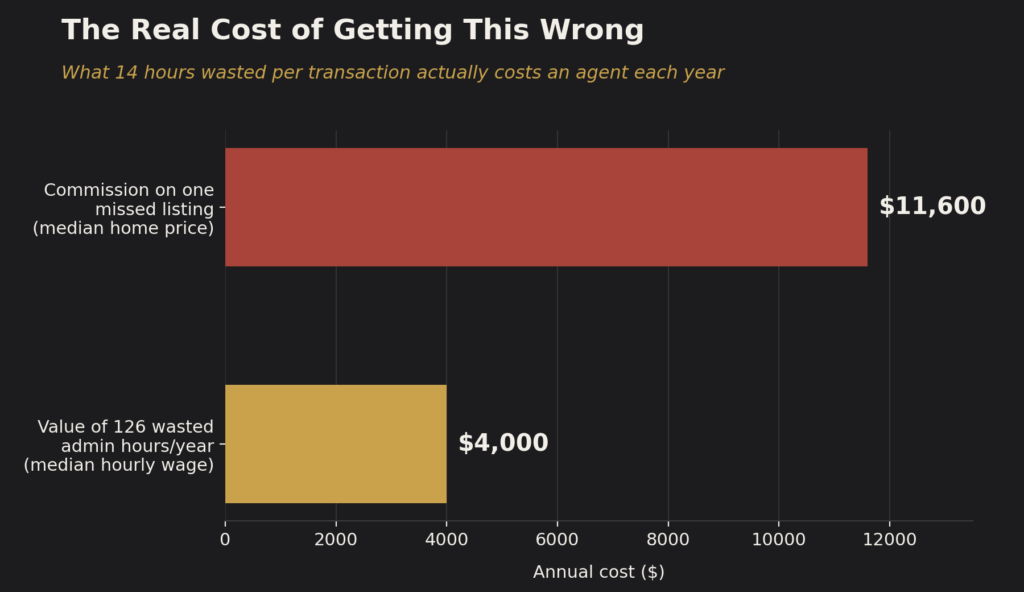
Run the math on a single agent’s year and the cost gets concrete fast. NAR’s 2026 Member Profile puts the median individual agent at nine transaction sides a year. If 14 hours wasted per transaction go to vendor reporting and seller updates, that is 126 hours a year, or more than three full 40-hour work weeks, spent on recap emails and status calls instead of new business.
The median U.S. existing-home price was $429,300 in May 2026, according to NAR, and typical listing-side commissions run close to 2.7 percent. That puts a single extra listing at roughly $11,600 in commission. If even one of those three reclaimed weeks converted into one additional listing a year, through prospecting time the agent never had before, the math implies over $11,000 left on the table annually. That number does not even count the sellers who quietly leave because updates felt thin, or the referrals they never send because the experience felt average instead of exceptional.
How This Plays Out in Practice
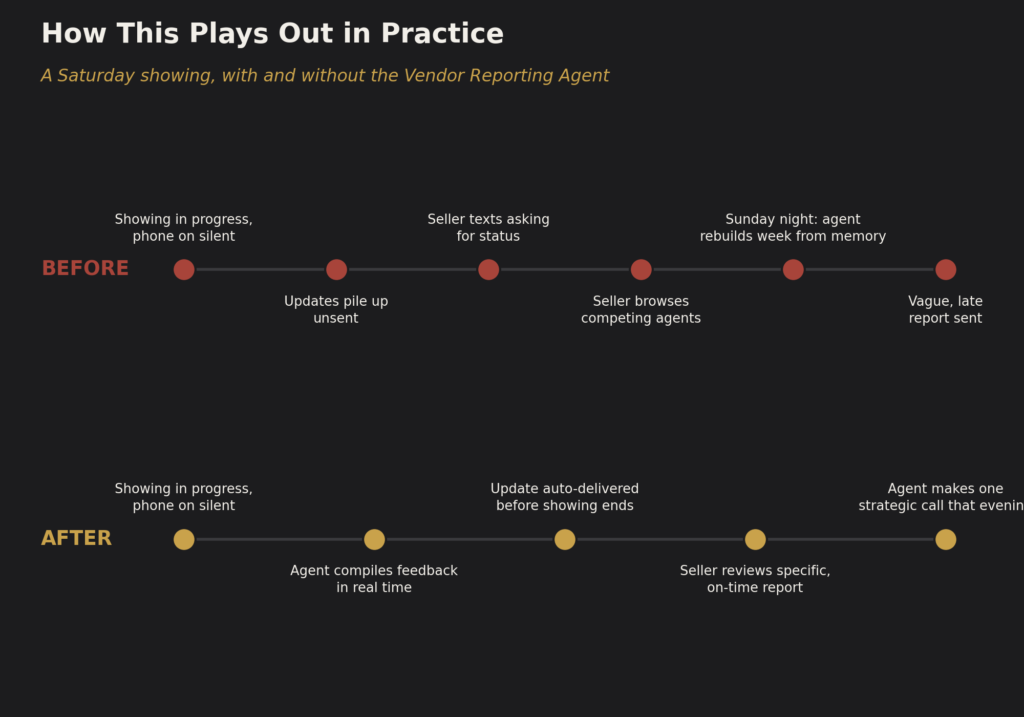
Picture a Saturday afternoon in a Frisco, Texas subdivision. Mara is mid-showing on a four-bedroom listing, phone on silent, focused on the buyer in front of her. Three other sellers are waiting on updates she has not had time to write, and one of them has already started checking competing listings online out of habit.
In the old version of this day, those updates wait until Sunday night. One seller texts asking if anything is happening with their listing. Another browses competing agents’ Instagram pages out of boredom and mild anxiety about whether their home is actually moving. By the time Mara sits down to write reports, she is reconstructing a week from memory, padding vague phrases like good interest because she cannot recall the specific feedback from each individual showing.
In the version with the Vendor Reporting Agent running, those same three sellers already have their twice-weekly update sitting in their inbox before Mara finishes the showing. It includes the actual feedback from each agent who toured the home, a short note on a nearby competing listing that just reduced its price, and a clear, specific next step instead of a vague reassurance.
Mara still calls one seller personally that evening, but the call is about strategy, whether to adjust price ahead of an open house, not a recap of facts the seller should have had three days earlier. The transaction moves at the same pace it always would have. The seller’s confidence in that pace simply does not erode along the way.
Why This Matters More in 2026 Than Ever
Inventory has been loosening through 2026, and sellers are noticing the difference. NAR reported a 3.2 percent increase in existing-home sales in May 2026, with the median sale price reaching a record $429,300 even as the months of supply climbed to 4.5, the highest level in nearly a year.
That shift matters because more inventory means more competing listings for a seller to watch nervously. A seller who only hears from their agent once a week is far more likely to fixate on a neighbor’s price cut or a competing open house than one who is getting consistent, specific updates that put those same data points in context first, before the seller has to go looking for them.
In a market with more choices on both sides, the agents who keep their reporting tight will keep more of their sellers calm, loyal, and willing to refer. The agents who let the hours wasted per transaction pile up will keep losing that trust to whoever responds faster, even when their actual work on the listing was just as strong.
Bottom Line
Fourteen hours wasted per transaction sounds abstract until it is multiplied across a real pipeline, a real year, and a real seller who quietly starts losing trust in the process.
The fix is not working longer hours or hiring another assistant to manage the assistant. It is removing the repetitive reporting work from the agent’s plate entirely, so the only conversations left between an agent and a seller are the ones that actually need a human voice, judgment, and experience behind them.
See how this works with Vendor Reporting Agent — see how it works. Or book a strategy call here to talk through what this looks like inside your own pipeline.
Frequently Asked Questions
Will my sellers know an AI is writing their updates?
The Vendor Reporting Agent drafts updates using your data and your voice settings, and you review anything sensitive before it goes out. Most sellers experience it as a more consistent version of the updates you were already trying to send.
What if a seller has a real question that needs a human answer?
The agent flags anything outside routine reporting, like a tough pricing question or a serious offer, straight to you. It handles the recurring update work, not the judgment calls.
Do I still need to call my sellers myself?
Yes, and that’s the point. Reclaiming the hours spent writing reports gives you more time for the calls that actually move a listing forward, like a pricing conversation after a slow first week.
How long does it take to set this up for an existing pipeline?
Most agents are running updates on their first listing within a day, since the agent pulls from data you’re already tracking. Full rollout across an entire pipeline typically takes about a week.
Sources
- NAR 2026 member profile shows Realtors more experienced — HousingWire
- Virtual Assistants for Real Estate Agents | 2025 Guide — VFA
- Why Most Real Estate Agents Waste 10+ Hours a Week on Admin Tasks — Vertu Agent
- 2025 Data: What Does a Real Estate Agent Do? Sellers Speak Out on Their Needs — Anytime Estimate
- NAR Existing-Home Sales Report Shows 3.2% Increase in May — NAR