Lead scoring for real estate agents has quietly become the difference between a database that pays out and one that just sits there. According to 82% of all real estate transactions come from repeat and referral business, yet most agents with 500+ contacts have no idea which 50 names in that list are actually ready to transact this month. They’re sitting on a goldmine and calling it randomly, hoping they hit the right vein. RISMedia
The Problem With a 500-Contact Database (And No Lead Scoring for Real Estate Agents)
Once an agent’s sphere crosses 500 contacts, the database stops being a list and starts being a logistics problem. There simply aren’t enough hours in a week to call everyone, so most agents default to calling whoever comes to mind — which usually means the loudest, most recent, or most demanding lead.
That’s a bad filter. The contact who emailed yesterday isn’t automatically more ready to buy than the one who went quiet eight months ago after a job relocation came through. However, without lead scoring for real estate agents, there’s no way to tell the two apart at a glance.
The data backs up how costly this blind spot is. A survey of 500 real estate professionals found that 86% of past clients say they would use their agent again or recommend them, yet those same agents reported only 20% of their business actually comes back to them. That gap between willingness and follow-through isn’t a referral problem. It’s a prioritization problem. Cres Insurance
Meanwhile, the agents pulling ahead aren’t working harder lists — they’re working smarter triage. They know which 30 contacts in their CRM moved this week (browsed listings, opened an email twice, searched a new zip code) and they call those people first. Everyone else gets a lighter-touch nurture. That single shift, in practice, is lead scoring for real estate agents in its simplest form.
What the Top Agents Actually Do
Marissa, a solo agent in Tampa with roughly 640 contacts in her CRM, used to start every Monday the same way: scrolling her database top to bottom, calling whoever “felt right.” Some weeks she’d burn three hours and land one decent conversation.
She switched to a scored approach instead. Every contact in her database now carries a live score based on recent behavior — website visits, email opens, search activity, time since last contact, and life-event signals like a recent listing search in a new school district. Her Monday mornings now start with a short list: the 15 contacts whose scores spiked over the weekend.
Contrast that with Derek, who runs a four-agent team in the same metro and still treats his database as one long, undifferentiated list. His team manually flags “hot leads” in a spreadsheet tab, but the flags go stale within days because nobody’s tracking behavior in real time. As a result, his team chases cold leads while warm ones go untouched for weeks.
The difference isn’t effort. Both agents work hard. The difference is that one of them knows, every single morning, exactly who to call first — and the other is still guessing.
The Research Behind Lead Scoring for Real Estate Agents
The numbers on neglected databases are stark. Despite being referred to their agent by a friend or having used that agent before, a striking share of sellers can’t even remember their agent’s name a year after closing, according to RealTrends — a direct result of follow-up that fades the moment a deal closes. RealTrends
NAR’s own research shows the prize is significant for agents who get this right. Among veteran agents, 40% report that repeat clients make up more than half their business, with another 28% coming from referrals — a combined 68% of total business from people they already know, per NAR’s 2025 Member Profile. That’s not luck. It’s the compounding result of staying visible to the right contacts at the right moments. Jamilacademy
Acquisition cost data makes the stakes clearer still. Retaining an existing client costs five to seven times less than acquiring a new one, and even a modest 5% increase in retention can lift profits by 25 to 95%. Lead scoring for real estate agents is what makes that retention systematic instead of accidental. Stylograph
How AI Solves Lead Scoring for Real Estate Agents
Sorting 500+ contacts by hand isn’t a discipline problem — it’s a math problem. A human can’t realistically track behavioral signals across hundreds of contacts every single day and re-rank the list in real time. That’s precisely the gap AI closes.
This is where a tool like the Database Reactivation Agent fits naturally into an agent’s workflow. Instead of replacing the agent’s judgment, it does the constant background tracking that no person has time for, then surfaces a short, ranked list of who actually deserves a phone call today. Built as part of the AxonEstate AI workforce, it’s designed specifically to keep large databases from going cold.
In practice, the agent:
- Monitors every contact’s digital behavior — site visits, email opens, search activity — and updates scores continuously, not once a quarter
- Flags life-event signals like a new job search location, a growing family, or a lease end date pulled from past conversation notes
- Re-engages cold contacts automatically with personalized, low-pressure check-ins instead of generic blast emails
- Surfaces a daily call list ranked by likelihood to transact, so mornings start with action instead of guessing
- Logs every touch back into the CRM so nothing falls through the cracks between team members
- Identifies which segments of the database have gone silent for 90+ days and need a different re-engagement approach
The result isn’t a bigger database. It’s a database that finally tells the agent what to do with it.
The Real Cost of Getting This Wrong
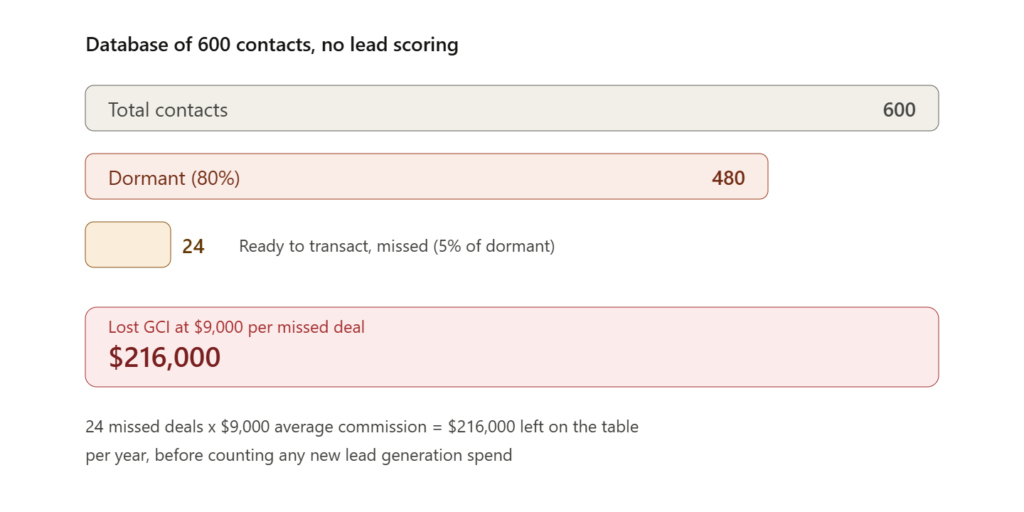
Picture an agent with 600 contacts and no scoring system. Industry data suggests that without active reactivation, roughly 80% of a database sits dormant in any given quarter — meaning around 480 contacts get effectively zero meaningful outreach.
If even 5% of those dormant contacts (24 people) are actually ready to buy or sell within six months, and the agent never identifies them, that’s 24 missed transaction opportunities. At a conservative average commission of $9,000 per closed deal, that’s $216,000 in GCI left on the table — not from bad leads, but from good leads nobody called in time.
Even capturing a third of that — eight deals — would add $72,000 in commission a year. That math doesn’t require new leads, new ad spend, or a bigger team. It just requires knowing who to call first.
How This Plays Out in Practice
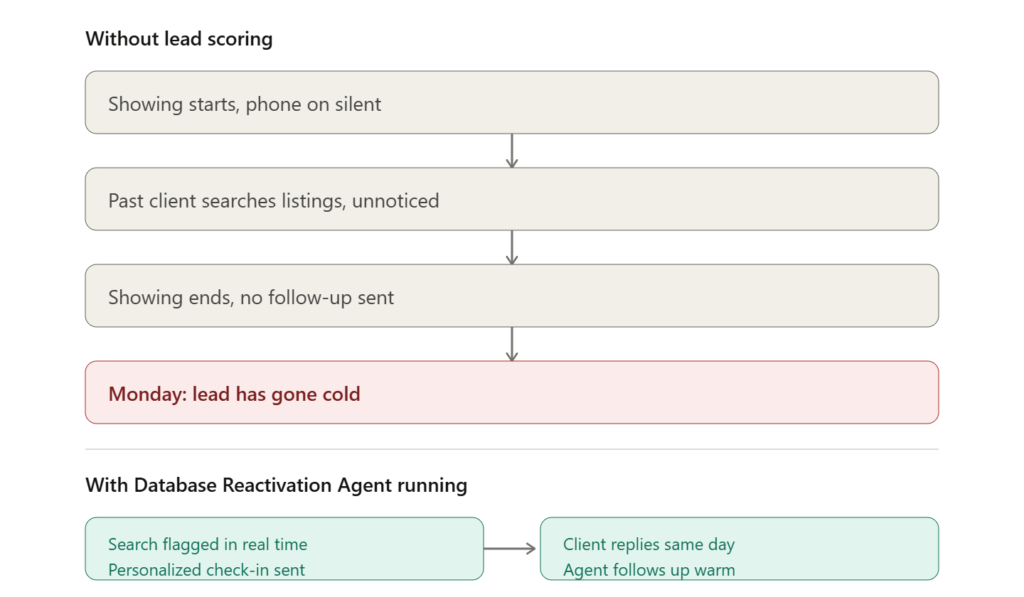
It’s a Saturday afternoon. An agent in a mid-size suburb is mid-showing on a three-bedroom colonial, phone on silent, fully present with the buyer in front of them. Without any system running in the background, every other opportunity in their database — the contact who just searched five new listings in a neighboring zip code, the past client whose lease happens to end in 60 days — sits invisible until Monday, if it gets noticed at all.
Now picture the same Saturday with the Database Reactivation Agent running quietly behind the scenes. While the agent is occupied with the showing, the system notices that a past client searched listings twice this week and flags them as newly warm. It sends a friendly, personalized check-in text on the agent’s behalf — nothing pushy, just a relevant nudge tied to what that contact actually searched for.
By the time the agent wraps the showing and checks their phone, there’s already a reply: the past client mentions they’ve been thinking about upsizing. That’s a warm lead, captured in real time, with zero hours stolen from the in-person showing that paid the bills that week. This is the practical edge that lead scoring for real estate agents provides — it works the hours the agent physically can’t.
Why Lead Scoring for Real Estate Agents Matters More in 2026 Than Ever
The market has shifted the math in favor of relationship-based business. With first-time buyers sitting at a historic low of 21% of the market and repeat buyers now representing 79% of transactions, the agents who built and maintained their databases years ago are the ones positioned to win those repeat deals today. Stylograph
At the same time, the agent population itself is thinning. NAR membership has dropped from a 2024 peak of around 1.55 million to roughly 1.45 million, with projections suggesting it could settle near 1.2 million by the end of 2026 if the slow market continues. Fewer agents means less noise — but only for the ones whose names actually surface when a past client is ready to move again. Jamilacademy
That’s exactly why lead scoring for real estate agents isn’t a nice-to-have anymore. In a shrinking, consolidating market, the agents with organized, actively-scored databases are capturing a disproportionate share of a smaller pie. Everyone else is competing for scraps.
Bottom Line
A 500-contact database isn’t an asset by default — it’s an asset only if an agent knows which contacts to act on today. Lead scoring for real estate agents turns a static spreadsheet into a living, prioritized call list, and that shift alone can recover tens of thousands in commission that would otherwise sit dormant.
The agents pulling ahead in 2026 aren’t generating more leads. They’re working their existing database with far more precision.
If you’re sitting on a large contact list and want to know who’s actually ready to talk, Database Reactivation Agent — see how it works, or book a strategy call here.
Frequently Asked Questions
How do I know which contacts in my database are actually worth calling? Look for recent behavioral signals — website visits, email opens, new search activity — rather than relying on memory or gut feeling. Contacts who’ve been active in the last 7–14 days are almost always a better use of your time than ones who haven’t engaged in months.
Isn’t lead scoring just for big teams with tons of leads? No — it matters most for solo agents and small teams precisely because they don’t have spare hours to manually sort hundreds of contacts. A scored list saves the most time for the people with the least bandwidth.
What’s the difference between a CRM and actual lead scoring? A CRM stores contact information; lead scoring actively ranks those contacts by how likely they are to transact soon. Most CRMs hold the data, but very few automatically tell you who to call first.
Will automated outreach to my database feel robotic to past clients? It shouldn’t, if it’s built well. Good systems personalize check-ins based on what the contact actually did (like a specific search or listing view) rather than sending generic blast messages, which is what makes the outreach feel relevant instead of spammy.
Sources
- Real Estate Referrals: The Tried-and-True Moneymaker — RISMedia
- How to Increase Repeat and Referral Real Estate Business — CRES Insurance
- Four secrets to mastering client retention — RealTrends
- Real Estate Referral Strategy 2026: 80% Past-Client Business — Jamil Academy
- Real Estate Client Retention: The 88% vs 12% Gap — Stylograph
- Real Estate Agent Statistics 2025–2026 — eInvoice Blog