Most of your leads come in after hours, and most of them never hear back from you in time. Industry research consistently shows that 62% of real estate leads come in after hours, well outside the 9-to-5 window most agents actually work. Meanwhile, the average agent takes over 15 hours to respond to a new inquiry, according to Inman’s 2025 Real Estate Technology Survey. By the time you call back, the lead has likely already connected with someone faster.
Why So Many Leads Come In After Hours
Buyers don’t shop for homes on your schedule. They browse listings after dinner, during their lunch break, and late on Sunday afternoons when the rest of the week finally slows down. As a result, the timing of real estate inquiries rarely lines up with when agents are actually available to answer.
Evenings between 6 and 9 PM see the heaviest inquiry volume, alongside weekends. That’s precisely when most agents are at dinner, at a showing, or simply off the clock. Meanwhile, NAR’s 2025 Profile of Home Buyers and Sellers found that 90% of buyers use online resources during their search, which means inquiries arrive continuously, day and night.
This creates a structural mismatch. Leads peak exactly when agent availability bottoms out. Additionally, the agents who are busiest during the day — running showings, closing deals, building their pipeline — are often the ones with the least bandwidth left over for the evening rush. Success at the job, ironically, makes the after-hours response gap worse.
What the Top Agents Actually Do
Jenna Castillo runs a four-person team in Austin, and for years she treated after-hours leads the way most agents do: as tomorrow’s problem. Inquiries piled up overnight, and by the time her team called back the next morning, half of them had gone cold.
The agents who outperform their market handle this differently. They don’t rely on willpower or a rotating “on-call” schedule. Instead, they build systems that respond the moment a lead comes in, regardless of the hour.
Castillo’s team eventually shifted to round-the-clock automated response, and the change was immediate. Leads that used to sit overnight were greeted, qualified, and routed before her team even woke up. In contrast, agents who stick with manual-only response are still calling back leads that already chose someone else.
The pattern repeats across markets and team sizes. Agents who treat after-hours coverage as infrastructure — not an afterthought — consistently out-convert agents who treat it as a personal hustle problem. The difference isn’t effort. It’s whether the system is built to work while the agent sleeps.
The Research Behind After-Hours Lead Response
The data on response speed is remarkably consistent across independent studies. MIT researcher Dr. James Oldroyd, working with InsideSales.com, analyzed over 1.25 million sales leads and found that contacting a lead within five minutes makes an agent roughly 21 times more likely to qualify it compared to waiting 30 minutes.
A separate WAV Group and Weichert study of 384 brokers found the average response time to a buyer inquiry was 917 minutes, or over 15 hours. Nearly half of the inquiries in that study received no response whatsoever. Meanwhile, NAR’s 2024 Home Buyers and Sellers Generational Trends Report found that 78% of buyers end up working with the first agent who responds to them.
Taken together, these studies point to the same conclusion: speed determines outcome far more than pitch, pricing, or polish.
How AI Solves the After-Hours Lead Gap
The fix isn’t asking agents to work more hours. It’s removing the dependency on human availability altogether. This is where AI changes the math entirely. Instead of leads sitting in a queue until morning, an AI agent engages instantly, at any hour, on any day.
AxonEstate’s Inbound Lead Responder was built specifically for this gap. Rather than sending a generic autoresponder, it carries on a real conversation with the lead the moment they reach out, then hands off a qualified, ready-to-talk prospect to the agent. It works alongside the rest of the AxonEstate AI workforce, so after-hours coverage fits into the same system agents already rely on for daytime lead flow.
Specifically, the Inbound Lead Responder:
- Responds to new inquiries within seconds, 24 hours a day, including weekends and holidays
- Greets the lead by name and references the specific property or listing they asked about
- Asks qualifying questions, including timeline, budget range, and pre-approval status
- Answers common questions about the property, the neighborhood, or next steps
- Flags hot leads in real time so agents can follow up personally while interest is still fresh
- Logs every conversation directly into the agent’s CRM, with no manual data entry required
As a result, agents wake up to a list of pre-qualified conversations instead of a backlog of cold inquiries.
The Real Cost of Getting This Wrong
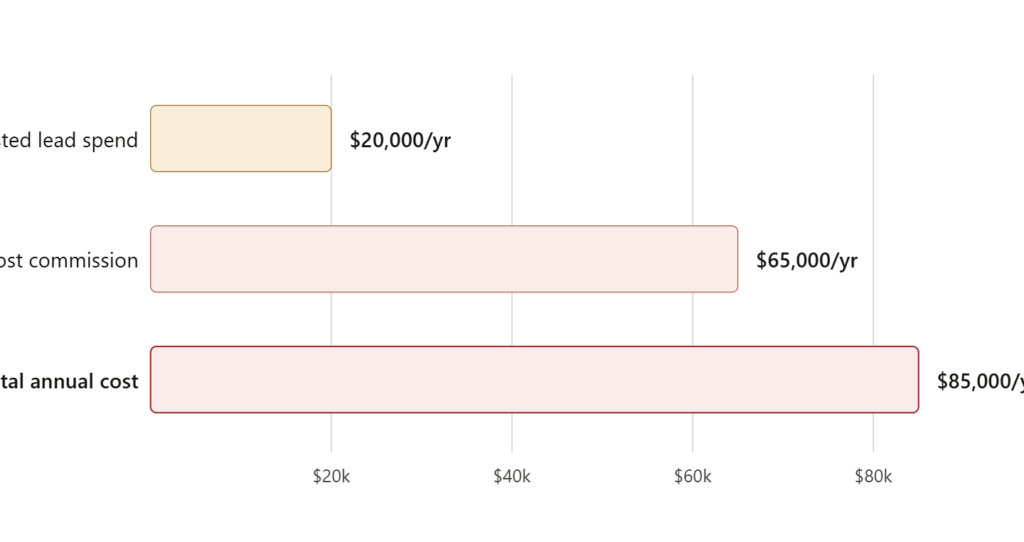
Consider a mid-sized team generating 40 portal leads a month at $250 per lead, or $10,000 in monthly lead spend. If 62% of those leads arrive after hours and the team’s average response time runs closer to 15 hours, a large share of those leads connect with a faster-responding agent before the team ever calls back.
At a typical buyer’s agent commission of roughly 2.75% on a $400,000 home, each converted lead is worth close to $11,000 in gross commission. Losing even six after-hours leads a month to slower response — a conservative estimate given the data — works out to over $65,000 a year in commission walking to someone else. That’s before accounting for the wasted ad spend on leads that never had a real chance to convert.
How This Plays Out in Practice
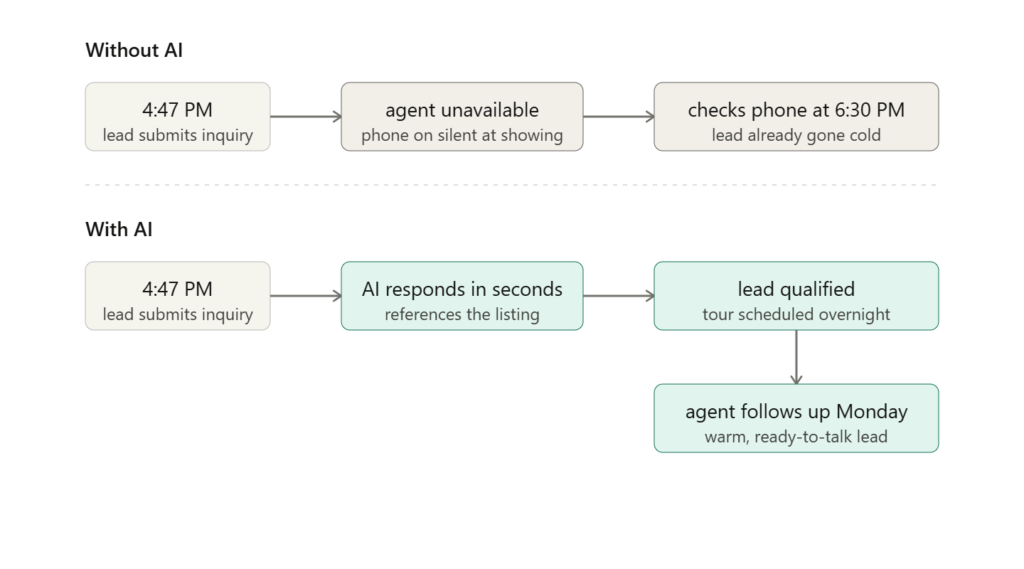
It’s a Saturday afternoon, and an agent is mid-showing for a three-bedroom townhouse in a suburban listing fifteen minutes outside the city. Her phone sits on silent in her bag. At 4:47 PM, a buyer browsing a competing listing on the same street submits an inquiry through a portal site, asking about financing options and availability for a weekend tour.
Without after-hours coverage, that lead waits. The agent doesn’t see the notification until she wraps up at 6:30, and by then the buyer has already messaged two other agents. One of them replied within four minutes. By Monday, the lead has scheduled a tour with someone else.
Now picture the same Saturday with an AI Inbound Lead Responder running in the background. The moment the inquiry comes in, the AI replies, references the exact listing, answers the financing question, and asks if the buyer would prefer a Saturday or Sunday tour. The agent finishes her showing, checks her phone, and finds a qualified, scheduled lead waiting instead of a missed opportunity. The difference isn’t effort. It’s infrastructure.
Why This Matters More in 2026 Than Ever
Buyer expectations have shifted permanently toward instant digital interaction, and real estate hasn’t caught up. Consumers now compare their experience inquiring about a home to ordering food delivery or booking a rideshare — instant, frictionless, and available at any hour.
This shift compounds the after-hours problem. As more inquiries originate from mobile browsing during evenings and weekends, the share of leads arriving outside business hours keeps climbing. NAR’s 2025 Profile of Home Buyers and Sellers found that 90% of buyers use online resources throughout their search, reinforcing that the buyer journey now happens primarily online, on the buyer’s own schedule.
Agents competing for the same shrinking pool of listings can no longer treat after-hours response as optional. The agents capturing market share in 2026 are the ones whose systems work whether or not they’re personally available.
Bottom Line
Most real estate leads arrive after hours, and most agents aren’t set up to respond fast enough when they do. The data is unambiguous: speed to lead determines who wins the relationship, and waiting until morning is no longer competitive. Closing that gap doesn’t require working nights and weekends. It requires a system built to respond the moment a lead comes in, regardless of the hour.
AxonEstate’s Inbound Lead Responder — see how it works. Or book a strategy call here to walk through your current lead flow and find where you’re losing leads after hours.
Frequently Asked Questions
Is it actually true that most real estate leads come in after hours?
Yes. Industry data consistently shows that around 60-62% of real estate inquiries arrive outside the traditional 9-to-5 window, with evenings and weekends seeing the heaviest volume. That’s when buyers are home from work and have time to browse listings.
What happens if I just use a regular autoresponder instead of AI?
A basic autoresponder confirms receipt but doesn’t actually engage the lead, which often creates a false sense of coverage. Leads who get a generic “thanks for reaching out” message still go on to contact other agents who respond with a real answer.
How fast does an AI agent actually respond compared to a human?
AI response is typically measured in seconds rather than hours, since there’s no inbox to check or schedule to clear. That speed matters because research shows a five-minute response makes you roughly 21 times more likely to qualify a lead than a 30-minute one.
Will an AI agent replace the relationship-building part of my job?
No. The AI handles the time-sensitive first response and qualification, then hands off a warm, qualified lead so you can focus on the parts of the job that require a human touch — building trust, negotiating, and closing.
Sources
- Real Estate Lead Response Statistics: 15 Numbers Every Agent Should Know in 2026 — AgentZap
- Why Real Estate Agents Lose Leads by Responding Too Slowly — Hyperleap
- Real Estate Lead Response Time: Tips & Data (2026) — Solvea
- After-Hours Lead Capture for Real Estate Agents — 215labs
- Real Estate Lead Response Time — Fyxer