Your phone buzzes, you miss it, you call back, and now it’s voicemail. That endless loop is exactly why every growing brokerage eventually needs a multi-channel follow-up system that works even when nobody picks up. According to Inman’s 2025 Real Estate Technology Survey, the average agent takes more than 15 hours to respond to a new lead. That’s plenty of time for the lead to call someone else instead.
Why Real Estate Follow-Up Breaks Down Without a Multi-Channel System
Most agents start with good intentions. A lead comes in, the agent calls, gets voicemail, and moves on. In practice, that single attempt quietly becomes the only attempt. Nothing else follows.
Because of this, promising leads go cold within days. Research from the National Sales Executive Association shows that 80% of sales require five or more follow-up contacts. However, 48% of agents never follow up after that first missed call. That gap is where deals quietly die.
Phone-only follow-up also depends on both people being reachable at the same moment. Sellers are at work, buyers are in meetings, and agents are out showing another property. Even so, every missed connection resets the clock and adds friction to a relationship that hasn’t even started.
Meanwhile, the lead hasn’t disappeared — they’ve simply moved on to whichever agent responded through a channel they actually check. In practice, a lead usually needs a text, an email, and a follow-up call spread across several days. That is exactly what a multi-channel follow-up system runs automatically. Without that structure, even a hardworking agent looks unresponsive, not because they don’t care, but specifically because their process only has one channel to work with.
What the Top Agents Actually Do
Consider Renee Castillo, who leads a five-agent team in Tampa, Florida. She juggles roughly 40 active buyer leads at any given time. Specifically, two years ago, her follow-up process looked like most agents’: call, leave a voicemail, add a sticky note, hope to remember tomorrow.
Today, that’s changed. Any lead who goes quiet after one call automatically gets a text within the hour, a follow-up email the next morning, and a second call attempt two days later. Every attempt is logged in one place, so Renee never wonders who she’s already contacted. She didn’t become more disciplined — instead, she built a multi-channel follow-up system that doesn’t need her discipline to function.
Contrast that with agents who still treat follow-up as a mental to-do list. In other words, a missed call becomes a missed opportunity because nothing else happens after it. The lead cools, the moment passes, and the agent never even learns a competitor scooped up the deal. Silence costs money.
The difference isn’t hustle. Renee doesn’t work more hours than before; she just stopped losing leads to silence. That single shift, from one channel to a coordinated sequence, makes the difference. It separates agents converting 2% of their online leads from agents converting closer to 8% or 9%, based on industry benchmarks for systematic follow-up.
The Research Behind a Multi-Channel Follow-Up System
The data on this topic is remarkably consistent. Research tied to MIT and InsideSales.com found that leads contacted within five minutes are 21 times more likely to qualify than leads reached after 30 minutes. This shows how quickly a phone-only approach starts losing ground.
On top of that, Zillow Group’s consumer research found that most buyers and sellers prefer a text over a phone call. Industry data also shows real estate texts get answered roughly four times more often than emails. That preference alone explains why a call-only strategy leaves so many leads unreached.
Beyond that, research connected to Real Trends and Tom Ferry adds another layer. A dormant lead represents $7,500 or more in lost potential commission. Reactivating that same contact through multiple channels, though, costs five to ten times less than generating a brand-new one. In other words, the research doesn’t just favor multi-channel outreach — it shows that skipping it is expensive.
How AI Solves Multi-Channel Follow-Up
This is exactly the gap an AI agent is built to close. Instead of relying on one person to remember every call, text, and email, the Database Reactivation Agent runs a structured sequence the moment a contact goes quiet.
Because it works across channels at once, it reaches people who screen calls but read texts, and people who ignore texts but open a well-timed email. As a result, fewer leads slip through simply because they preferred a channel the agent wasn’t using. This is why the follow-up process becomes a system rather than a memory test — the broader idea behind AxonEstate‘s approach to running an agent’s day-to-day workload.
In practice, the agent:
- Detects when a lead or past client hasn’t responded within a set window and triggers the next touchpoint automatically
- Sends personalized text messages referencing the specific property or conversation, not a generic check-in
- Follows an unanswered call with a same-day email summarizing what was discussed and what happens next
- Rotates contact channels across a multi-day sequence instead of repeating the same call that already failed
- Flags a warm reply immediately, so the agent steps into the conversation only once a lead re-engages
- Logs every attempt and reply on one timeline, so nothing depends on sticky notes or memory
Because of this, agents spend their time on conversations that are actually happening, not the ones they’re only hoping will happen.
The Real Cost of Getting This Wrong
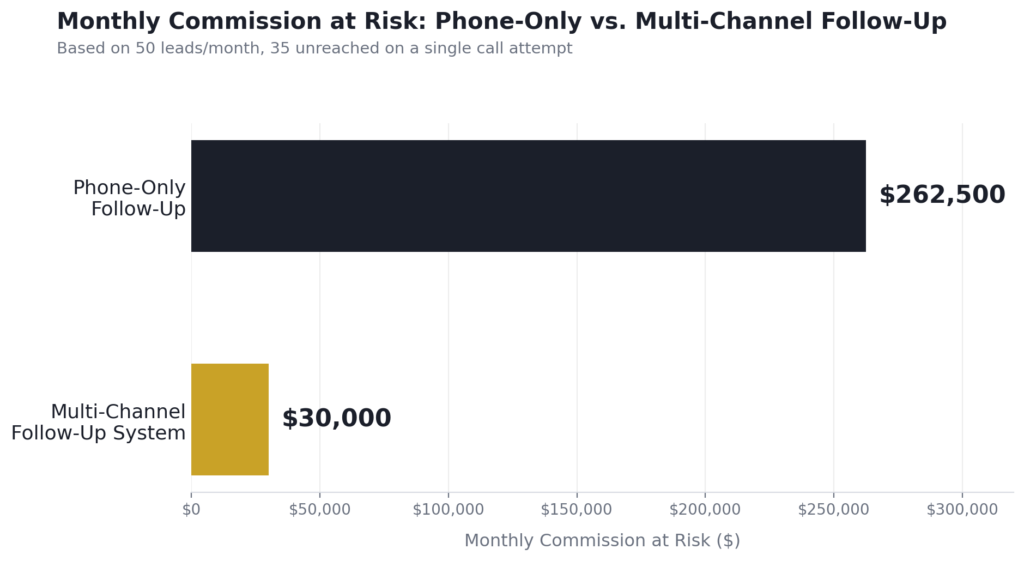
In practice, here’s what phone tag actually costs. Say an agent generates 50 online leads a month but only reaches 15 on the first call. That means 35 leads go unreached every month. Based on data showing each unreached lead represents roughly $7,500 in lost potential commission, that’s as much as $262,500 in commission potential missed monthly.
Even if only 10% of those unreached leads would have converted with proper follow-up, that’s still 3 to 4 closings walking away every month. At a typical $7,500 per deal, that’s $22,000 to $30,000 in gross commission income. Over a year, that’s a quarter-million dollars left on the table because nobody called back a second or third time. That’s real money, gone.
This is why phone tag isn’t just annoying. Specifically, it’s a direct, measurable drain on revenue that compounds every month a coordinated follow-up system isn’t in place.
How This Plays Out in Practice
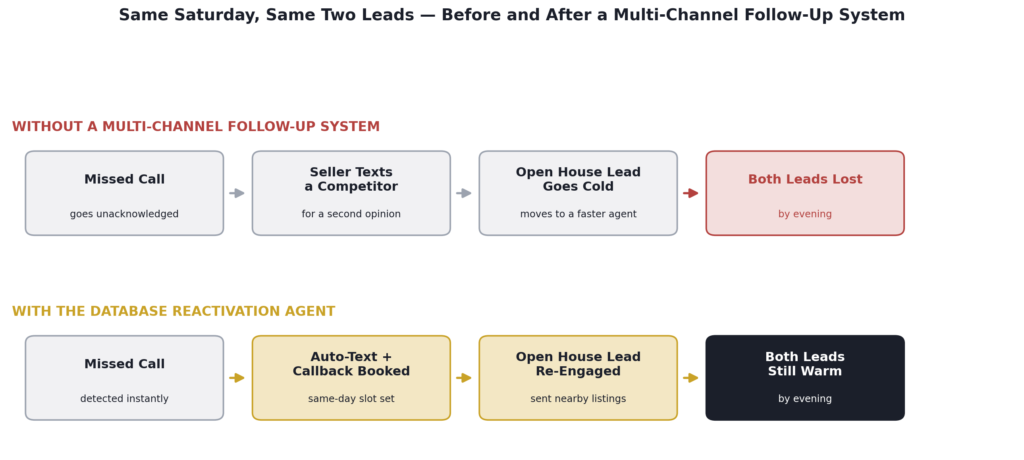
Picture a Saturday afternoon. An agent is walking a young couple through a three-bedroom bungalow in Riverside, phone on silent mid-showing. Meanwhile, a seller nearby texts asking about a price reduction, and a buyer from Thursday’s open house calls to ask if the home is still available. Two chances, both at once.
Without a system in place, both messages sit untouched until evening. As a result, the seller has already texted another agent for a second opinion. The open house buyer has moved on to a listing that responded faster. The agent learns about both missed chances hours later, once the moment that mattered has passed.
Now picture that same Saturday with a multi-channel follow-up system running in the background. The seller’s text triggers an instant acknowledgment and a same-day callback slot on the agent’s calendar. The open house buyer gets a text confirming the home is available, along with two nearby comparable listings. When the agent finishes the showing and checks her phone, both leads are still warm.
The property, the suburb, and the missed call are all completely ordinary. What changes is whether a quiet phone means a lost lead or only a delayed one.
Why This Matters More in 2026 Than Ever
Buyer and seller expectations have shifted fast. According to Inman’s research, 62% of real estate inquiries now arrive outside normal business hours — at dinner, during a showing, or overnight. That single stat explains why phone-only follow-up increasingly fails before it even starts. Timing keeps moving.
Beyond that, more consumers expect the same instant, multi-channel service they get from every other business. Think of a confirmation text from a delivery app, a chat reply from a retailer, or an email receipt within seconds. Real estate hasn’t caught up, and buyers notice the gap immediately when an agent goes quiet for a day.
This is why a strong follow-up system matters more in 2026 than it did a few years ago. Leads aren’t more impatient out of nowhere. Instead, they’re comparing every agent’s responsiveness against every other service they use daily. Agents who close that gap win the business; agents who don’t lose it to someone who does.
Bottom Line
Phone tag doesn’t mean your leads aren’t interested. Instead, it means your follow-up depends on a single channel that doesn’t always work.
A multi-channel follow-up system fixes that by meeting leads wherever they actually respond — call, text, or email — instead of hoping they pick up. That means the agents converting more of their pipeline aren’t working harder. They’ve just stopped losing leads to silence. That’s the whole shift.
If missed calls and cold leads are quietly costing your business commission every month, see how the Database Reactivation Agent — see how it works, or Book a strategy call here.
Frequently Asked Questions
How many times should I actually follow up with a real estate lead before giving up?
Most conversions happen between the fifth and twelfth contact, not the first or second. Specifically, give a lead at least seven to eight touches across calls, texts, and emails spread over a month. Giving up after one or two attempts is the single biggest reason agents lose leads they already paid for.
Is texting leads actually okay, or does it feel pushy?
Texting is one of the most preferred contact methods among today’s buyers and sellers. That’s true as long as messages stay specific and useful, rather than generic check-ins. In practice, a text referencing the exact property or question they asked about reads as helpful, not pushy.
What’s the difference between this and just setting reminders in my CRM?
Reminders still depend on you remembering to act and manually switching channels yourself. In contrast, a multi-channel follow-up system runs the sequence automatically, rotating between call, text, and email based on what’s already happened. That difference is what keeps leads warm during your busiest weeks, not just your slow ones.
Will an AI agent handling follow-up make me seem less personal to my clients?
Not when it’s set up well: the AI handles repetitive first-touch and reminder messages, then flags any real reply straight to you. This is why the actual conversation still stays personal. Finally, clients notice the faster response, not the system behind it.