Open house follow-up is one of the most valuable — and most wasted — opportunities in real estate. According to the National Association of Realtors, 92% of buyers use the internet during their home search, yet agents who meet them in person consistently fail to capitalise on the moment. Research from the Harvard Business Review found that companies contacting leads within one hour are nearly seven times more likely to qualify them than those who wait even 60 minutes longer. For real estate agents running weekend open houses, that window is ruthlessly short — and most let it close.
Why Open House Follow-Up Breaks Down Before Monday Morning
Saturday ends. You hosted 30 groups through a three-bedroom in the suburbs, answered questions about school catchments, parking, and the age of the roof — and you have a stack of sign-in sheets, a handful of business cards, and a phone that hasn’t stopped buzzing with other clients.
By Sunday evening, the energy from the day has faded. You’re preparing for a listing presentation Monday morning, and those open house contacts are sitting in a pile. According to Velocify’s lead response study, 35–50% of deals go to the vendor who responds first — yet most agents don’t send a single follow-up message until Tuesday at the earliest.
The problem isn’t motivation. It’s bandwidth. A single agent juggling multiple listings, buyer meetings, and admin simply cannot execute personalised open house follow-up across 20–30 contacts at the pace the market demands. So the window closes. Leads cool. Buyers call another agent who happened to be faster.
This isn’t a minor inefficiency. It’s a structural flaw in how most agents operate. And it compounds every single weekend.
What the Top Agents Actually Do
Consider Jordan Malik, a solo agent based in Austin, Texas, who runs two to three open houses every weekend across the city’s fast-moving suburbs. Two years ago, Jordan’s follow-up process was identical to most agents’: a bulk email blast sent Sunday night, a few personal calls Monday morning to the names he remembered most vividly, and then — nothing. His conversion rate from open house visitors to buyers sat under 4%.
After systematising his follow-up, Jordan’s conversion rate climbed to 11% within six months. The change wasn’t a new script. It was speed and segmentation. Visitors who expressed strong interest received a personal message within 90 minutes of leaving. Curious but uncommitted visitors entered a structured follow-up sequence that ran across multiple days. Neighbours who stopped in for a look were acknowledged and asked for referrals.
The contrast with agents who don’t prioritise this is stark. Agents without a structured open house follow-up process average one or two conversions per quarter from open house leads. Agents who respond within two hours and follow a multi-touch sequence convert three to four times more of the same traffic. The open house itself isn’t the variable. The follow-up is everything.
The Research Behind Open House Follow-Up Timing and Conversion
The data on follow-up timing is unambiguous. A study published in MIT’s Sloan Management Review found that the odds of contacting a lead drop dramatically after the first five minutes of inactivity — and continue falling sharply through the first hour. In real estate, where buyers are simultaneously browsing Zillow, attending multiple open houses, and speaking to competing agents, that drop-off is even steeper.
The NAR 2024 Profile of Home Buyers and Sellers reported that buyers now visit a median of eight properties before making an offer — meaning every open house contact is likely speaking to multiple agents. Speed of follow-up becomes a direct competitive differentiator, not a courtesy.
A Zillow Consumer Housing Trends Report found that 71% of buyers work with the first agent who responds to their enquiry. When that first response comes from the agent who met them at an open house, the relationship is already warmer — but only if contact happens before the lead moves on. Waiting 24 hours effectively resets the agent back to cold.
How AI Solves the Open House Follow-Up Problem
The core challenge isn’t knowing what to do — it’s doing it at speed, across every contact, every weekend, without burning out. This is precisely where AI changes the equation. The Open House Follow-Up Agent from AxonEstate is built specifically for this workflow — not as a generic CRM automation, but as an agent trained on real estate follow-up sequences that convert.
While the agent is still at the property or driving to the next appointment, the AI is already working through the sign-in list. Here’s what it does:
- Sends personalised follow-up messages to every visitor within 60 minutes of the open house closing — segmented by interest level captured at the door
- Asks specific qualifying questions: timeline, pre-approval status, whether they’re working with another agent, and what they liked or didn’t like about the property
- Flags hot leads to the agent in real time with a summary of the prospect’s responses, so the agent can step in with a direct call at exactly the right moment
- Runs a multi-day follow-up sequence for warm and cool leads, spacing messages appropriately to avoid inbox fatigue
- Captures feedback from visitors who weren’t interested in this specific property and feeds that into buyer-match recommendations for other listings
The result is that every open house visitor — not just the ones the agent happened to remember — receives a timely, relevant, personalised response.
The Real Cost of Getting This Wrong
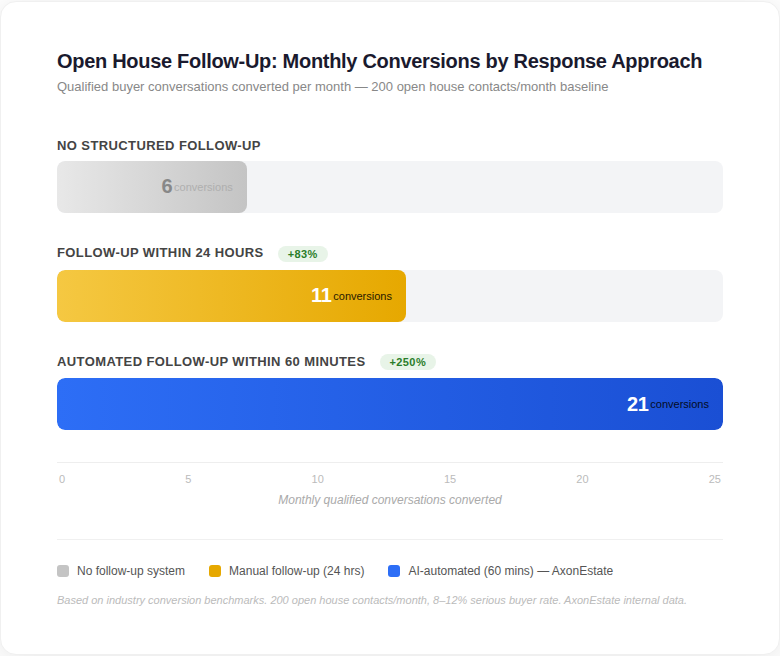
Here’s a concrete calculation. An agent hosts two open houses per weekend, attracting an average of 25 visitors each — 50 contacts per weekend, roughly 200 per month. Industry data suggests that 8–12% of open house visitors are serious buyers actively in the market. That’s 16–24 genuinely hot leads every month.
Without a structured follow-up process, an agent might convert 3–4% of total visitors — six to eight qualified conversations per month. With a same-day follow-up system driving conversion to 10–11%, that same traffic produces 20–22 converted conversations. The difference is 14–16 additional qualified buyer relationships per month.
At a median sale price of $850,000 and a typical commission of 2.5%, each closed transaction is worth approximately $21,250 in GCI. If even two of those additional relationships close in a quarter, that’s $42,500 in gross commission income the agent is currently leaving on the table — every quarter. Annually, the cost of poor open house follow-up for a typical active agent exceeds $150,000 in missed GCI.
How This Plays Out in Practice
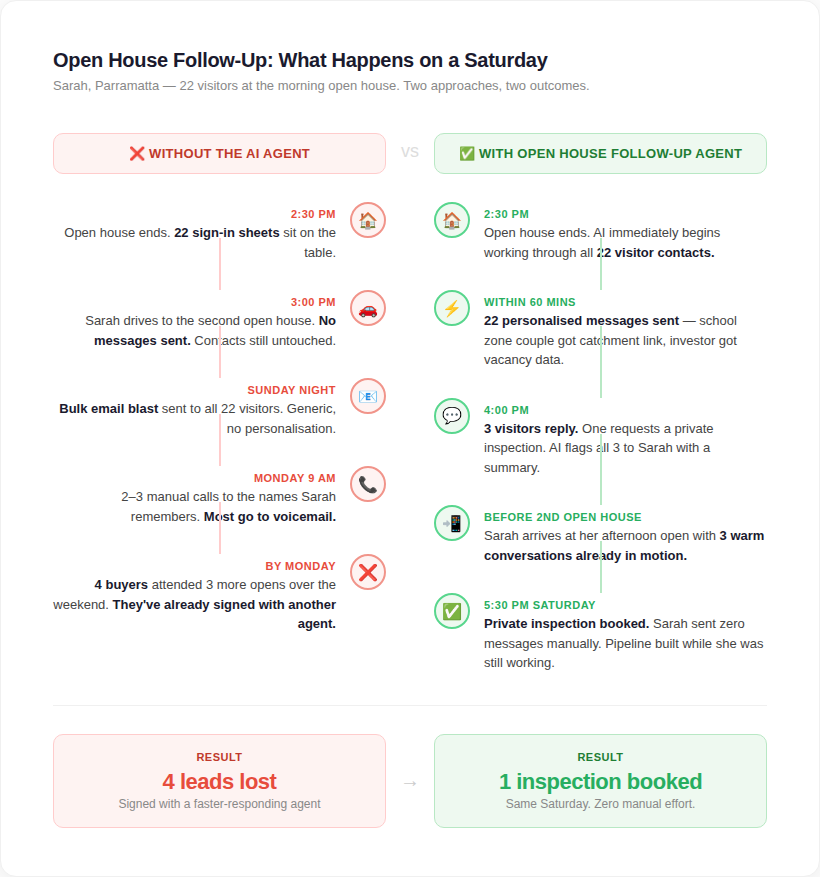
It’s 2:30pm on a Saturday. Sarah is an agent in Parramatta, running back-to-back opens across two properties — a renovated four-bedroom in a sought-after school zone and a two-bedroom apartment three streets away. Both have solid foot traffic. She’s talking to a young couple about the ensuite when her phone buzzes with another query about a separate listing. Without a follow-up system, the 22 sign-in sheets from the morning open house will sit untouched until Sunday night. By then, four of those buyers will have attended three more opens and signed with someone else.
With the Open House Follow-Up Agent running, the story changes immediately. As Sarah wraps the morning session, the AI has already sent a tailored message to every visitor. The couple who asked about the school zone received a message specifically referencing the catchment, with a link to the council map they requested. The investor who mentioned rental yields got a follow-up with suburb vacancy data. Three visitors responded within 90 minutes. One asked for a private inspection.
The AI flagged all three to Sarah with a priority summary waiting in her inbox before she arrived at the second property. Sarah walked into the afternoon session with three warm conversations already in motion — without sending a single message herself. That’s the practical difference between reactive and automated open house follow-up.
Why This Matters More in 2025 Than Ever
Buyer behaviour has shifted decisively toward speed and digital responsiveness. The CoreLogic 2024 Australian Buyer Survey found that 68% of active buyers describe “agent responsiveness” as a top-three factor in their decision to continue working with an agent — ahead of local market knowledge and negotiation reputation.
At the same time, the volume of open houses has increased as inventory in key markets recovers. More open houses mean more contacts, more sign-in sheets, and more follow-up work for the same number of agents. Without automation, the backlog compounds week after week.
Buyers in 2025 are also more likely to self-educate before attending an open house. They’ve already seen the listing, checked comparable sales, and know roughly what they’re willing to pay. When they walk through the door, they’re further along in the decision process than buyers were five years ago — which means the open house follow-up conversation is often the last step before commitment, not a preliminary touch. Agents who treat it as administrative afterthought are walking away from buyers who were almost ready to say yes.
Bottom Line
The lead is already warm when they walk out of your open house. The only question is whether you’re fast enough to keep it that way. Every hour of silence after that visit signals to the buyer that they’re not a priority — and in a market where agents are competing hard for the same pool of motivated buyers, that signal has consequences.
Speed, personalisation, and persistence across every visitor — not just the memorable ones — is what separates agents who convert open houses into closed deals from those who host them and wonder why the pipeline stays thin.
See how the Open House Follow-Up Agent works — and book a strategy call here to see it in action for your business.
Frequently Asked Questions
How quickly should I follow up with open house visitors?
Within 60–90 minutes of the open house closing is the gold standard. Research consistently shows that lead response rates drop sharply after the first hour. If you can’t follow up manually that fast, an automated system should handle the first contact while you’re still on-site.
What should I say in an open house follow-up message?
Reference something specific from the visit — a question they asked, a feature they commented on, or a concern they raised. Generic messages get ignored. Personalised messages get replies. If you captured their interest level or notes at the door, use that information in the first message.
How many times should I follow up if they don’t respond?
A minimum of five to seven touches across eight to ten days is standard for warm leads. Most agents give up after two. The data shows that a significant portion of conversions happen on the fourth or fifth contact — which means persistence, with appropriate spacing, directly impacts your close rate.
Is it worth following up with visitors who weren’t interested in that specific property?
Absolutely. A visitor who wasn’t right for that listing is still a buyer actively in the market. They’ve raised their hand. A follow-up that acknowledges the mismatch and offers to match them to something more suitable keeps the relationship alive — and positions you as the agent who listens, which is exactly how referrals and future transactions start.