The real estate agent AI workforce is no longer a futuristic concept — it’s already running inside the businesses of top-producing agents across North America. According to a Delta Media Group survey of major brokerages, over 87% of brokerages and agents are actively using real estate AI tools daily in 2026. But most agents are still using AI like a calculator — one task at a time. The agents pulling ahead are treating it differently. They’re building an entire AI workforce, one specialist at a time, until no critical role in their business goes unmanned. Ascendix
The Staffing Problem Every Solo Agent Knows Too Well
Running a real estate business as a solo agent means wearing every hat simultaneously. You’re the lead responder, the follow-up specialist, the listing coordinator, the market analyst, the database manager, and the compliance checker — all at once. That’s not a job description. That’s a breaking point.
The average real estate agent spends less than 30% of their time on dollar-productive activities such as showing properties, negotiating deals, and building client relationships. The other 70% disappears into administrative tasks, marketing, follow-ups, and data entry. Think about what that means in practice. For every 10-hour workday, only three hours are spent doing the work that actually earns commissions. Seven hours evaporate into the operational overhead of running a business that was never designed to be run by one person. Write
The old solution was to hire. A transaction coordinator here, an inside sales agent there, maybe a virtual assistant to handle follow-ups. Rising operational costs, shrinking commission margins, and soaring client expectations are pushing traditional models to their breaking points. Hiring staff solves the capacity problem but creates a new one: payroll, management time, training overhead, and the risk that your team’s performance is inconsistent. The staffing model that worked in a seller’s market no longer pencils out. Kleio
What the Top Agents Actually Do
The agents who consistently outperform their peers aren’t necessarily working more hours. They’ve redesigned their business around specialization — the same principle that drove the shift from generalist doctors to specialist surgeons. Instead of one person trying to do everything adequately, each function gets its own dedicated operator.
Consider Marcus Webb, a solo agent based in Scottsdale, Arizona, who runs a two-person operation with his partner. Marcus was consistently writing between 18 and 22 transactions per year — a solid number, but a ceiling he couldn’t break through without burning out or hiring aggressively. He began deploying AI agents one by one to handle specific roles: one for inbound lead response, one for database reactivation, one for open house follow-up, one for listing launches. Within eight months, his transaction volume climbed to 34 sides — without adding headcount.
The contrast with agents who haven’t made this shift is stark. Those agents are still manually texting leads at 9 PM after showings. They’re still letting database contacts go quiet for six months because there’s no bandwidth to follow up. Their listing launches still rely on one burst of activity and then silence. Meanwhile, agents like Marcus have a system where every function runs continuously, with zero gaps in coverage. The difference isn’t talent. It’s infrastructure.
The Research Behind the Real Estate Agent AI Workforce
Multiple research streams now confirm what early adopters already discovered — the real estate agent AI workforce isn’t optional for high-volume agents.
Real estate firms deploying AI agents have seen lead volumes surge by 300%, appointment conversions jump to over 40%, and significant cost savings. Those aren’t modest efficiency gains. They’re the kind of numbers that separate top producers from the rest of the market. GPTBots
The AI real estate market grew from $222.65 billion in 2024 to over $303 billion in 2025, and more than half of real estate agents now use AI-powered tools. That adoption curve is accelerating, not plateauing. A significant 85% of agents using AI report time savings, while 74% of property management companies now utilize AI for task automation. Beyond time, the financial case is equally clear: AI is projected to drive 38% of efficiency savings in real estate by 2030. MindStudioAll About AI
McKinsey’s analysis of agentic AI in real estate found that the biggest gains in automated workflows come from eliminating the “chasing work” around judgment moments — assembling context, drafting options within guardrails, routing to the right human, and executing the chosen path quickly and consistently. In other words, the highest-value role for an AI agent isn’t replacing human judgment. It’s clearing away every time-consuming task that surrounds the moment of human judgment so the agent can focus solely on the decision. McKinsey & Company
How AI Solves the Real Estate Agent AI Workforce Problem
The solution isn’t one AI tool that tries to do everything. That’s the same mistake as hiring one generalist assistant when you need 14 specialists. The solution is a dedicated AI agent for every distinct function in your business — each one trained and optimized for its specific role.
AxonEstate has built exactly that: a platform of 14 specialist AI agents, each covering a critical function in a real estate business. The agent that ties the entire operation together is the Daily Briefing Agent, which surfaces a consolidated, prioritized view of everything your AI workforce has done overnight — so you start each day knowing exactly where to focus your human attention.
The Daily Briefing Agent specifically:
- Compiles overnight lead activity across all inbound channels and flags the highest-priority contacts requiring a response
- Surfaces which database reactivation sequences generated replies, so hot conversations don’t sit unnoticed in a queue
- Reports on listing performance metrics from the previous day, including portal views, inquiry volume, and engagement trends
- Highlights any compliance or disclosure deadlines approaching within the next 72 hours
- Delivers a prioritized action list so the first 30 minutes of every workday drive revenue instead of triage
This is the operational hub of the AI workforce model. Without a daily briefing layer, 14 specialist agents produce 14 separate streams of information with no human-readable synthesis. With it, the entire system reports to you in one focused brief — and you walk into every day knowing exactly what your AI workforce accomplished while you slept.
The Real Cost of Getting This Wrong
Here’s what the gap actually costs when an agent tries to manage 14 roles manually — or leaves them unmanned entirely.
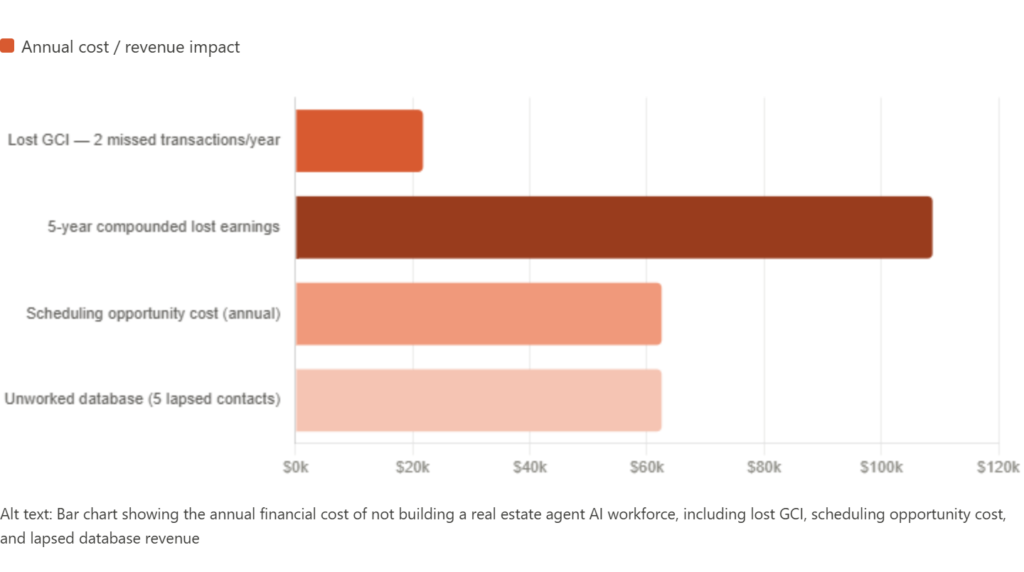
The average solo agent handles roughly 20 active contacts in their database at any given time who are within 90 days of a transaction decision. If just 5 of those contacts go quiet due to slow follow-up — which happens routinely without automated systems — and each represents a potential $500,000 sale at a 2.5% commission, that’s $62,500 in potential GCI sitting unworked. The average real estate agent spends 10 to 15 hours per week on scheduling alone — 500 to 750 hours per year that could go toward revenue-generating activities. At an agent’s effective hourly rate of $100 in productive time, that’s $50,000 to $75,000 in opportunity cost from scheduling alone — before accounting for the leads never followed up, the listings never properly launched, and the database contacts who quietly listed with a competitor. MindStudio
The math compounds fast. An agent losing just two transactions per year to follow-up failure — at a median sale price of $435,000 — is walking away from $21,750 in gross commission income annually. Over five years, that’s more than $100,000 in lost earnings. That’s not the cost of not hiring an assistant. That’s the cost of not building the right system.
How This Plays Out in Practice
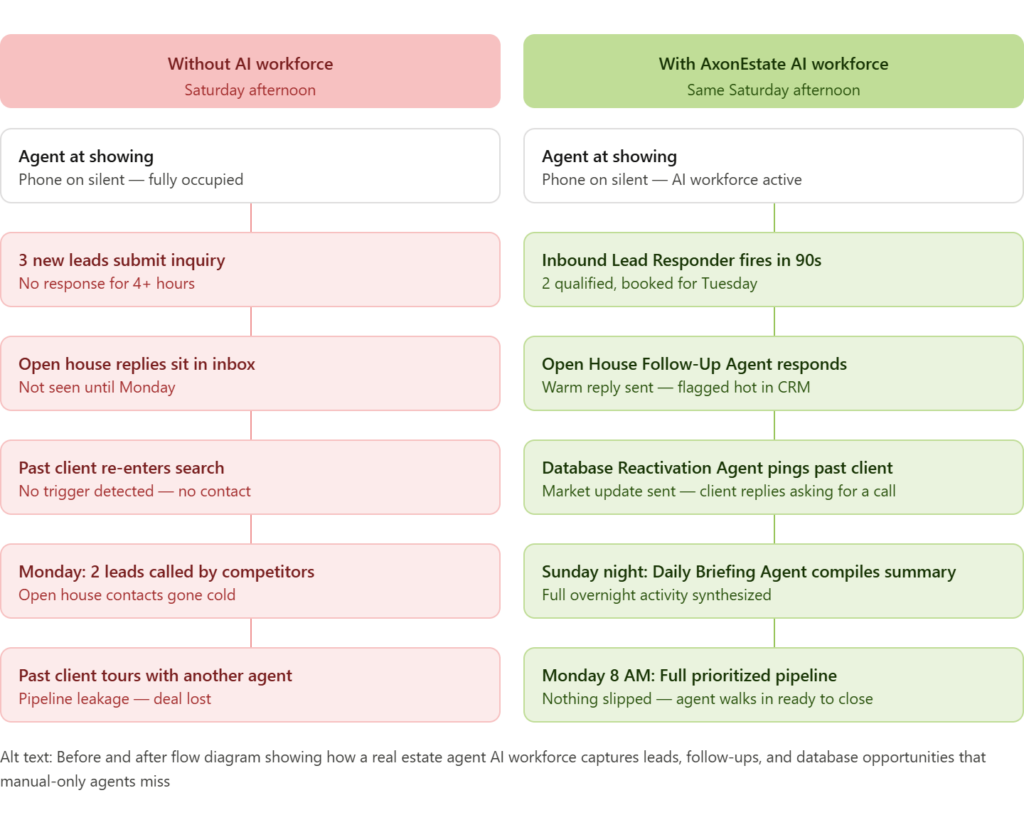
It’s Saturday afternoon. Your phone is on silent. You’re mid-walkthrough on a $680,000 craftsman in Plano, Texas — the buyers are emotional, they’re asking good questions, and this is the moment that requires your full attention.
Without an AI workforce, here’s what’s happening in the background: three new leads from your Zillow listing just filled out a contact form and haven’t received a response. Two open house attendees from last Sunday sent replies to your follow-up but their messages are buried in your inbox. A past client in your database just re-entered the search phase — you have no idea because nobody’s watching. By Monday morning, the new leads have already been called by two competing agents. The open house replies have gone cold. The past client is now touring homes with someone else.
With your AxonEstate AI workforce running, the picture is entirely different. The Inbound Lead Responder automatically engages all three new contacts within 90 seconds, qualifies their timeline and budget, and books the two serious prospects directly into your calendar for Tuesday. The Open House Follow-Up Agent surfaces the two inbox replies, sends a warm response, and flags them as hot in your CRM. The Database Reactivation Agent has already pinged the re-entering past client with a relevant market update — and they’ve replied asking for a call. You finish the Saturday walkthrough, you make an offer on Monday morning, and your Daily Briefing Agent hands you a clean summary of everything that happened while you were focused on your buyers. Nothing slipped.
Why This Matters More in 2025 Than Ever
Buyer and seller expectations have fundamentally shifted. Responsiveness — once a differentiator — is now a baseline. A lead who submits an inquiry and waits four hours for a response doesn’t wait patiently. They move to the next agent on the list.
A January 2026 report analyzed by HousingWire found that 90% of real estate AI investment in 2025 was driven by three priorities: efficiency, insights, and personalization. That tells you where the market is heading. Clients now expect the kind of immediate, tailored communication that was previously only possible at scale with a large team. At the same time, commission structures are under pressure and operational costs are rising — making it harder than ever to justify the payroll that would previously have delivered that experience. MoxiWorks
The agents who build their AI workforce now are setting a service standard that manual-only agents simply cannot match. Not because AI is faster than humans — though it is — but because it never sleeps, never gets overloaded, and never drops a follow-up because it had a busy Saturday.
Bottom Line
Running 14 specialized roles in your real estate business is no longer contingent on having a team of 14 people. The real estate agent AI workforce model replaces that headcount with specialist agents — each one running a specific function, continuously, without gaps. The result is a business that responds faster, follows up consistently, and captures deals that would otherwise slip through the cracks of a manually managed operation.
The agents winning right now aren’t necessarily the best negotiators or the most experienced in their market. They’re the ones who built the best infrastructure. That infrastructure starts with deploying the right agents and ends with knowing, every single morning, exactly what your system accomplished.
Explore the Daily Briefing Agent — see how it works. Ready to build your full AI workforce? Book a strategy call here.
Frequently Asked Questions
Do I need to be tech-savvy to run 14 AI agents in my real estate business?
No. Platforms like AxonEstate are designed specifically for real estate professionals, not software developers. The agents are pre-built for real estate workflows — you configure them to your business once, and they run automatically from that point forward.
Will AI agents replace the personal relationship I have with my clients?
No — and that’s the point. AI agents handle the operational tasks so you have more time for the relationship work that actually requires a human: negotiations, in-person meetings, emotional support during stressful transactions. The AI workforce handles follow-up volume; you handle the conversations that matter most.
How is a specialist AI agent different from a general AI tool like ChatGPT?
A general AI tool responds when you ask it something. A specialist AI agent runs continuously in the background, monitoring triggers, taking actions, and reporting outcomes — without you having to prompt it. Each AxonEstate agent is trained on specific real estate workflows, which means it executes tasks at a level a generic tool can’t replicate.
What happens if an AI agent makes a mistake or sends the wrong message?
AxonEstate agents operate within guardrails you set during configuration, and all communications are tied to templates you approve. If a response or action falls outside expected parameters, the agent flags it for your review rather than acting unilaterally. Your Daily Briefing Agent surfaces any anomalies each morning so nothing goes unnoticed.
Sources
- Over 87% of Agents Now Use AI Daily — AscendixRE / Delta Media
- AI for Real Estate Agents: 5 Workflows — GPTBots
- 10 AI Agents for Real Estate Professionals — MindStudio
- AI Statistics In Real Estate for 2025 — AllAboutAI
- How Agentic AI Can Reshape Real Estate’s Operating Model — McKinsey
- AI Tools for Real Estate: 10 Marketing Automation Workflows — Write.Homes
- The Best AI Tools for Real Estate Agents 2026 — MoxiWorks