Most agents experimenting with real estate AI workflows are making a critical mistake — they’re automating activity without changing outcomes. According to a 2024 survey by the National Association of Realtors, more than half of all agents now use at least one AI tool in their business, yet conversion rates across the industry remain stubbornly flat. The tools are spreading fast. The results aren’t. This article breaks down exactly why — and reveals the three workflows top-producing agents are building instead.
Why Real Estate AI Workflows Are Failing Most Agents
AI in real estate looks impressive on the surface. Instant replies, automated drip sequences, chatbots on listing pages — the technology is genuinely remarkable. However, most agents are using these tools to patch over the same broken processes rather than rebuild them. That distinction matters more than any feature comparison.
The core issue is workflow design. An AI tool that sends a canned reply at 2 AM does not qualify a buyer. A chatbot that captures a name and email does not know whether that person has a mortgage pre-approval or is simply browsing. Most tools handle the easy part — the initial touchpoint — and then leave the agent exactly where they started: staring at an unqualified lead with no clear next step.
According to Salesforce’s State of Sales report, 44% of salespeople give up after a single follow-up attempt. In real estate, that number skews even higher because agents are pulled in multiple directions at once — listings, showings, negotiations, admin work. Follow-up falls through the cracks not because agents don’t care, but because their system doesn’t support them.
For most agents, the result is a growing list of leads they mean to call — and a growing suspicion that AI isn’t working. It isn’t the AI. It’s the workflow.
What the Top Agents Actually Do
The agents consistently closing deals with AI are not using more tools than their competitors. They’re using fewer tools, in a more deliberate sequence. That difference in approach is everything.
Consider Sarah Chen, a solo agent based in Austin, Texas, who runs a small team of two buyer’s agents. Before restructuring her process, Sarah responded to online leads whenever she had time — which, most days, meant hours after the initial inquiry came in. Her close rate from inbound sources was around 4%.
Sarah didn’t add more software. Instead, she rebuilt her follow-up process around three specific workflows: an instant response workflow that engaged every lead within 90 seconds, a qualification workflow that filtered out unserious inquiries before she spent any time on them, and a nurture workflow that followed up with undecided leads automatically over 30 days. Within three months, her close rate from the same lead sources jumped to 11%. Same leads. Different workflow.
In contrast, her colleague at the same brokerage adopted six new AI tools over the same period. He now uses them to write listing descriptions and generate social captions. His conversion rate hasn’t moved. The tools are more impressive. The results are not.
The difference isn’t sophistication. Top agents focus their AI on the highest-leverage moment in the sales cycle — which is almost always the first five minutes after a lead comes in. Everything else is secondary.
The Research Behind Real Estate AI Workflows
The data on real estate AI workflows is clear and consistent across multiple independent studies. In a landmark analysis published in the Harvard Business Review, researchers found that the probability of contacting a lead drops by more than ten times if you wait longer than one hour after initial inquiry. Firms that responded within five minutes were nine times more likely to reach the prospect at all.
A separate analysis by the National Association of Realtors found that the majority of buyers and sellers contact only one agent before committing to a relationship. That means whoever responds first holds a structural advantage — regardless of experience, marketing budget, or brand recognition.
Additionally, Salesforce’s State of Sales research found that high-performing sales teams are 2.3 times more likely to use AI for lead prioritization than average performers. Speed and sequence — not sophistication — are the variables that separate top producers from everyone else. These findings don’t just apply to SaaS companies or call centres. They directly explain the performance gap sitting inside every real estate team right now.
How AI Solves the Real Estate AI Workflow Problem
Understanding the problem is half the battle. The other half is building the right system to solve it.
The Inbound Lead Responder from AxonEstate was built specifically for the highest-leverage moment in the sales cycle — the first five minutes after a lead comes in. Instead of relying on an agent to check their phone at exactly the right time, this agent runs automatically, 24 hours a day, seven days a week.
Here’s what it specifically does:
- Responds to every new inbound lead within 90 seconds, regardless of the time of day or night
- Sends a personalised first message referencing the specific property or search that triggered the inquiry
- Asks two targeted pre-qualification questions to determine buying timeline and finance status
- Routes hot leads to the agent’s phone via SMS with a full lead summary before the agent says a word
- Books a callback or consultation directly into the agent’s calendar without requiring any agent involvement
- Logs every interaction to the CRM so the agent has complete context before their first live conversation
This isn’t generic automation. It’s a structured workflow built around the specific moment where most real estate deals are won or lost. The Inbound Lead Responder handles what most agents physically cannot — being present and responsive at 11 PM on a Tuesday.
The Real Cost of Getting This Wrong
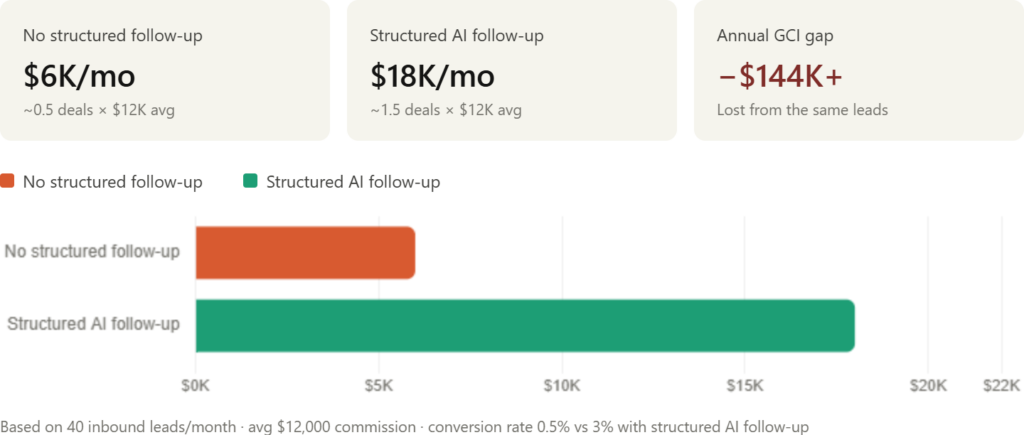
Let’s make this concrete with real numbers. Say you generate 40 inbound leads per month from your website, portals, and social channels. Industry average conversion from lead to closed deal sits at roughly 0.5% to 1% for agents without structured follow-up. At best, that means you close half a deal per month from those 40 leads.
Now apply the research. Agents with fast, structured follow-up — responding within five minutes and following up at least five times — convert at 3% to 5% from the same lead volume. Suddenly, those same 40 leads produce one to two closed deals per month.
At an average commission of $12,000, the gap between those two outcomes is $12,000 to $18,000 every single month. Over a full year, that’s $144,000 to $216,000 in lost GCI — from the exact same lead sources, with the exact same marketing spend.
Most agents never see this number because they measure the leads they close, not the leads they lose. That invisible cost is where the majority of an agent’s income quietly disappears — not because of bad leads, but because of a broken first-response workflow.
How This Plays Out in Practice
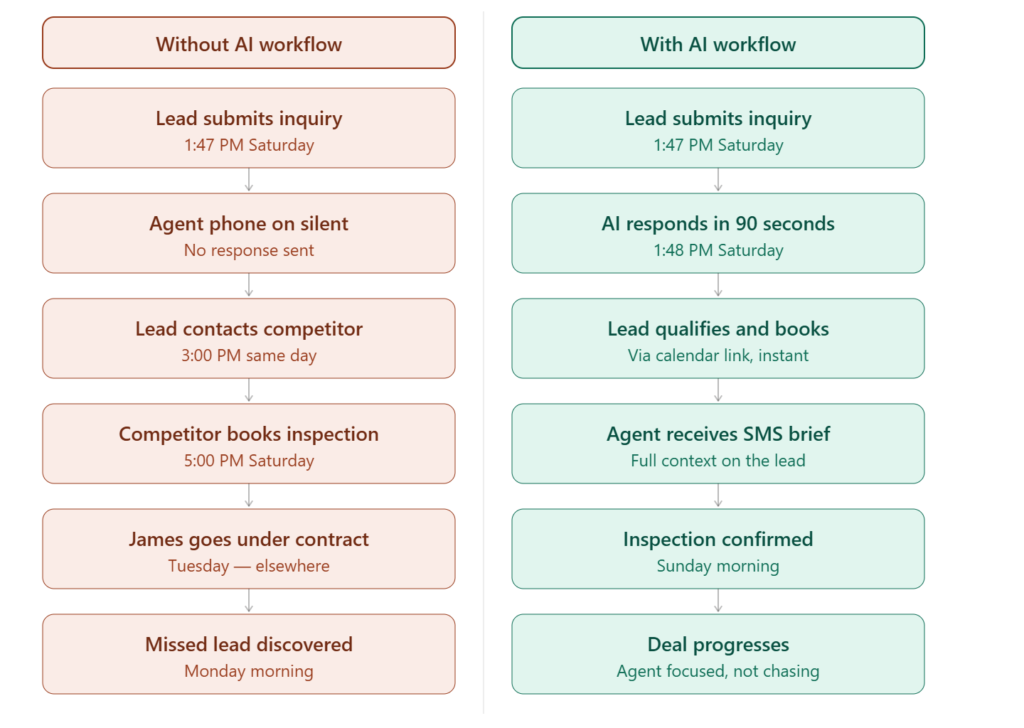
Here’s a real scenario. It’s Saturday at 1:47 PM. A buyer named James submits an inquiry on your three-bedroom townhouse listing in Northcote. He’s already pre-approved, he’s been actively searching for two months, and he’s asking to inspect the property this weekend. Your phone is on silent. You’re mid-showing at another property across town.
Without a structured system, James gets nothing — no acknowledgement, no reply, no next step. By 3 PM, he’s submitted the same inquiry through a competitor’s listing. By 5 PM, another agent has already booked his inspection. By Tuesday, James is under contract with someone else. You never even knew he existed until you finally checked your inbox Monday morning.
Now run the same scenario with the Inbound Lead Responder active. At 1:47 PM, the agent responds to James within 90 seconds. It acknowledges his inquiry, confirms the property details, and asks about his preferred inspection time. James books a Sunday morning slot through a calendar link. The system then sends you a live summary — James’s name, finance status, inspection preference, and a direct link to confirm. You finish your showing, glance at the notification, and see a pre-qualified buyer with a Sunday appointment already locked in.
Same lead. Same timing. Completely different outcome. This is exactly what real estate AI workflows look like when they’re designed around the right moment instead of the most convenient one.
Why This Matters More in 2025 Than Ever
The real estate market in 2025 is structurally different from even two years ago. Higher interest rates have reduced the total volume of active buyers, which means fewer leads are entering the market — and the leads that do come in carry significantly more weight. Missing one is no longer a minor setback. It’s a meaningful financial loss.
At the same time, buyer expectations have shifted dramatically. According to Zillow’s 2024 Consumer Housing Trends Report, more than 70% of buyers now expect a response from an agent within one hour of reaching out. However, the industry average response time remains measured in hours, not minutes. That gap is widening, not narrowing.
In this environment, agents who implement structured real estate AI workflows gain a compounding advantage over time. As competitors continue relying on manual follow-up, agents with reliable automated systems convert more from the same shrinking market. The window to build that advantage is right now — before fast response time becomes the universal baseline expectation rather than the exception that wins business.
Bottom Line
Real estate AI workflows don’t fail because the technology isn’t good enough. They fail because most agents layer automation on top of broken processes and expect different results. That produces more automated activity — not more closed deals.
The agents closing deals with AI share one approach: they’ve focused their automation on the highest-leverage moments in the sales cycle, particularly the first five minutes after a lead arrives.
If you want to close more deals from the leads you’re already generating, start there. Check out the Inbound Lead Responder — see how it works. Or Book a strategy call here to walk through your current setup and identify exactly where leads are falling through the gaps.
Frequently Asked Questions
Do I need a big team to use AI workflows effectively?
No. Solo agents often benefit most because they have no backup when leads come in outside business hours. AI handles the immediate response so you never lose a lead to slow reaction time, regardless of team size.
What’s the difference between AI automation and an AI workflow?
Automation sends a message. A workflow guides a lead through a deliberate sequence of steps — response, qualification, booking, follow-up — with logic built in at each stage. Automation is a tactic; a workflow is a system. The results are very different.
Will buyers know they’re talking to an AI?
The Inbound Lead Responder is designed to engage leads naturally and hand off to the agent before the conversation becomes complex. Most initial inquiries don’t require a human — they require a fast, relevant reply. The handoff happens before the buyer ever needs to know the difference.
How quickly can I get this set up?
Most AxonEstate agents are fully configured and live within one business day. There’s no code involved and no technical expertise required. You connect your lead sources, set your preferences, and the system handles the rest.