Your real estate CRM database is sitting on more closed deals than your next ad campaign ever will. NAR’s 2025 Member Profile found that veteran agents earn 68% of their business from repeat clients and referrals. That business is already sitting in a contact list. Most agents never mine it, choosing instead to buy new leads while the old ones go cold.
Why Your Real Estate CRM Database Becomes a Graveyard
Every agent starts strong. A new lead comes in, gets a warm call, and lands a note in the CRM. Then life happens.
A showing runs long, an offer falls through, and the follow-up task sits untouched for a week. That week turns into a year. This pattern is brutally common: Deal Machine OS found that 48% of agents never follow up with a lead at all.
Most buying decisions take five to twelve touches before a prospect commits. Yet most agents stop after two attempts, according to HousingWire’s analysis of agent follow-up habits. The result is a real estate CRM database stacked with abandoned conversations, each one a person who once trusted you enough to share their contact information.
Many of those people are still out there, still planning a move, still waiting for someone to check in. Instead, they get a holiday card once a year and nothing else. Database rot compounds quietly, because new leads pile on top of old ones and tags go stale. Eventually the list becomes too overwhelming to work by hand, so agents stop trying.
That decision is backward. Every contact already cost time or money to acquire. Letting that investment sit untouched is the most expensive habit in the business. Even so, most agents wait until the list feels chaotic before doing anything about it.
What the Top Agents Actually Do
Elena Cruz runs a four-person team out of Tampa, Florida, with roughly 1,400 contacts in her CRM. Two years ago, her database looked like everyone else’s. It was a junk drawer of old leads, past clients, and open house sign-ins nobody had touched in months.
Elena changed one habit: every contact untouched for ninety days got a short, personal check-in instead of a blast email. “Still thinking about that move to the Westshore area?” That single habit now produces close to a third of her annual closings. For example, a contact with an ending lease got one check-in text and signed a buyer agreement two months later.
Compare that to most agents, who treat their database as a graveyard rather than a garden. They add contacts constantly but rarely circle back. A lead goes quiet for six months, and the agent assumes the relationship is dead.
In reality, the prospect’s circumstances probably just changed — a new job, a baby, a lease renewal they’re dreading. Without a system tracking those shifts, the agent never finds out. By then, a competitor’s sign is already up on the lawn. Specifically, the agent loses not just one commission, but the referrals that client would have sent for years afterward.
The Research Behind Real Estate CRM Database Reactivation
The data backs up what top producers already know. NAR research cited by Digital Maverick found that 64% of buyers and sellers worked with an agent they had used before, or one a friend had referred. That single number explains why repeat and referral business consistently outperforms cold prospecting. As a result, the smartest agents spend more time deepening existing relationships than chasing brand-new strangers.
Timing matters just as much as relationships. Industry research shows only 8% of prospects act within 30 days of first contact, while 27% convert within two to three months. That leaves roughly 65% of potential business requiring patient nurturing that most agents abandon too soon.
CRM adoption itself moves the needle, too. Agents who use a CRM consistently see meaningfully higher conversion rates than agents working from memory, according to Deal Machine OS’s 2026 benchmark report. Specifically, the pattern across every source is the same: the business is already there, waiting on a system that won’t let it go cold. Unlike paid traffic, a database already contains people who know, like, and trust the agent.
How AI Solves Real Estate CRM Database Overload
Knowing the data is one thing. Acting on it across hundreds or thousands of contacts is another problem. No agent has time to manually sort a real estate CRM database with a thousand entries. That gap is exactly what AI was built to close.
The Database Reactivation Agent from AxonEstate works through that backlog automatically. Instead of an agent guessing which contacts are warm, it scores every record and surfaces the ones most likely to be ready. As a result, the database keeps working even on days an agent is buried in showings.
Specifically, the agent:
- Scans every contact in the database and scores reactivation likelihood based on time since last contact, prior search activity, and life-event signals
- Sends personalized text and email outreach that reintroduces the agent and asks a low-pressure timeline question instead of a generic “checking in”
- Flags any contact who replies with buying or selling intent and builds a task with the full conversation history attached
- Runs automatic anniversary and seasonal touches, including home-purchase anniversaries and listing-expiration windows
- Surfaces signals such as a past client’s home appearing on another agent’s listing, prompting an immediate personal check-in
- Updates every contact’s status and tags directly inside the existing CRM, so nothing gets duplicated
That last point matters most. The system works inside the tools an agent already uses, not instead of them. Beyond that, the broader AxonEstate platform connects this agent to the rest of an agent’s workflow, so a reactivated lead flows straight into nurture sequences without a manual handoff.
The Real Cost of Getting This Wrong
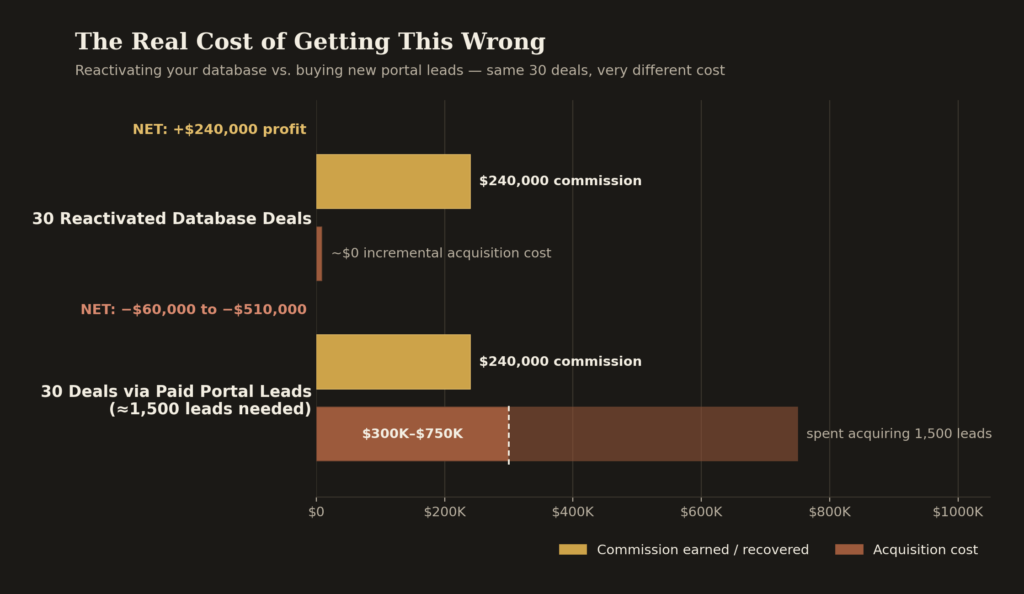
Picture a mid-sized team with 600 contacts sitting untouched in their CRM: past clients, expired leads, and abandoned inquiries from the last three years. If just 5% of that list is ready to transact this year, a conservative estimate, that’s 30 deals sitting dormant. In other words, that’s not a pool of strangers — these are people who already picked up the phone once before.
At a typical commission of $8,000 per closed transaction, those 30 ignored deals represent $240,000 walking out the door. That figure doesn’t even include the referrals those clients would have sent if someone had stayed in touch. Finally, multiply that gap across a four-person team, and the number stops looking like a rounding error.
Compare that to the cost of acquiring 30 new leads through paid portals. Conversion rates there often sit below 2%, and individual leads can cost $200 to $500 each. An agent would need roughly 1,500 fresh leads to match the 30 deals already sitting, ignored, in their own database. On top of that, referral leads from happy past clients convert at 15% to 50%, far higher than anything a portal delivers.
How This Plays Out in Practice
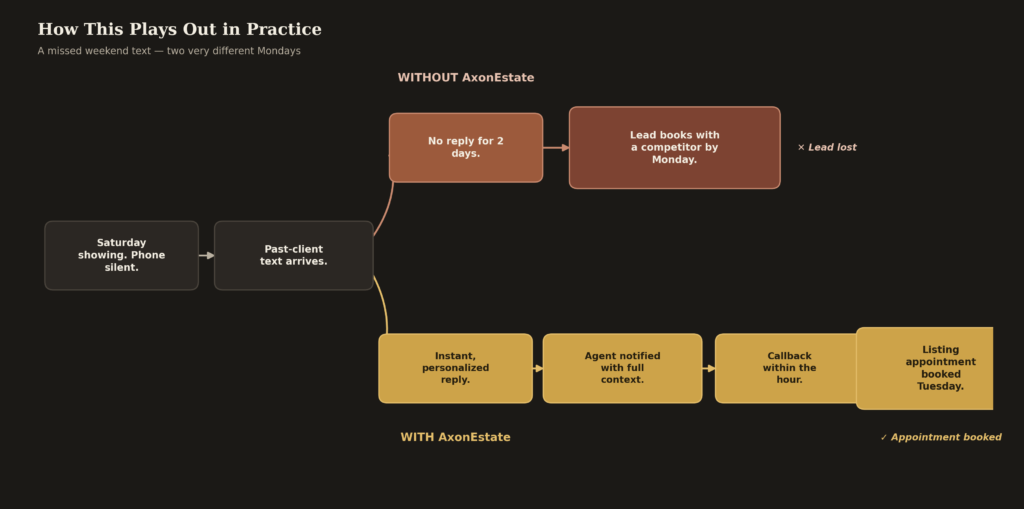
It’s a Saturday afternoon. An agent is mid-showing on a three-bedroom townhome in a quiet suburb, phone on silent in her bag. Without a reactivation system, a past client from four years ago texts asking about the market.
That text gets no reply for two days. By Monday morning, the contact has booked a listing appointment with someone else. With the Database Reactivation Agent running, that same Saturday looks different.
The past client’s text triggers an instant response referencing their original purchase and the current value of homes in their neighborhood. The agent gets a notification the moment the conversation turns toward listing, with full context already attached. By the time she finishes her showing, there’s no scramble to remember who this contact is.
The conversation history, property details, and a suggested next step are already waiting. She calls back within the hour and books the listing appointment for Tuesday. That gap, between a text going unanswered and a text being handled instantly, is where deals are won or lost. Meanwhile, the rest of her database keeps getting worked quietly in the background, all weekend, without her lifting a finger.
Why This Matters More in 2026 Than Ever
Buyer and seller expectations keep climbing every year. NAR’s 2025 Profile of Home Buyers and Sellers found that 88% of buyers still purchased through an agent, and most interviewed only one before choosing who to work with. Trust and familiarity, not comparison shopping, decide who gets the call.
That dynamic makes an existing real estate CRM database more valuable than ever. Buyers and sellers increasingly expect their agent to remember them and respond the moment they reach out. A slow or forgotten follow-up doesn’t just lose one deal anymore; it pushes that contact toward whichever competitor responds first. Beyond that, younger buyers in particular expect a level of responsiveness closer to a retail experience than a traditional transaction.
At the same time, lead costs on every paid channel keep rising, while conversion rates on cold traffic keep falling. Agents who lean on their existing database instead of chasing strangers are simply running a leaner business. That efficiency compounds with every year the database keeps growing.
Bottom Line
A real estate CRM database is not dead weight. It’s the most undervalued asset most agents own, sitting untouched while they chase new leads at a premium price.
In practice, the agents pulling ahead in 2026 aren’t working harder. They’re simply refusing to let a contact go cold, using AI to do it at a scale no human assistant could match. More importantly, that shift just means working what’s already paid for.
Ready to see what’s hiding in your own list? Database Reactivation Agent — see how it works, or book a strategy call here to walk through your database with the AxonEstate team.
Frequently Asked Questions
Will this annoy my past clients with too many messages?
No. The agent paces outreach around relevant triggers like anniversaries, listing windows, and life-event signals instead of blasting the whole list at once. Messages stay personalized and low-pressure, the opposite of a generic mass email.
Does this work with my existing CRM, or do I have to switch systems?
It works inside the CRM you already use. The agent updates statuses and tags directly in your existing database instead of forcing a migration to a new platform.
How long before I see leads coming back from old contacts?
Most teams see the first replies within a couple of weeks, since the agent prioritizes contacts already showing reactivation signals. Full results build over several months as it works through the entire database.
What happens when a reactivated contact actually wants to talk to me?
You get an immediate notification with the full conversation history attached, so you can pick up the conversation as if you never stopped talking to them.
Sources
- Income Steady, Even as Market Slows: 2025 Member Trends — NAR
- 75+ Real Estate Lead Generation Statistics (2026) — Deal Machine OS
- Getting Leads but Not Closing, Your Real Estate Follow-Up Is the Leak — HousingWire
- Real Estate Lead Follow Up: 6 Proven Rules for Massive Success — Digital Maverick
- 88% of Home Buyers Still Rely on Agents, NAR 2025 Report Finds — BAM
- How to Stop Losing Property Leads with a Powerful CRM — TechImplement
- Real Estate Referral Networks: For Agents and Brokers — AgentsGather