Every real estate agent has a database. Most agents have a good one — names, numbers, email addresses, transaction history, notes from conversations years ago. They built it over time, transaction by transaction, open house by open house.
And then they mostly ignore it.
Not on purpose. It just happens. New leads come in, paid campaigns need attention, listings need marketing. The database — the people who already know and trust you — gets a Christmas card once a year if they’re lucky.
Here’s what’s sitting in that ignored list: your next 3 listings. And here’s why real estate database reactivation deserves a permanent spot on your calendar.
The Math Nobody Wants to Face
Recent research from the National Association of Realtors found that 66% of recent sellers used an agent who was either referred to them or who they had worked with before. Half of all sellers used the same agent for both their purchase and sale, and that figure climbs to 71% when the seller stays within 10 miles of where they bought. BnarBnar
Let’s put that in plain terms: the majority of your past clients will happily use you again — or send you a referral — if you stay on their radar. Most haven’t heard from you in over a year.
This is not a lead generation problem. It’s a follow-up problem. And real estate database reactivation is extremely fixable.
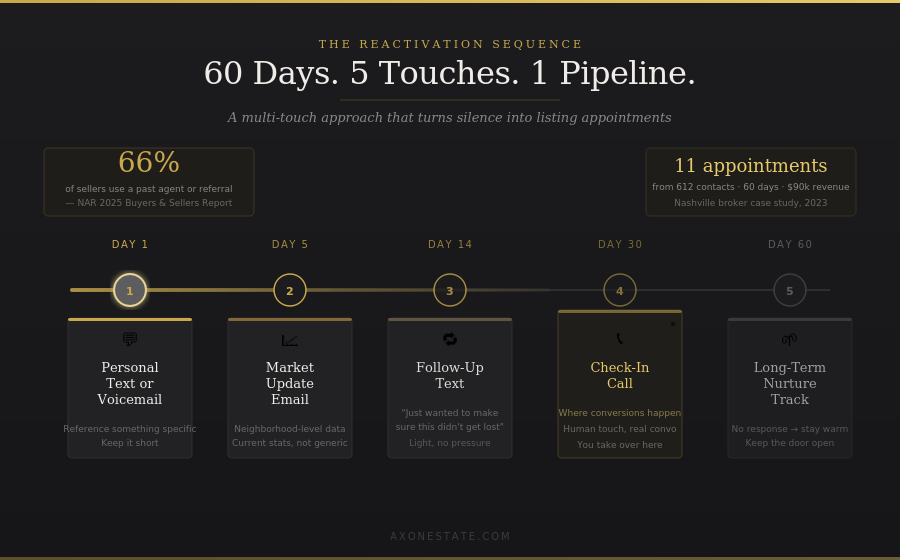
A broker in Nashville ran an experiment in 2023. Her team had 612 past clients in their CRM, most of whom hadn’t been contacted in more than 14 months. They ran a straightforward reactivation sequence — a personal text, followed by a market update email, followed by a check-in call from an agent.
Over 60 days, they booked 11 listing appointments and closed 4. Their cost: a few hours of setup and 3 weeks of follow-up work. Their revenue: over $90,000 in commissions.
No new ad spend. No new leads. Just the database they already had.
Why Agents Don’t Do This Naturally
The answer isn’t arrogance or laziness. It’s a combination of things.
It feels awkward. Calling someone 18 months after their closing and asking if they’re thinking of selling feels forced. Agents worry about coming across as a salesperson rather than a trusted advisor.
There’s no system for it. Without a structured approach, reactivation becomes “I’ll call Dave sometime this week” — which means Dave never gets called.
It’s hard to know who to prioritize. A database of 400 people is overwhelming. Who do you start with? People who bought 3 years ago and might be ready to move up? Investors who haven’t transacted in a while? Past sellers in neighborhoods where inventory is low?
CRMs aren’t built for this. Your CRM stores contacts. It doesn’t identify which ones are statistically likely to be thinking about selling. It doesn’t know that the couple who bought a 3-bedroom in 2019 now have two kids and might need to upsize.
What Good Database Reactivation Looks Like
The worst version of real estate database reactivation is a mass email that says “Hey, thinking of selling? Let me know!” It’s generic, it reeks of desperation, and it gets ignored.
Good reactivation is segmented and personal.
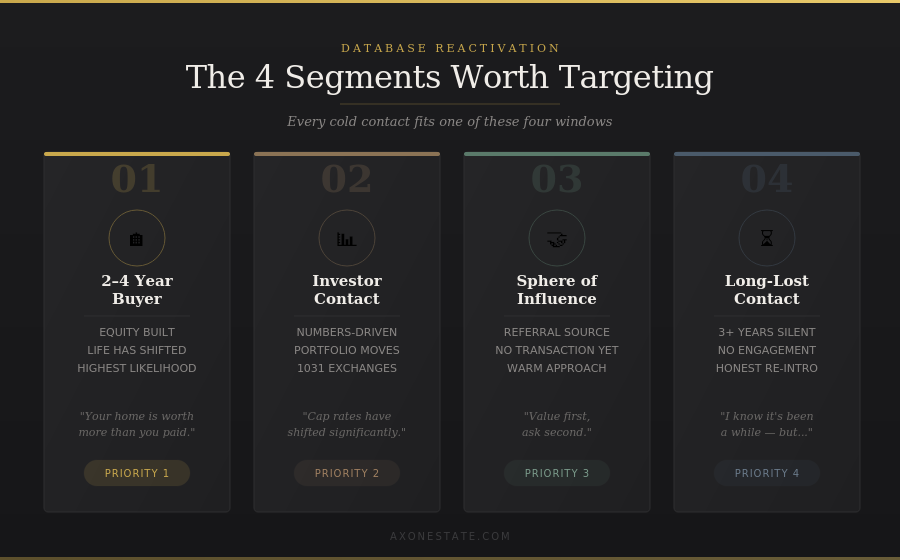
Segment 1: The 2–4 year buyer. People who bought with you 2–4 years ago are statistically in the highest-likelihood window to sell again. They’ve built equity. Life has changed (job, family, finances). They may be thinking about moving but haven’t made a move yet.
Message angle: “The market in your neighborhood has shifted — homes like yours are selling faster than they were when you bought. Thought you’d want to know what yours is worth today.”
Segment 2: The investor contact. Past investors or landlords in your database may be thinking about liquidating, 1031 exchanging, or adding to their portfolio. They respond to numbers, not emotions.
Message angle: “Cap rates in [neighborhood] have shifted significantly. Happy to pull a quick analysis if useful.”
Segment 3: Sphere of influence — no transaction history. People in your database who never transacted with you but referred someone, attended an event, or just stayed connected. They need a warmer, lighter touch.
Message angle: Value-add first. Market insight. Neighborhood news. Then a soft check-in.
Segment 4: Long-lost contacts (3+ years, no engagement). These are the coldest, but they exist in every database. A brief, honest message works better than pretending you’ve stayed in touch.
Message angle: “I know it’s been a while — I wanted to reach back out because [specific, relevant reason]. No agenda, just wanted to reconnect.”
The Sequence That Works
A reactivation sequence is not a single message. It’s a multi-touch approach across 30–60 days:
- Day 1: Personalized text or voicemail. Short. Reference something specific.
- Day 5: Market update email with their neighborhood’s current stats.
- Day 14: Follow-up text if no response. Lighter — “Just wanted to make sure this didn’t get lost.”
- Day 30: Check-in call from an agent. This is where conversion actually happens.
- Day 60: Add to long-term nurture sequence if still no response.
The key word is personalized. The difference between a sequence that generates appointments and one that generates unsubscribes is specificity.
Where AI Changes the Game
Manually running this sequence across 400 contacts — segmented properly, with personalized messaging — takes weeks of focused work. Most agents start and abandon it within a few days because it’s overwhelming.
This is exactly what AI handles well, and it’s what makes large-scale database reactivation realistic for the first time.
AxonEstate’s Database Reactivation Agent goes through your existing contact list, identifies which contacts fall into which segment based on transaction history and timeline, generates personalized outreach for each one, and runs the full sequence — texts, emails, follow-ups — without requiring the agent to manage every individual interaction.
When a contact responds positively, it flags them immediately for the agent to take over. When someone says “not right now,” it moves them to a long-term nurture track. When someone doesn’t respond, it keeps working through the sequence before stepping back.
The agent does the volume work. You do the actual conversations.
A Note on Tone: Why This Isn’t Spam
There’s a meaningful difference between a reactivation campaign and a spam blast. The difference is:
- Spam: Generic message to everyone, no context, clear mass-send energy.
- Reactivation: Specific message tied to who that person is, what they did, and what’s changed since you last talked.
A past client who bought a 4-bedroom house in 2021 getting a text that says “Hey Sarah, market’s interesting in Lakewood right now — homes in your neighborhood are up about $40k from what you paid. Worth a quick call if you’re ever curious what yours is worth” is not spam. It’s useful information from a trusted person.
Done right, past clients don’t feel hunted. They feel remembered.
How This Plays Out in Practice
Picture an agent with 380 contacts in their CRM, most untouched since their last closing. A proper database reactivation push starts by sorting that list: the 2021–2023 buyers go into the highest-priority segment, the handful of investors get a market-data angle, and the long-dormant contacts get a low-pressure “just checking in” message.
Within the first two weeks, a handful of replies start coming back — some from people who’d been quietly thinking about selling but had no reason to reach out first. By day 30, the agent isn’t cold-calling strangers. They’re following up with warm leads who already trust them, sourced entirely from a list that existed the whole time.
That’s the core appeal of real estate database reactivation: it doesn’t require new marketing spend, new ad creative, or new lead sources. It requires turning attention back to people who are already halfway sold on working with you again.
The ROI Argument
Let’s be blunt: database reactivation has the highest ROI of almost any activity in real estate marketing.
You’ve already paid to acquire these contacts — through advertising, through time, through years of relationship-building. Ignoring them and spending money to acquire new leads instead is one of the most common and most expensive mistakes in the industry.
A single listing from a reactivated past client comes with no lead cost, no cold outreach friction (they already know you), a higher close rate thanks to the warm relationship, and a higher referral likelihood after the transaction closes.
This isn’t theory. Ask any top producer who’s been in business 10+ years where their best deals come from. Almost universally: their database.
Bottom Line
Your CRM is not a contact storage system. It’s a revenue engine — but only if you actually use it.
Real estate database reactivation is the highest-return activity most agents never fully execute because it requires consistency, personalization, and volume at the same time. AI is the only realistic way to do all three simultaneously.
AxonEstate’s Database Reactivation Agent was built to solve exactly this problem — turning a silent database into a consistent source of listings, appointments, and referrals. Book a strategy call here to see how it works.
FAQ
Q: Won’t past clients find this annoying if I reach out out of nowhere? A: If you send a generic mass message, yes. If you send something specific and relevant to their situation, most people appreciate hearing from you. The key is personalization.
Q: How many contacts should I have before this is worth doing? A: Honestly, 50 is enough to make it worthwhile. The more you have, the more valuable the exercise — but size isn’t the barrier.
Q: What if I don’t have a CRM and my contacts are in a spreadsheet? A: Start there. Even a clean spreadsheet is enough to run a reactivation campaign.
Q: How often should I reactivate my database? A: A full reactivation push is worth doing every 12–18 months for contacts who haven’t engaged. Between those, consistent light-touch nurture keeps you top of mind without requiring a formal campaign.
Sources
- NAR 2025 Profile of Home Buyers and Sellers — overview via Greater Lansing MLS
- Key Takeaways from NAR’s 2025 Profile of Home Buyers and Sellers — Virginia REALTORS
Internal link: AxonEstate Database Reactivation Agent