Every agent believes they need more leads. But the truth is simpler, and harder to hear: a strong real estate follow-up system beats a bigger pipeline every single time. According to NAR, buyers now spend a median of 10 weeks searching before they close. That means the agent who stays in the loop the longest usually wins the deal, not the one who generated the most inquiries.
The Real Estate Follow-Up System Most Agents Don’t Actually Have
Most agents don’t have a follow-up system. Instead, they have a follow-up habit, and habits break the moment life gets busy.
Here’s how it usually plays out. A new lead comes in on a Tuesday. The agent calls once, leaves a voicemail, and heads to a showing. By Thursday, the lead has gone quiet. By the following week, it’s forgotten entirely, buried under new inquiries that will meet the same fate.
This isn’t a discipline problem. It’s a structural one. According to research from the National Sales Executive Association, 80% of sales require five or more follow-up contacts. Yet nearly half of all agents give up after just one attempt. Because of this, the math never works in their favor.
Meanwhile, the lead didn’t disappear. They kept browsing Zillow, kept talking to friends, and eventually called the agent who actually followed up. That agent didn’t have a better listing presentation. They didn’t have a bigger ad budget either. They just had a real estate follow-up system that didn’t depend on memory or motivation.
As a result, the gap between top producers and everyone else has less to do with talent and more to do with process. One agent has a system that runs whether they’re at a showing, at dinner, or asleep. The other agent has good intentions and a CRM full of leads nobody called back.
What the Top Agents Actually Do
Marisol Vega runs a five-person team out of Austin, Texas, closing around 60 transactions a year. Two years ago, her team’s biggest leak wasn’t lead generation. It was everything that happened after the first call.
She noticed a clear pattern. Leads who didn’t convert in the first 48 hours almost never heard from the team again unless they called back first. So Marisol rebuilt the process around one rule: every lead gets touched on a set schedule, regardless of how busy the day gets.
Specifically, her team now sends a same-day text, a call within the hour, and a scheduled follow-up sequence that runs for weeks, not days. Nothing depends on any single agent remembering to do it, and nothing slips just because someone had back-to-back showings.
The contrast with agents who skip this step is stark. A solo agent working the same market might generate twice as many leads as Marisol’s team in a given month, yet still close fewer deals. In other words, more leads without follow-up just means more names sitting on a list that never gets called.
Marisol’s team didn’t out-market anyone in Austin. They out-followed-up everyone else, and that persistence is the entire difference between a good year and a record one.
The Research Behind Consistent Follow-Up in Real Estate
The data on this is remarkably consistent across sources. Research compiled from the National Sales Executive Association, and cited widely across the real estate industry, found something striking. Most sales close between the fifth and twelfth point of contact, not the first or second. Despite that, close to half of all agents never follow up on a lead at all.
Speed matters just as much as persistence. Studies on lead response time have found that contacting a prospect within five minutes makes them dramatically more likely to convert than waiting even half an hour. Agents who respond first to an inquiry also tend to win the client outright, regardless of price or listing quality. Additionally, sales performance research shows that calling a lead six times, instead of stopping after one or two attempts, increases the odds of actually reaching them by roughly 70%.
None of this is about working harder for longer hours. Instead, it’s about building a real estate follow-up system that keeps showing up long after motivation naturally runs out.
How AI Solves the Real Estate Follow-Up Problem
This is exactly the gap AI was built to close. A follow-up sequence doesn’t require creativity or judgment. It requires consistency, and that’s precisely where software outperforms a busy human on their fourth showing of the day.
The Open House Follow-Up Agent from AxonEstate handles this by treating every open house visitor like a lead worth keeping, not just a name scrawled on a sign-in sheet. Instead of hoping an agent remembers to reach out on Monday, the agent runs automatically, every single time, for every visitor.
Specifically, it:
- Sends a same-day thank-you text to every visitor within minutes of them leaving the property
- Follows up automatically over the next several weeks with relevant property updates and check-ins
- Flags visitors who show buying signals, like repeat website visits or replies, so the human agent knows exactly who to call
- Logs every interaction directly into the CRM, so nothing gets lost between tools or team members
- Adjusts the messaging cadence based on how engaged each individual lead actually is
- Hands off warm leads to the agent with full context attached, not a cold list of names
Because the sequence runs the same way every time, no lead falls through the cracks just because Saturday got busy. That consistency is what separates AxonEstate from a simple autoresponder. It’s a real estate follow-up system built specifically around how agents actually lose deals. On top of that, teams using this kind of automation through AxonEstate free up hours each week that used to go toward manual, repetitive check-ins.
The Real Cost of Getting This Wrong
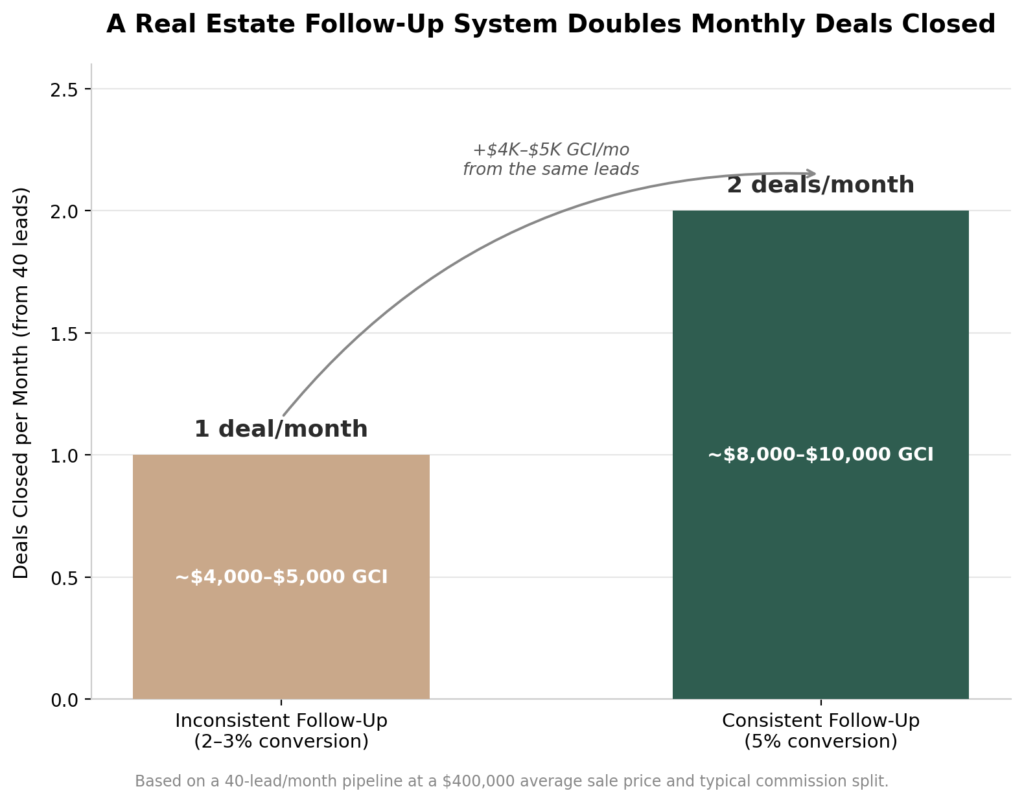
Let’s put an actual number on this. Say an agent generates 40 new leads a month through ads, referrals, and open houses combined. Industry data puts average internet lead conversion at around 2 to 3% when follow-up is inconsistent.
That means roughly one closed deal each month from that entire pipeline, even though the leads themselves were perfectly good. Now assume the agent tightens up follow-up and pushes conversion to even 5%, a rate top-performing teams reach through structured, consistent contact. That’s two deals a month instead of one, from the exact same leads.
On a $400,000 average sale price, at a typical commission split, one additional deal a month works out to an extra $8,000 to $10,000 in gross commission income. Multiply that across a full year, and inconsistent follow-up isn’t a minor inefficiency. It’s a six-figure leak for a busy team, hiding in plain sight inside the CRM.
This is why the real cost of a weak real estate follow-up system rarely shows up on a spreadsheet. Instead, it shows up quietly, as leads that drift off and go to someone else.
How This Plays Out in Practice
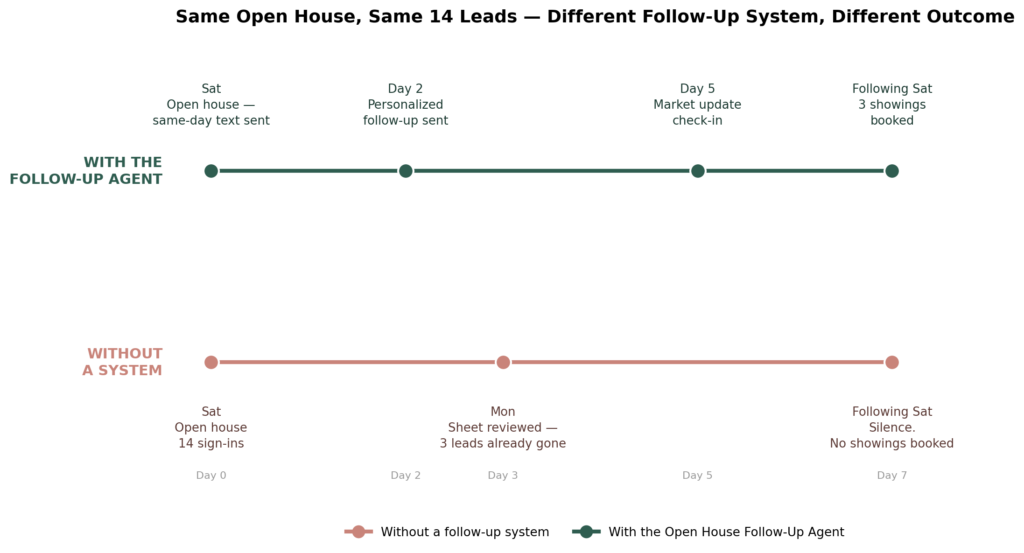
Picture a Saturday afternoon open house in a suburb outside Austin: a three-bedroom home in Round Rock, priced right, with steady foot traffic all afternoon. The agent collects 14 sign-ins, answers questions for four hours straight, and heads home exhausted by 5 p.m.
Without a system, here’s what happens next. The sign-in sheet sits in a car console until Monday morning. By the time anyone reaches out, three of those visitors have already made offers elsewhere, and the rest have stopped responding altogether. The open house generated plenty of genuine interest and almost no actual results.
Now picture that same Saturday with an AI agent running quietly in the background. Each visitor gets a same-day text thanking them for stopping by, along with a link to similar nearby listings. Two days later, the ones who clicked through get a short, personalized follow-up message. A week after that, the system checks in again with a market update specific to Round Rock.
By the following Saturday, the agent already has three real conversations scheduled. Not because they worked any harder, but because nothing depended on their memory after a long day of back-to-back showings. Instead of chasing cold leads a week too late, they’re touring a serious, pre-warmed buyer through a second property.
Same open house. Same 14 leads. A completely different outcome, because one version had a real estate follow-up system quietly running, and the other one didn’t.
Why This Matters More in 2026 Than Ever
The follow-up gap matters more this year than it used to. According to NAR’s May 2026 existing-home sales report, inventory has climbed to 4.5 months of supply. Buyers are taking noticeably longer to decide than in the tighter markets of recent years.
That shift changes the math on follow-up completely. When buyers move fast, a missed call is forgivable. When they’re weighing more options over a longer window instead, the calculus flips. The agent who stays visible for weeks, not days, is the one still in the room when the buyer finally acts.
At the same time, expectations have shifted too. Buyers now interact with instant responses everywhere else in their lives, from food delivery to customer service. Quietly, they expect something similar from the people helping them buy a home. Even so, most real estate follow-up still runs on memory and good intentions alone.
Beyond that, longer search timelines change who wins. The agents willing to stay consistent for 8, 10, or even 12 weeks are the ones capturing deals that used to simply go to whoever called first.
Bottom Line
More leads won’t fix a follow-up problem on their own. A real estate follow-up system will.
The agents pulling ahead in 2026 aren’t necessarily working harder or spending more on ads. Instead, they’re simply the ones still showing up on week six, when everyone else has already moved on to the next lead.
That kind of consistency is hard to maintain manually, and honestly, it doesn’t have to be manual anymore. See how the Open House Follow-Up Agent works — see how it works, or book a strategy call here to talk through what a real follow-up system could look like for your own team.
Frequently Asked Questions
How many times should I actually follow up with a real estate lead before giving up?
Most sales happen between the fifth and twelfth contact, not the first or second, so don’t give up after one voicemail. A good rule of thumb is to keep a lead in a follow-up sequence for at least 8-10 weeks unless they explicitly ask you to stop. If you’re only calling once or twice, you’re likely losing deals to whoever calls a third time.
Isn’t automated follow-up going to feel robotic to my leads?
Not if it’s set up well. Good automation handles the repetitive parts — the same-day text, the check-in a week later — while flagging genuine interest so you can jump in personally at the right moment. Leads generally care more about getting a timely response than about who or what sent it.
What’s the difference between a CRM and an actual follow-up system?
A CRM stores your leads and lets you log notes; it doesn’t do anything on its own. A real estate follow-up system actually reaches out, on a schedule, whether or not you remember to log in that day. Most agents already have a CRM — what they’re missing is the system that runs inside it.
Will this replace the personal relationship-building agents are known for?
No — it’s meant to protect it. Automating the repetitive first-touch follow-up frees you up to spend your time on the calls and conversations that actually need a human, instead of burning hours on check-ins a system can handle just as well.
Sources
- NAR Existing-Home Sales Report Shows 3.2% Increase in May — National Association of Realtors
- 88% of Home Buyers Still Rely on Agents, NAR 2025 Report Finds — BAM
- Real Estate Lead Response Statistics: 15 Numbers Every Agent Should Know in 2026 — AgentZap
- 75+ Real Estate Lead Generation Statistics 2026 — Deal Machine OS
- 30 Real Estate Lead Generation Statistics Every Agent Should Know in 2026 — CloseDaily