A real estate ISA is the team member whose entire job is answering, qualifying, and following up on leads before an agent gets involved. Harvard Business Review’s landmark study on online sales leads found that firms contacting a new inquiry within an hour are nearly seven times more likely to qualify it than firms that wait. That single statistic explains why teams hire an inside sales agent in the first place, and why so many of those hires still come up short. Here is what the role actually involves, where it breaks down, and why an AI agent now does it better, faster, and for far less.
The Real Estate ISA Bottleneck No One Talks About
Most teams hire a real estate ISA to fix a speed problem. For the first few months, it works. A dedicated person answers calls, texts back fast, and qualifies buyers before handing them to an agent. However, the role has built-in limits that no amount of training fixes.
Specifically, an ISA works roughly 40 to 50 hours a week. Leads, on the other hand, do not. Nearly 35% of inbound real estate leads arrive after business hours, on weekends, or over holidays, according to lead-conversion research from VoiceInfra. That means more than a third of your pipeline lands while your ISA is asleep, at dinner, or off for the weekend.
On top of that, the role has a churn problem. Inside sales and SDR-style positions average just 14 to 18 months of tenure, based on industry benchmarking from SalesHive. People leave, get promoted, or burn out. As a result, every departure means a hiring gap, a multi-week ramp-up, and a stretch of leads going stale while the seat sits empty.
Even a great ISA can only handle one conversation at a time. When three leads come in during an open house weekend, two of them wait. In a business where the first responder usually wins the client, that is why “wait” is the most expensive word on the team.
What the Top Agents Actually Do
Marisol Tran runs a six-agent team in Tampa, Florida. For two years, she cycled through ISAs before changing her approach. Her old model looked like every other team’s: one inside sales agent fielding everything from 9 a.m. to 6 p.m. Then a shared voicemail box took over overnight.
The gap showed up every weekend. Tran’s team found that nearly 40% of their Zillow and Realtor.com leads came in after 6 p.m. or before 9 a.m., a window her inside sales agent simply could not cover alone. Because of this, leads sat for ten, twelve, sometimes sixteen hours before anyone replied.
Instead of hiring a second ISA for nights and weekends, Tran layered an AI agent under her existing team. It catches every lead the moment it arrives. It then qualifies each one with the same questions her best ISA used, and texts a confirmed showing time straight to the agent’s calendar. In practice, her human team now spends its time on warm, ready-to-talk leads instead of cold ones.
Teams running a single-ISA model tell a different story. Weekday conversion stays strong. Meanwhile, weekends fall off a cliff, and the hiring cycle repeats every time the role turns over. The difference is not effort — it is coverage.
The Research Behind Real Estate Lead Response
The data on response speed is consistent across multiple independent studies. Harvard Business Review’s analysis of business-to-business leads found that companies contacting a prospect within an hour qualified almost seven times more of them than companies that waited. In fact, firms that waited a full day were over 60 times less likely to ever connect at all.
Inman’s 2025 Real Estate Technology Survey found something striking: the average agent takes more than 15 hours to respond to a new lead, a figure reported by AgentZap’s review of the data. That gap between best practice and actual practice is exactly where an inside sales agent is supposed to step in. Beyond that, it is also exactly where coverage gaps reopen it.
Compensation data adds another layer. ZipRecruiter puts the average U.S. ISA base salary at roughly $44,000 a year. Glassdoor’s broader figure, which includes commission, lands closer to $86,000, according to reporting from The Close. On top of that, add benefits, software, and management time, and the fully loaded cost climbs well past the number on the offer letter.
How AI Solves the ISA Coverage Gap
Once you see the pattern, the fix becomes obvious. The problem was never effort or skill. Instead, it was coverage, consistency, and cost stacking up against a role with only so many hours in a week. This is why an AI agent is built to close exactly that gap.
AxonEstate’s Inbound Lead Responder picks up every lead the second it arrives. It does not matter if that is 2 p.m. Tuesday or 11 p.m. Sunday during an open house weekend. It runs the same qualifying conversation a trained ISA would, every time, without a sick day or a two-week notice. As one piece of a full AxonEstate workforce, it hands warm, qualified leads straight into your existing workflow instead of replacing the relationships your agents already manage.
In practice, the agent:
- Responds to every new lead from your website, Zillow, or Realtor.com within seconds, day or night
- Asks qualifying questions about timeline, financing, and motivation using your team’s actual scripts
- Books showings and listing appointments directly onto an agent’s calendar without back-and-forth texting
- Logs every conversation and qualification note into your CRM automatically
- Flags hot leads for an immediate human handoff instead of letting them sit in a queue
- Keeps working nights, weekends, and holidays without overtime, turnover, or a hiring search
The Real Cost of Getting This Wrong
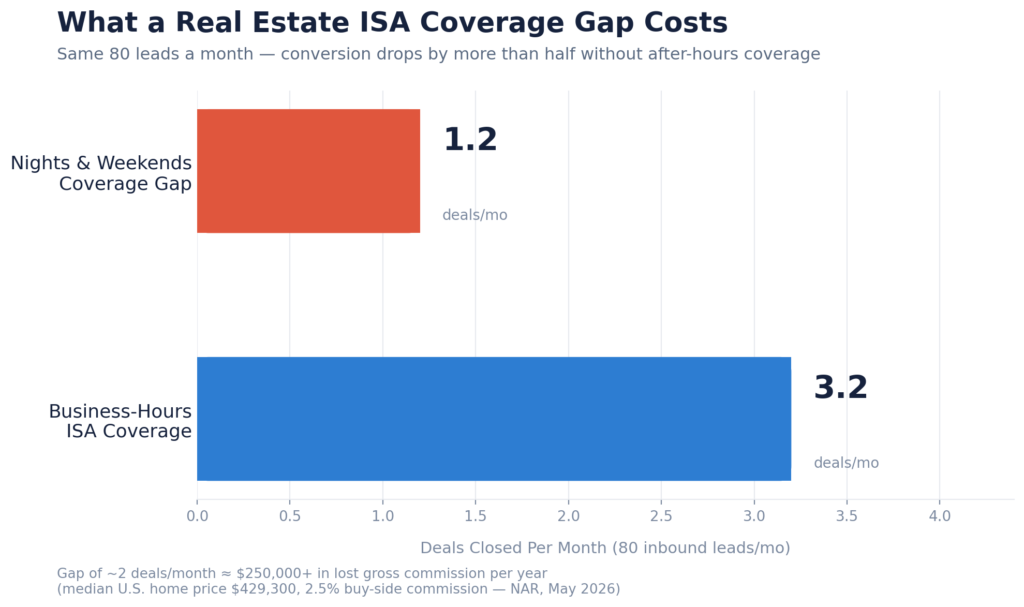
Here is what a coverage gap actually costs. A team generating 80 inbound leads a month has a real estate ISA covering standard business hours. That setup typically converts around 4% of those leads into closed deals, or roughly 3.2 deals a month. When response time slips to one or three hours, which happens every night and every weekend, conversion instead falls closer to 1.5%, or about 1.2 deals a month.
That gap, just under two deals a month, is not small. The median U.S. home price was $429,300 in May 2026, according to the National Association of Realtors, and a typical buy-side commission runs 2.5%. That means each missed deal costs roughly $10,700 in gross commission. Two missed deals a month adds up to more than $250,000 a year for a single mid-sized team.
How This Plays Out in Practice
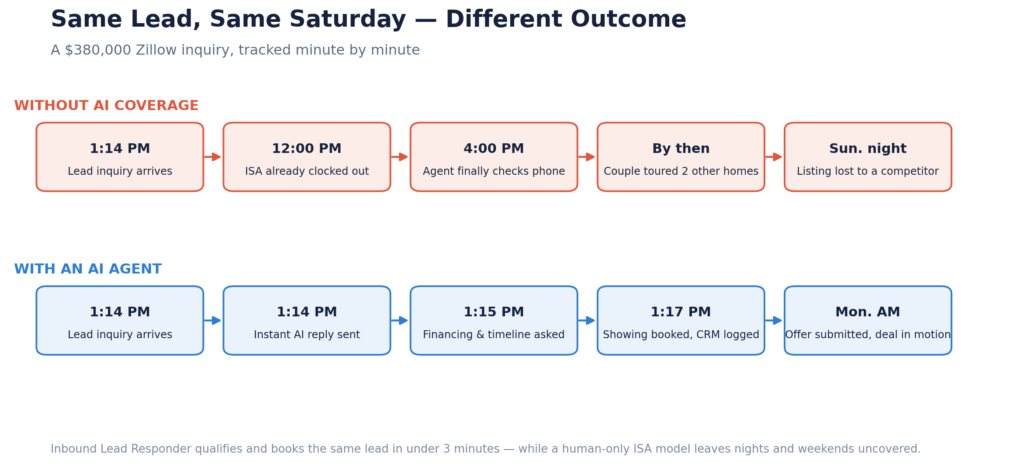
Picture a Saturday afternoon in a suburban market like Brandon, Florida. An agent is mid-showing on a three-bedroom ranch, phone on silent. Meanwhile, a lead comes in through a Zillow inquiry on a $380,000 listing across town: a couple who just got pre-approved and want to see the home before an offer deadline Monday.
Without coverage, that lead sits. The ISA clocked out at noon, and the agent does not check her phone until 4 p.m. By then, the couple has already toured two comparable homes with agents who replied right away. As a result, the listing goes under contract to someone else by Sunday night.
With an AI agent running in the background, the story changes completely. The lead lands at 1:14 p.m. and gets an instant reply confirming the listing is available, followed by two quick questions about financing and timeline. By 1:17 p.m., the couple has a confirmed Sunday showing on the agent’s calendar, with a qualification note already logged in the CRM. Instead of finding out the lead went cold, the agent learns about the new appointment the moment she checks her phone after her showing wraps.
Same lead, same Saturday, same market. The only difference is what happened in the first three minutes.
Why This Matters More in 2026 Than Ever
The 2026 housing market is putting more pressure on speed, not less. First-time buyers now make up just 21% of the market, an all-time low. Meanwhile, the typical buyer’s age has climbed to 59, per NAR data from chief economist Lawrence Yun. As a result, agents are competing harder for a smaller, more selective pool of ready buyers.
At the same time, existing-home sales climbed to 4.17 million in May 2026, with a record median price of $429,300, a market heating back up after several sluggish years. More activity means more leads hitting your pipeline at once. Because of this, a real estate ISA working alone has less room than ever to fall behind. Buyers comparing several agents at once will simply move on to whoever replies first.
In a market like this, instant response is not a nice-to-have. Instead, it is the baseline expectation for any team that wants to compete for a shrinking, pickier pool of serious buyers.
Bottom Line
A real estate ISA was always meant to solve one problem: making sure no lead waits. However, the role just was not built to run all day, every day, without breaks, sick days, or turnover. That is a structural limit, not something a better hire can fix.
An AI agent removes that ceiling entirely. It responds in seconds, qualifies consistently, and never clocks out. On top of that, it does all of this for a fraction of what a single full-time hire costs once salary, benefits, software, and turnover are added up.
See how it works with the Inbound Lead Responder, or book a strategy call here to walk through what coverage looks like for your lead volume.
Frequently Asked Questions
Do I still need a human ISA if I bring on an AI agent? Most teams keep a human for complex conversations, objection handling, and relationship-building. Instead of handling everything, the AI agent takes over instant response and initial qualification. The two work together rather than one fully replacing the other.
Will leads know they’re talking to AI instead of a human ISA? AxonEstate’s agent is upfront about being an AI assistant when asked directly. Even so, it is built to sound natural and helpful, not robotic. Most leads care more about getting a fast, useful answer than who sent it.
How fast does the AI actually respond compared to a human ISA? The agent responds within seconds, any hour of the day. In contrast, the average human response time, per Inman’s own survey, runs over 15 hours industry-wide.
What happens to leads that come in at 2 a.m. or on a holiday? They get the exact same instant response and qualification conversation as a lead arriving at 2 p.m. on a Tuesday. In other words, nothing waits for business hours to start.
Sources
- The Short Life of Online Sales Leads — Harvard Business Review
- Existing-Home Sales — National Association of Realtors
- NAR Forecast: Home Sales Expected to Jump 14% in 2026 — National Association of Realtors
- 5 Amazing Things You Never Knew an Inside Sales Agent Could Do — Follow Up Boss
- What Is a Real Estate ISA? A Complete Guide — The Close
- The True Cost of an SDR (Sales Development Rep) — SalesHive
- Real Estate Lead Response Statistics: 15 Numbers Every Agent Should Know in 2026 — AgentZap