Most agents are sitting on a goldmine and don’t know it. Real estate lead nurturing — the consistent, strategic follow-up with contacts who aren’t ready to transact today — is the single highest-ROI activity available to any agent. According to the National Association of Realtors (NAR), 87% of buyers say they would use their agent again, yet only 12% actually do. The gap between intent and repeat business isn’t a loyalty problem. It’s a follow-up problem.
Why Real Estate Lead Nurturing Fails for Most Agents
The average agent database looks impressive on paper: hundreds of contacts accumulated over years of open houses, buyer consultations, referrals, and portal inquiries. In practice, the majority of those contacts hear nothing after the first conversation. Real estate lead nurturing simply stops.
It’s not laziness. It’s math. A solo agent managing active listings, buyer appointments, and vendor calls has no realistic capacity to maintain meaningful contact with 400 people on a rolling basis. According to Salesforce’s State of Marketing report, it takes an average of 6–8 touchpoints before a prospect makes a buying decision. Most agents give up after two.
The consequences are severe — and invisible. A contact who goes quiet doesn’t announce they’ve listed with someone else. They just disappear. Meanwhile, a competitor who stayed in touch — even with something as simple as a quarterly market update — earns the call.
The psychology here matters. Buyers and sellers in the consideration phase aren’t ignoring agents; they’re waiting for the right moment. That moment could be 3 months away or 18 months away. Without a structured nurturing system, agents have no way to be present at the exact point the lead becomes ready.
What the Top Agents Actually Do
The highest-performing agents treat their database like a managed asset, not an inbox folder. Sarah Linton runs a 4-person team in Dallas, Texas. After switching to a structured nurture system, her team’s referral rate climbed from 14% to 31% over 18 months — without adding a single new lead source.
Sarah’s approach wasn’t complicated. Every contact in her CRM was tagged by timeline: “active now,” “6 months,” “12+ months,” and “past client.” Each segment received different content at different intervals. The 12-month leads got a neighbourhood market snapshot once a month. Past clients got a personal check-in twice a year plus a property anniversary message.
What separated Sarah from agents who struggle isn’t talent. It’s consistency. Most agents treat follow-up as a task for when things slow down. Sarah’s team treated it as infrastructure — something that runs regardless of how busy the week gets.
The contrast is stark. Agents without a nurture system close the deals in front of them and start over every quarter. Agents with one compound their database over time, turning yesterday’s open house attendee into next year’s listing appointment.
The Research Behind Real Estate Lead Nurturing
The data on long-term follow-up is unambiguous. A study published by the Keller Center for Research found that most real estate transactions are preceded by a relationship that spans more than a year. Prospects who were nurtured consistently were significantly more likely to choose the agent they heard from most recently — not the one they originally liked best.
Harvard Business Review research on customer retention found that a 5% increase in retention can produce profit gains of 25% to 95%, depending on industry. In real estate, where a single transaction generates thousands in commission, holding onto even a small percentage of dormant leads has enormous financial implications.
Additionally, research from Inside Real Estate shows that the average lead in a real estate CRM takes 18 months to convert. Agents who abandon follow-up before that window closes leave the majority of their potential GCI on the table. Real estate lead nurturing isn’t a nice-to-have — it’s the core mechanism by which pipelines are built.
How AI Solves Real Estate Lead Nurturing
This is where the economics of nurturing change completely. The reason most agents fail at follow-up isn’t motivation — it’s capacity. Manually sending personalised messages to 300 contacts, at the right interval, with the right content, is simply not scalable by a human being managing an active book of business.
AxonEstate built the 12-Month Nurture Agent specifically to close this gap. It runs continuously in the background — handling the touchpoints that would otherwise fall through the cracks.
Here’s what the 12-Month Nurture Agent does concretely:
- Sends automated, personalised check-ins to every contact in the database on a pre-set schedule — monthly, quarterly, or custom intervals
- Adjusts message content based on lead segment (first-home buyer, investor, past client, vendor inquiry)
- Detects reply activity and flags engaged contacts for the agent to follow up personally
- Delivers suburb-specific market updates relevant to each contact’s stated interest areas
- Tracks open rates and response signals to identify the warmest leads in the pipeline at any given time
- Re-engages silent contacts after a defined period with a tailored “just checking in” message sequence
The result is a database that stays warm at scale — without the agent needing to touch it daily.
The Real Cost of Getting This Wrong
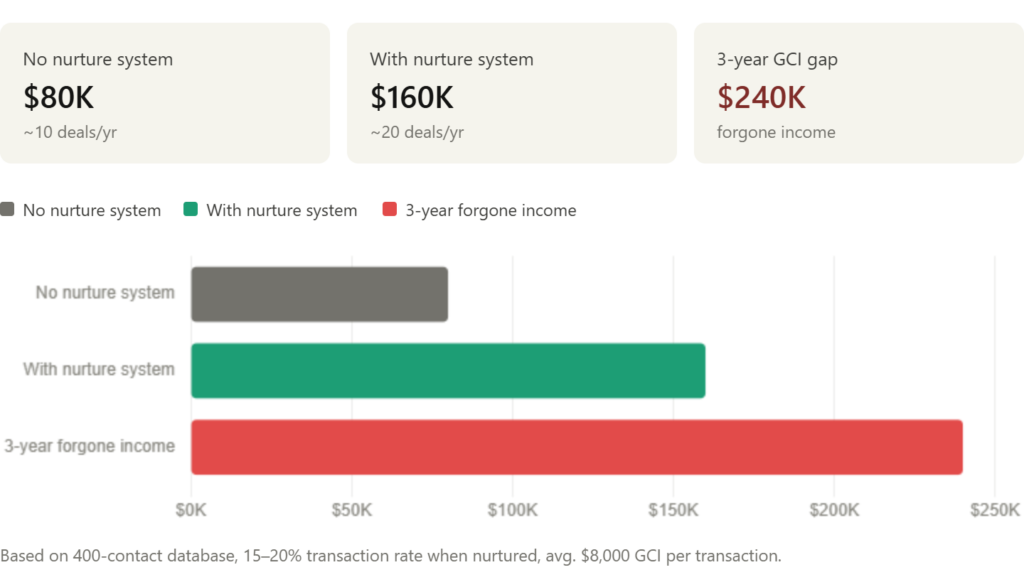
Here’s a concrete number to sit with. Assume an agent has 400 contacts in their database. Industry benchmarks suggest 15–20% of any real estate database will transact in a given year if properly nurtured. That’s 60–80 potential transactions.
Now assume the agent is only closing 10 a year — a realistic figure for a solo agent without a nurture system. At an average GCI of $8,000 per transaction, that’s $80,000 per year. A nurtured database producing even 20 transactions generates $160,000 — double the GCI from the same lead pool, with no additional marketing spend.
The gap — $80,000 — is the annual cost of not having a real estate lead nurturing system. Compounded over three years, that’s $240,000 in forgone income sitting in a CRM that nobody is talking to. On top of that, every deal that goes to a competitor represents a referral chain that also goes elsewhere. The damage multiplies.
How This Plays Out in Practice
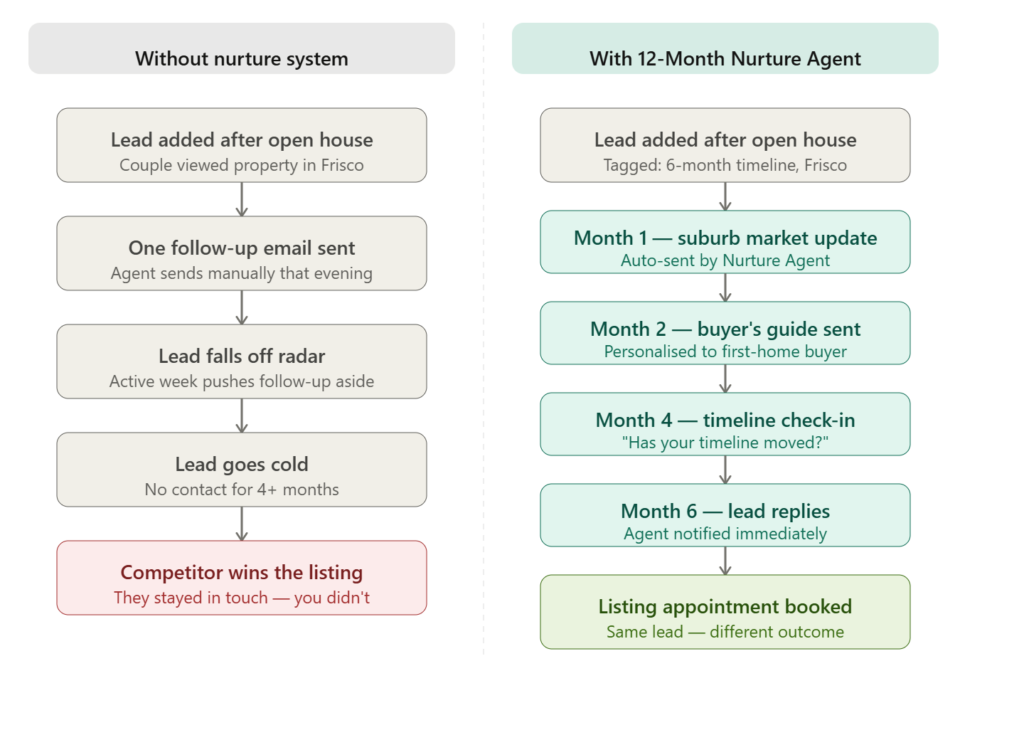
It’s Saturday afternoon. An agent is showing a four-bedroom in Frisco to a couple who are serious but need another 6 months before they can act. She takes down their details, sends them a quick follow-up email that evening, and then — inevitably — they fall off her radar as the week fills up with active buyers.
Six months later, that couple lists with another agent. Not because they liked the other agent more. Because that agent’s monthly market update landed in their inbox two weeks before they were ready to commit.
Now replay that same Saturday with the 12-Month Nurture Agent running. The couple is added to the database after the showing. They’re tagged as “6-month timeline, Frisco, family home.” The system sends them a neighbourhood update in 30 days, a buyer’s guide in 60, and a gentle check-in at month 4 asking if their timeline has moved. By month 6, they reply. The agent is notified. She books the listing appointment.
Same lead. Same agent. Completely different outcome — because the nurturing happened automatically, in the background, while she was focused on other clients.
Why This Matters More in 2025 Than Ever
The real estate market has shifted. Longer decision timelines, higher interest rate sensitivity, and increased buyer caution mean that the gap between first contact and transaction is wider than it’s ever been. Real estate lead nurturing has become the defining competitive advantage between agents who grow their businesses year-on-year and those who reset constantly.
According to a 2024 report from the Real Estate Standards Organisation (RESO), consumer expectations for personalised communication have risen sharply — buyers and sellers now expect relevant, timely contact rather than generic newsletters. Agents who can deliver that at scale will win the long game.
The agents still relying on manual follow-up or sporadic check-ins are playing a losing hand. The volume of leads entering the market, combined with the length of today’s buyer decision cycles, makes consistent nurturing impossible without automation.
Bottom Line
Your database isn’t a list of old leads. It’s a pipeline of future transactions — most of which will go to a competitor if you don’t stay in front of them. Real estate lead nurturing is the system that converts that pipeline into actual income.
The math is simple. The execution is where most agents fall short — not from lack of will, but from lack of capacity. That’s a solvable problem.
12-Month Nurture Agent — see how it works. Or if you want to talk through how AxonEstate fits your specific database and market, book a strategy call here.
Frequently Asked Questions
How often should I be following up with leads who aren’t ready to buy yet?
The research points to monthly contact as the baseline for warm leads, with quarterly touchpoints for colder contacts. The key is consistency over frequency — a reliable monthly update outperforms sporadic bursts of attention followed by silence.
Is automated nurturing going to sound robotic to my database?
Not if it’s built correctly. Effective real estate lead nurturing automation uses personalisation fields, segment-specific content, and natural language — contacts rarely identify the message as automated when the system is set up properly. The 12-Month Nurture Agent is built for this specifically.
What should I actually be sending to leads who are 12+ months out?
Market snapshots for their target suburb, relevant buyer education content, and occasional personal check-ins work well. The goal isn’t to sell — it’s to stay top of mind so you’re the agent they think of when they’re finally ready.
How do I know which leads in my database are worth nurturing vs. which ones I should drop?
Most aren’t worth dropping. Unless a contact has explicitly asked to be removed or is clearly out of market, the cost of maintaining contact is low and the upside is real. Segment by timeline and adjust frequency — don’t discard.