A real estate listing launch is one of the most time-sensitive events in any agent’s calendar. According to the National Association of Realtors, homes that receive an offer in the first week sell for significantly more than those that linger — often 2–3% above asking price. Miss that window, and the property starts accumulating days on market, price reductions, and buyer skepticism. Getting the launch right isn’t a nice-to-have. It’s the whole game.
Why the First 7 Days Determine Everything in a Real Estate Listing Launch
The moment a listing goes live, a clock starts. Buyers and their agents are watching new properties with algorithms and saved searches. The first wave of interest — the buyers who see a new listing within 24 to 72 hours — are typically the most motivated. They’re active in the market, they’ve been waiting, and they move fast.
However, most agents are already stretched thin when a new listing drops. Between coordinating photographers, preparing disclosures, scheduling opens, and managing existing clients, the immediate follow-through that a listing launch demands often falls through the cracks. A buyer enquires via the portal at 7pm on Friday and hears nothing until Monday morning. By then, they’ve moved on.
According to Zillow Research, homes that go under contract within the first week spend 57% less time on market overall compared to homes that take longer to attract their first offer. That compression matters. In contrast, a property that sits past day 14 without an offer is already psychologically stigmatised in the eyes of buyers — even if nothing is wrong with it.
The problem isn’t the property. It’s the gap between listing going live and agent response capacity. Short paragraphs, fast follow-up, and coordinated outreach in those first 96 hours are what separate a clean launch from a slow bleed. Most agents know this. Most still can’t execute it consistently on their own.
What the Top Agents Actually Do
Sarah Callahan runs a four-person team in Austin, Texas. She lists between four and six properties per month, and her average days on market sits at nine — well below the local average of 22. Her approach to a listing launch isn’t reactive; it’s scripted. The moment a property goes live, a pre-built communication sequence begins. Buyer leads who enquired on similar properties in the past six months get a personalised outreach. Her database gets an alert. Portal enquiries get a response within eight minutes, on average — including on weekends.
What Sarah does differently isn’t magic. It’s sequencing. She mapped out every touchpoint that needs to happen in the first 96 hours and systemised each one. Additionally, she pre-loads buyer match criteria so the moment a listing is active, the right buyers are already being contacted — not the day after, not after a manual check, but automatically.
Agents who don’t do this tend to rely on the portal to do the work. They assume if a buyer is serious, they’ll call. In practice, serious buyers have options. They’re talking to three agents, watching five listings, and making decisions quickly. The agent who responds first, with the right information, in the right tone, wins the appointment. The agent who responds Monday morning often doesn’t win anything.
In other words, a strong listing launch isn’t about the property — it’s about the agent’s ability to create urgency, coordinate outreach, and follow up fast. Sarah’s team can do that because they’ve removed the manual steps. Most solo agents haven’t.
The Research Behind Listing Launch Timing — and Why Speed Matters
The data on listing launch performance is consistent across multiple studies. Redfin’s analysis of millions of transactions found that homes listed on a Thursday generate the highest sale price and attract the most interest, because they go live before the weekend viewing window — the period when most buyers are actively inspecting. Timing the launch to the right day isn’t incidental; it’s strategic.
Beyond timing, response speed to enquiries has a dramatic impact on conversion. Research from the Harvard Business Review found that companies contacting online leads within one hour were nearly seven times more likely to qualify the lead than those who waited even 60 minutes longer. While that study covers broader sales contexts, real estate portals operate on the same psychology — a buyer enquiring at 6:30pm on a Saturday night expects a response within minutes, not the next business day.
On top of that, NAR’s 2024 Profile of Home Buyers and Sellers found that 97% of buyers used the internet during their home search, and the majority began that search well before engaging an agent. That means buyer intent is established long before first contact — and the agent who reaches them first, with relevant information, has a structural advantage. A well-executed real estate listing launch captures that window. A reactive one misses it entirely.
How AI Solves the Real Estate Listing Launch Problem
The challenge with a listing launch isn’t knowledge — most experienced agents know exactly what needs to happen. The challenge is execution at speed, across multiple channels, while managing everything else that comes with an active listing. This is where AI changes the dynamic entirely.
The Listing Launch Agent from AxonEstate is built specifically for this moment. It activates the moment a new property goes live and runs the entire first-week communication sequence without requiring the agent to manage each touchpoint manually. Specifically, it handles:
- Automatically contacting matched buyers from the agent’s database who fit the property’s criteria within minutes of listing going live
- Sending personalised outreach to portal enquiries within the first hour, around the clock — including Saturdays and Sundays
- Scheduling open home inspections and confirming attendees without back-and-forth phone tag
- Notifying the vendor with a structured launch update so they feel informed and confident from day one
- Following up with open home attendees within 24 hours using contextual messaging tied to the property
- Flagging high-intent leads to the agent in real time so the most important callbacks happen first
The result is that every buyer who touches a new listing in the first 96 hours gets a fast, relevant, professional response — without the agent being chained to their phone.
The Real Cost of Getting This Wrong
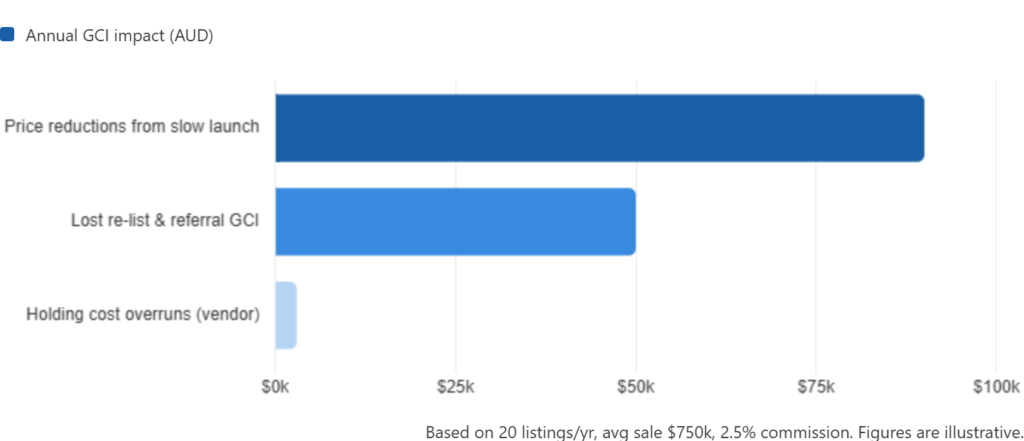
Consider a mid-tier agent with an average sale price of $750,000 and a commission rate of 2.5%. Each transaction is worth $18,750 in GCI. Now suppose that agent lists 20 properties per year, and on six of those listings, a slow launch contributes to a price reduction — an average reduction of $15,000 per property. That’s $90,000 in lost vendor value. Meanwhile, two of those listings take an additional three weeks to sell because the first-week window was missed. At a cost of $500 per week in holding costs per vendor, that’s another $3,000 in friction across those files.
Beyond the direct dollar impact, slow launches erode something harder to quantify: vendor trust. A vendor who feels their property wasn’t launched aggressively enough will not re-list with the same agent. In a referral-driven business, one lost re-list and its associated referrals can cost $40,000–$60,000 in future GCI. That means a single poorly executed real estate listing launch isn’t just a missed week — it’s a chain of downstream losses that compounds quietly.
Most agents never calculate this. They see days on market as a market problem, not a systems problem. Meanwhile, the cost keeps accumulating.
How This Plays Out in Practice
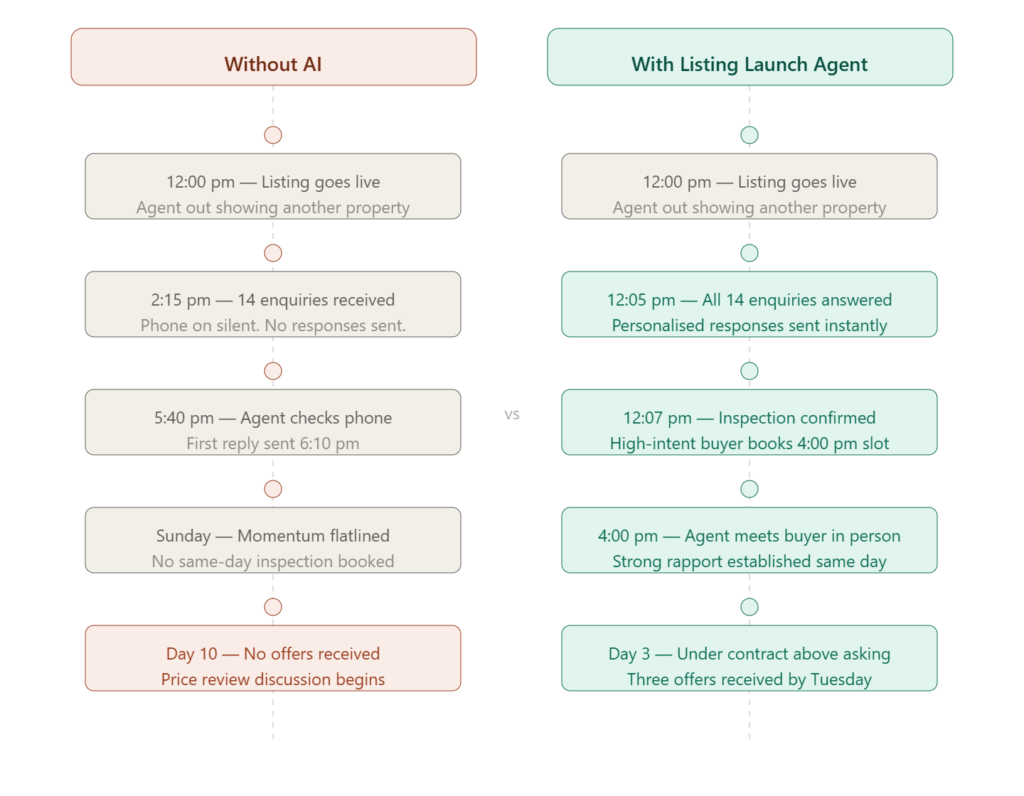
It’s Saturday at 2:15pm. Marcus is showing a young couple through a three-bedroom townhouse in Parramatta, his phone on silent. Back at the office, his new listing — a four-bedroom home in Penrith — went live at noon. By 2:30pm, fourteen buyers have clicked through on Domain. Three have filled out an enquiry form. One has sent a message that reads: “Is there an inspection this weekend? We could come today.”
Without AI, Marcus sees these messages at 5:40pm when he checks his phone between showings. He responds to the most urgent-looking one at 6:10pm. The buyer who wanted to inspect that afternoon has already booked with another agent to see a different property. By Sunday evening, the momentum has flatlined.
Now run the same Saturday with the Listing Launch Agent running. At 12:05pm, all fourteen portal enquiries have received a personalised response with inspection details, a property brochure, and an invitation to book a time. The buyer who asked about a same-day inspection receives a confirmed slot at 4:00pm. Marcus gets a real-time flag that a high-intent buyer has booked and is arriving in two hours. He wraps his current showing, drives to Penrith, and meets a motivated buyer face-to-face.
The property receives three offers by Tuesday. Because of this, Marcus doesn’t need a second open home. The vendor is happy. The buyer who booked that Saturday slot ends up being the winning bidder.
Same property. Same Saturday. Entirely different outcome.
Why This Matters More in 2025 Than Ever
The real estate market in 2025 is not forgiving of slow responses. Buyer behaviour has shifted decisively toward digital-first engagement, and the expectation of immediate contact has been set by every other industry — from banking to e-commerce to food delivery. Real estate has been slower to catch up, but buyers are no longer willing to wait.
At the same time, inventory levels in many markets remain tight, which means competition for desirable properties is intense. Buyers who find a listing that fits their brief are ready to move — and they’ll move on just as quickly if the agent doesn’t engage them within the first few hours.
According to CoreLogic’s 2024 Australian Property Market Review, vendor satisfaction scores are strongly correlated with perceived agent responsiveness in the first week of a campaign. Vendors who felt their agent communicated proactively during the launch week rated their agent significantly higher and were more likely to recommend them. In other words, a real estate listing launch that goes smoothly isn’t just a sales tactic — it’s also your next five referrals.
Bottom Line
The first seven days of a listing are not a warm-up. They are the campaign. Every hour of delay in responding to an enquiry, every open home confirmation that goes unsent, every matched buyer who doesn’t get a call — all of it costs real money, and most of it happens because agents are running too many processes manually.
The agents consistently closing above asking price with minimal days on market aren’t luckier. They’ve removed the human bottleneck from the first-week sequence. They respond faster, follow up better, and keep vendors informed — not because they work harder, but because the system works while they focus on relationships.
If you want a listing launch that actually performs, start with the infrastructure. Listing Launch Agent — see how it works. Or book a strategy call here to see how AxonEstate fits your current workflow.
Frequently Asked Questions
How quickly should I follow up with enquiries during a listing launch?
Within the first hour is the industry benchmark — but within minutes is where the real advantage sits. Research consistently shows that response time under 5 minutes produces dramatically higher lead conversion than responding within even an hour. On a Saturday afternoon, that window is nearly impossible to hit manually.
Does the timing of when I go live on the portals actually affect my result?
Yes, measurably. Thursday listings consistently outperform Monday and Tuesday launches because they align with the buyer’s weekend inspection mindset. Going live on a Thursday gives you 48–72 hours of visibility before the heaviest foot traffic period, which means more pre-qualified attendees at your Saturday open.
What should I be sending matched buyers at launch — and how do I find them?
Your existing CRM should contain buyer enquiries from similar properties in the past 3–6 months. At launch, those buyers should receive a personalised message with the key property details, a clear call to action to book, and a sense of urgency. The problem is identifying them quickly and contacting all of them at scale — which is exactly what an AI agent is built to do.
Can AI really handle vendor communication during a listing launch without me?
It can handle structured reporting — launch update summaries, enquiry counts, inspection bookings confirmed, buyer feedback collected. What it doesn’t replace is the high-stakes conversation when an offer comes in or a vendor needs strategic advice. The agent’s time is best spent on those moments. Everything else can run automatically.
Sources
- Home Selling Statistics — National Association of Realtors
- Days on Market and Pricing Analysis — Zillow Research
- The Short Life of Online Sales Leads — Harvard Business Review
- Best Day to List a Home for Sale — Redfin
- 2024 Australian Property Market Review — CoreLogic
real estate listing launch
real estate listing launch
real estate listing launch