Your real estate listing launch is not a soft opening — it is the moment that shapes every offer, every negotiation, and every dollar of your commission. According to the National Association of Realtors (NAR), listings that receive strong early engagement sell faster and closer to asking price than those that sit and wait. Yet most agents spend weeks prepping the property and minutes planning the launch. The first 48 hours are not a warm-up. They are the competition.
Why Most Real Estate Listing Launches Fall Flat
The gap between a listing that ignites and one that stagnates usually comes down to what happens in those first two days. Agents post on the MLS, share to their personal Facebook page, and wait. Meanwhile, the algorithm has already moved on, and buyers who scrolled past your listing on day one rarely come back.
The problem is systemic. Most agents manage multiple listings, dozens of active leads, and an overflowing inbox — all at once. Coordinating the photography, the copy, the portal uploads, the buyer database, and the agent-to-agent outreach is a multi-step process that rarely fires on all cylinders simultaneously.
Research from Zillow shows that listings receive the highest volume of views within the first 24 hours of going live. After that, view rates drop sharply as fresher listings push yours down the feed. A delayed email blast, a missed buyer match, or a social post that goes out 18 hours late can directly cost you showing appointments — and offers.
On top of that, vendors — the sellers — are watching. They are refreshing the portal. They are counting the enquiries. A quiet first 48 hours does not just hurt the sale. It damages trust and opens the door to difficult conversations about price reductions far too early.
What the Top Agents Actually Do
The best agents treat launch day like a product release. Everything is sequenced, timed, and executed without gaps.
Consider Maya Patel, a four-person team in Austin, Texas. Before any listing goes live on the MLS, Maya’s process triggers automatically: her buyer database is screened for matches, a personalised SMS goes out to 40 qualified buyers within the hour, agent-to-agent alerts hit local networks before the portal even indexes the address, and the vendor receives a structured activity report by 9 AM the next morning.
Compare that to the average agent — who uploads photos, writes a description, hits publish, and hopes the phone rings. The contrast is not subtle. Maya’s listings consistently attract multiple enquiries within the first day. The average agent’s listings often sit quiet for 72 hours before the first showing request.
The difference is not effort. Maya does not work more hours than her peers. The difference is that she has a system that does the coordination work the moment a listing goes live. Every buyer-facing touchpoint, every agent relationship, and every vendor communication fires in sequence — without her having to think about it.
The Research Behind Real Estate Listing Launch Timing
The evidence on listing timing is clear and consistent. Redfin found that homes listed on a Thursday attract more views in their first week than those listed on any other day — because buyers tend to plan showings over the weekend. Missing the Thursday window can mean a full week of delayed traction.
A separate analysis by Homes.com found that property listings with professional photography and immediate buyer outreach receive significantly more enquiries in the first 48 hours than listings using agent-taken photos or delayed email campaigns. The quality of the launch assets matters as much as the timing.
NAR data also shows that the longer a property sits on the market without an offer, the higher the likelihood of a price reduction. Listings that attract early offers sell at a median of 100% of list price. Those that linger past 30 days typically close at 94–96% — a significant gap on a $700,000 home.
How AI Solves the Real Estate Listing Launch Problem
The coordination problem — multiple tasks, multiple contacts, tight timing — is exactly where AI agents outperform manual processes. The Listing Launch Agent from AxonEstate is built specifically for this moment. The second a listing goes live, it takes over the launch sequence automatically.
Here is what it does concretely:
- Screens your existing buyer database and identifies matches by bedrooms, price range, location, and lifestyle criteria — within minutes of the listing going live
- Sends personalised SMS and email alerts to matched buyers with the property address, key features, and a direct link to book a showing
- Fires agent-to-agent outreach to local buyer’s agents who have active buyers in the relevant price bracket and suburb
- Pushes the listing to social media channels with pre-written copy and image assets optimised for each platform
- Delivers a structured Day 1 vendor activity report — showing enquiry volume, views, and match notifications — without you writing a word
This is not automation for automation’s sake. Each action is sequenced to hit buyers at the right moment — when the listing is fresh, the excitement is real, and competition for buyer attention is at its lowest.
The Real Cost of Getting a Listing Launch Wrong
Run the numbers and the cost of a weak launch becomes very real, very fast.
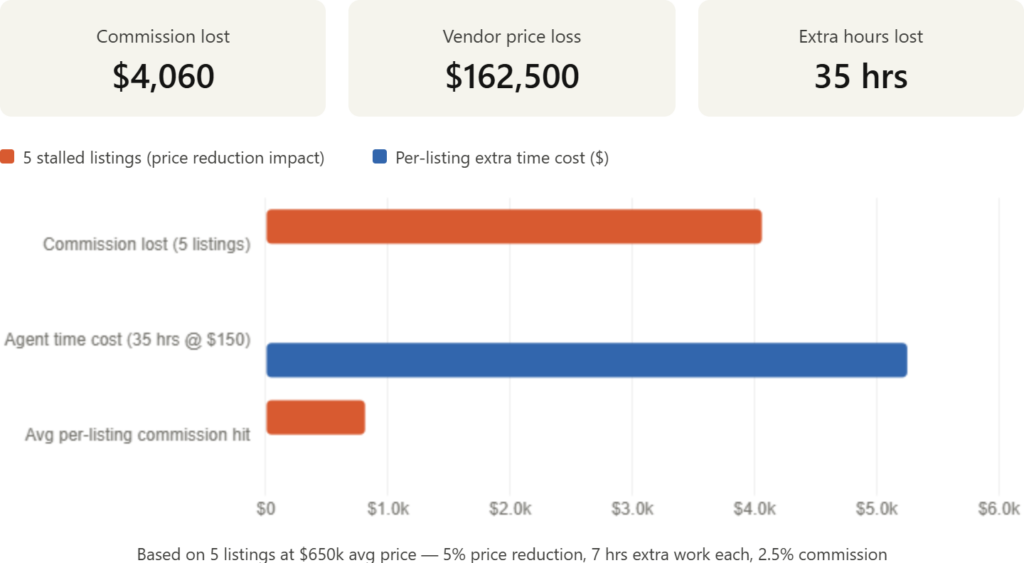
Assume you sell 20 listings a year at an average price of $650,000, with a 2.5% commission. That is $325,000 in gross commissionable income (GCI). NAR data shows listings that launch poorly and sit for 30-plus days close at roughly 95% of list price. Listings that attract early competition close at or above list price.
On a $650,000 listing, a 5% price reduction costs the vendor $32,500 and costs you $812 in commission. That is one listing. Across five slow listings in a year — where weak launches led to price reductions — you are looking at $4,000 or more in lost commission, plus the reputational damage from vendors who did not see results.
Beyond commission, there is the time cost. A listing that stalls requires you to renegotiate vendor expectations, run additional open houses, and field uncomfortable calls. Industry estimates suggest agents spend an average of 6–8 extra hours per listing that stalls in the first month. At $150 per billable hour, that is $900–$1,200 per stalled listing — before accounting for the emotional labour.
How This Plays Out in Practice
Here is the before picture. It is Saturday at 2 PM. You are showing a four-bedroom property in Cedar Park to a couple who have been searching for six weeks. Your phone is on silent. Back at the office, your new listing — a three-bedroom townhouse in Round Rock priced at $495,000 — went live on the MLS at noon. By the time you finish the Saturday showing, check your phone, and get home, it is 6 PM. You send a quick email blast. You post to Instagram. It is now Sunday morning. The listing has been live for 18 hours with three saves and zero showing requests.
Now the after picture. Same Saturday. Same showing in Cedar Park. The moment the Round Rock townhouse goes live at noon, the Listing Launch Agent fires automatically. By 12:15 PM, 34 matched buyers have received a personalised SMS. By 12:30 PM, 12 local buyer’s agents have been contacted with a property brief. By 3 PM, the listing has 6 showing requests. By Sunday morning, the vendor has received an automated activity report showing 89 portal views, 34 outreach contacts, and 8 confirmed showing appointments.
You did nothing differently. You were still in Cedar Park doing your job. The launch ran without you — and it ran properly.
Why This Matters More in 2025 Than Ever
Buyer behaviour has shifted dramatically. Buyers now expect near-instant responses and real-time information. A 2024 survey by the National Association of Realtors found that 97% of buyers used the internet during their home search, and the majority expected responses to enquiries within one hour.
At the same time, inventory is rising in many markets, which means buyers have more choices. A listing that does not create urgency in the first 48 hours is competing against 10 or 20 other properties that launched the same week. The first 48 hours of a real estate listing launch are no longer just important — they are the deciding window.
Meanwhile, sellers are more informed than ever. They track their listing’s performance on portals, compare enquiry rates with neighbours’ sales, and expect their agent to be proactive. A slow launch is not invisible to vendors the way it might have been ten years ago. It raises questions — and raises the risk of the relationship deteriorating before the sale is even close.
Bottom Line
The first 48 hours of a real estate listing launch are not a formality. They are the highest-leverage moment in the entire sale. The agents who treat them that way consistently outsell those who do not — in commission, in vendor satisfaction, and in referrals.
You do not need more hours in the day. You need a system that executes the launch sequence at the right time, every time, regardless of what else is on your plate.
Listing Launch Agent — see how it works. Or book a strategy call here to see it applied to your current listing pipeline.
Frequently Asked Questions
How quickly should I notify buyers after a listing goes live?
Within the first hour. Zillow data shows that new listings receive their peak view volume in the first 24 hours, with the sharpest spike in the first few hours of going live. Outreach that hits buyers within 60 minutes of a listing appearing on the MLS reaches them while the property is genuinely new and interest is highest.
What should a good listing launch checklist include?
At minimum: buyer database screening and outreach, agent-to-agent notification, social media posts across at least two platforms, a vendor activity update scheduled for the next morning, and confirmation that all portal listings are live and accurate. Most agents cover two or three of these. The ones closing above list price typically cover all five — and do it within hours of going live.
Can I actually run this kind of launch if I have three listings going live in the same week?
Yes — but not manually. Running three simultaneous launches at this level requires either a full-time assistant dedicated to listing coordination or an AI agent that handles the sequencing automatically. The human version breaks down under volume. The automated version does not.
Does an early real estate listing launch strategy actually affect the final sale price?
It does, and the mechanism is straightforward. Early enquiries create competition. Competition creates urgency. Urgency leads to multiple offers. Multiple offers push the price up or hold it at list. NAR data consistently shows that homes receiving offers in the first two weeks close at a higher percentage of list price than those that sit. Launch quality is one of the most controllable variables in that outcome.
Sources
1. Days on Market and Final Sale Price — National Association of Realtors
2. Best Day to List a Home — Redfin Research
3. Photography and Listing Performance — Homes.com