According to NAR’s 2026 Member Profile, team-based agents posted a median of 32 transaction sides last year, compared with just nine for solo agents working alone. That gap explains why so many brokers want to scale real estate team production instead of grinding out deals solo. But most leaders still try to get there the old way: post a job, interview for weeks, then cross their fingers. As a result, growth stalls long before the market does.
Why Most Team Leaders Can’t Scale a Real Estate Team by Hiring Alone
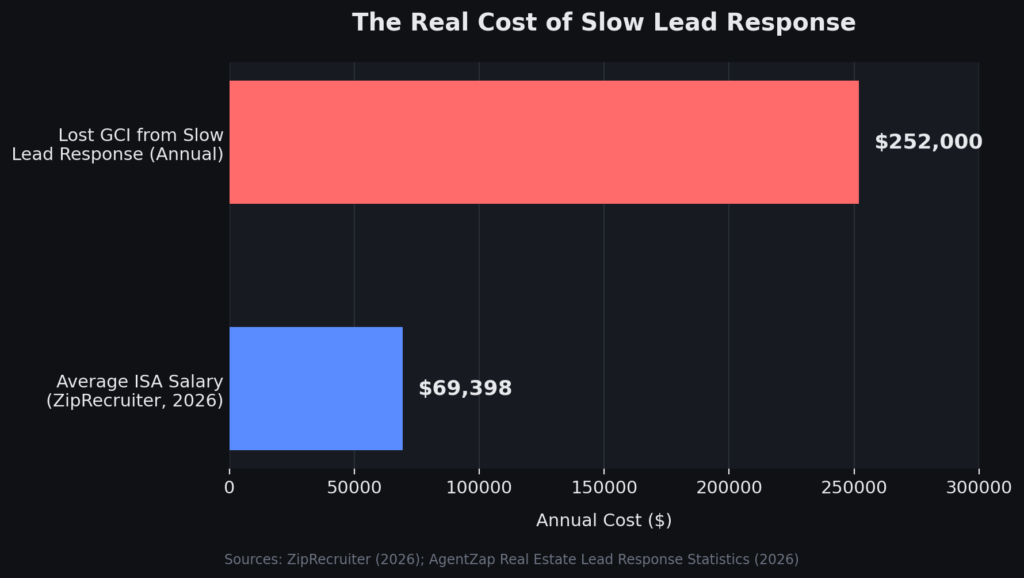
Hiring feels like the obvious next step once leads start piling up. However, every new hire adds fixed cost before they add a single closed deal. According to ZipRecruiter, the average real estate inside sales agent now earns $69,398 a year. That figure doesn’t even include training time, benefits, or turnover risk.
Meanwhile, the leads keep coming whether or not someone is ready to answer them. For example, a single Saturday open house can generate a dozen new contacts in one afternoon. Without a fast, structured follow-up system, most of those contacts go cold before Monday’s team meeting. That’s marketing spend wasted on leads nobody ever calls back.
This is why so many team leaders feel stuck between two bad options. They can’t afford to hire fast enough to match rising lead volume. At the same time, they can’t afford to let leads sit untouched either. In practice, that squeeze is what actually caps growth, not a lack of ambition.
Specifically, it’s the gap between generating a lead and reaching it fast. In other words, that gap is exactly where teams need to scale real estate team capacity without adding another salary.
Even teams with a healthy pipeline hit this wall eventually. A leader closing 40 deals a year might look at 150 monthly leads and start pricing out a new ISA. But the math is brutal from day one. Specifically, a new hire needs weeks of training, months to hit quota, and a salary the whole time they’re ramping up.
Meanwhile, this month’s leads still need an answer today, not in a quarter. Next month’s leads will need the same thing all over again, whether or not the new hire has started yet.
What the Top Agents Actually Do
Consider two team leaders working the same Dallas suburb. Maria runs a five-agent team and still answers every inbound lead herself between showings. Her response time creeps past two hours on busy days. Meanwhile, her database of 1,400 contacts gets a real touch maybe twice a year, usually right before a holiday card campaign goes out.
Down the street, Jordan leads a similarly sized team but built a different system. Every new lead gets an instant response and gets qualified against basic criteria. From there, it lands on an agent’s calendar as a booked appointment automatically. Jordan didn’t scale real estate team headcount to make this happen.
Instead, he restructured how work moves through the business, starting with the first sixty seconds after a lead comes in. Unlike Maria, he doesn’t have to choose between a showing and a fast response.
The difference shows up in the numbers, not the org chart. Maria’s team closes what her personal bandwidth allows on any given week. As a result, that caps out around three or four deals a month, regardless of how many leads come in. Jordan’s team closes what the market actually provides.
That’s because the system runs whether he’s at his desk or at a showing. That’s the real split between agents who plateau and agents who compound, year after year.
The Research Behind Scaling a Real Estate Team
Speed matters more than most leaders assume. Research from MIT and InsideSales.com found that contact rates drop sharply after the first hour. Specifically, rates fall by a factor of ten once that hour passes after a lead comes in. Follow-up beyond that window rarely converts at all.
In practice, agents who respond within five minutes are roughly 21 times more likely to convert a lead than agents who wait half an hour. That single number explains a lot about why some teams grow and others stall.
Yet Inman’s 2025 Real Estate Technology Survey found that the average agent takes 917 minutes to respond to a new inquiry. That’s more than 15 hours. It’s not a minor gap, either. It’s the difference between a live lead and a dead one, repeated across every single contact a team generates.
Beyond response speed, RPR’s 2026 survey found that 82% of agents have already adopted some form of AI. Most of that use, though, is writing and marketing content, not the lead-handling work that actually protects revenue. That’s exactly the gap teams need to close if they want to scale real estate team output without burning out their best agents.
How AI Solves the Real Estate Team Scaling Problem
This is exactly the gap an AI agent is built to close. Instead of hiring another person to sit by the phone, a team can hand outbound prospecting to a system that never clocks out. The Outbound Prospecting Agent from AxonEstate works through expired listings, FSBOs, and sphere contacts on a consistent schedule. As a result, cold data actually gets worked instead of sitting untouched in the CRM.
For a team leader trying to scale real estate team output without adding payroll, that shift matters more than any single feature. Specifically, the agent:
- Calls and texts new outbound leads within minutes of assignment, not hours
- Qualifies contacts by motivation, timeline, and budget before handing off to an agent
- Works expired and FSBO lists on a set weekly cadence without manual list-building
- Logs every interaction directly into the team’s CRM, no double entry required
- Books appointments straight onto an agent’s calendar once a lead is ready
- Flags stalled conversations so a human can step in at the right moment
Even so, the agent isn’t meant to replace judgment on the close. Instead, it’s built to make sure every contact gets touched before it goes cold. That’s the part most teams already know they’re losing today, month after month, without ever seeing it on a spreadsheet.
The Real Cost of Getting This Wrong
Consider a team generating 300 new leads a month. If even 40% sit untouched past that critical first hour, roughly 120 leads a month are effectively wasted before an agent ever picks up the phone. At a conservative 2% conversion rate on properly worked leads, and an average commission of $9,000 per closed deal, that’s over $21,000 in lost GCI every month. Over a year, that adds up to more than $250,000.
That’s real money walking straight past the team’s own marketing spend. For example, a team that spends $3,000 a month generating those leads is effectively lighting most of that budget on fire before an agent ever picks up the phone.
That number doesn’t even include the cost of the ISA salary a team might spend trying to plug the gap. Per ZipRecruiter, that role averages $69,398 annually before bonuses, commission, and the months it takes a new hire to ramp up to full productivity. In other words, the slow-response problem is expensive twice. Once, it costs the deals it loses.
Then it costs the payroll spent trying to fix it the old way, often before the new hire has produced a single closing.
How This Plays Out in Practice
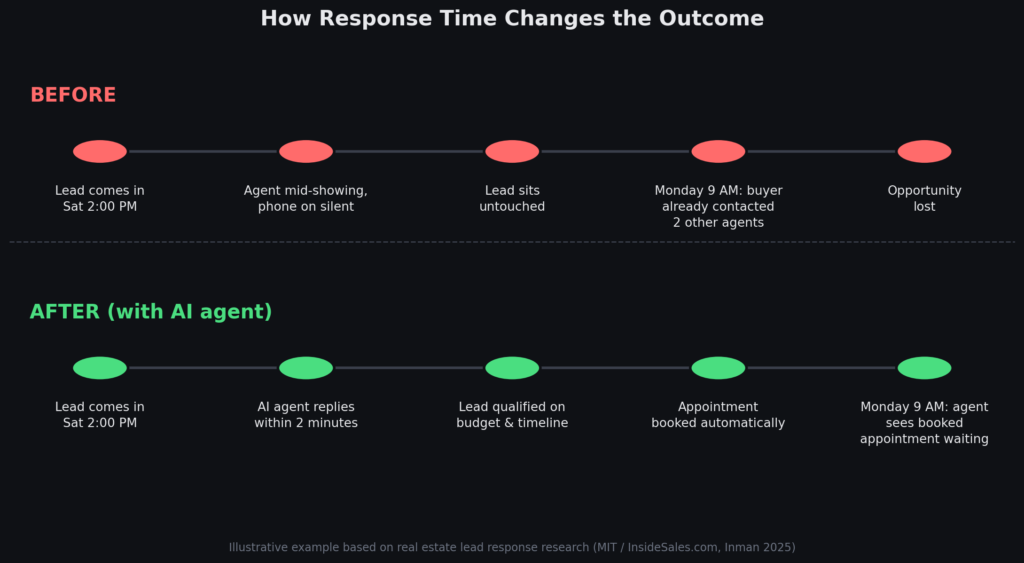
Picture a Saturday afternoon in a Fort Worth townhome development. An agent is mid-showing, phone on silent, with three more appointments stacked before dinner. Without automated follow-up, a new Zillow lead sits in the inbox until Monday morning. By then, it’s cold and half-forgotten.
There’s a good chance that buyer has already reached out to two other agents by the time anyone calls back.
Now run the same Saturday with an AI agent running in the background. Instead, the lead gets a text within two minutes and answers a few qualifying questions about budget and timeline. From there, they pick a time for a callback without anyone lifting a finger. By the time the agent finishes their last showing and checks their phone, there’s a booked appointment waiting instead of a missed opportunity, along with a full transcript of what the buyer actually said.
That’s the entire difference between a team that plateaus at its founder’s personal capacity and one that keeps growing on the weekends nobody’s watching. Nothing about the property or the buyer changed. What changed is that someone, or something, was actually there to answer when it counted.
Why This Matters More in 2026 Than Ever
Housing affordability remains the top obstacle for buyers this year. On top of that, inventory stays tighter in most markets than agents would like. That means every serious buyer or seller who does reach out is worth fighting for. According to NAR, 21% of REALTORS® now work as part of a team, and that share keeps climbing as agents lean on shared systems to handle a tougher market.
At the same time, AI adoption has gone from a novelty to standard practice almost overnight. Delta Media’s 2026 Real Estate Leadership AI Survey found that 97% of brokerage leaders now report their agents are using AI in some form. That’s up from just 80% two years earlier.
Because of this, teams that still rely on manual follow-up aren’t just slower now. They’re competing against teams that effectively never miss a lead, in a market with less room for error than ever. This is why the teams working hardest to scale real estate team output this year are the ones investing in systems, not just headcount.
Bottom Line
Scaling isn’t about adding more people to answer more phones. It’s about making sure every lead gets a fast, consistent response, regardless of who’s available at that moment. Teams that solve this problem grow past their founder’s personal bandwidth, deal after deal, month after month.
Teams that don’t stay capped at whatever one person can physically handle in a day. That’s the whole difference between a team that plateaus and one that keeps compounding.
Ready to see what this looks like for your team? Outbound Prospecting Agent — see how it works, or book a strategy call here.
Frequently Asked Questions
Do I still need an ISA if I use an AI prospecting agent?
Not necessarily. Many teams replace the ISA role entirely, while others keep a human for high-value conversations and let the agent handle first response and qualification instead.
Will leads know they’re talking to AI at first?
Most platforms disclose this upfront. AxonEstate’s agents are built to be transparent about it while still keeping the conversation natural and genuinely helpful.
How fast can a team actually get set up?
Most teams connect their CRM and lead sources within a few days. From there, the agent is fully live and working leads inside the first week.
Does this replace my agents, or just support them?
It’s built to support them. The agent handles first response, qualification, and scheduling, then hands a ready appointment to a human for the parts that actually need one.
Sources
- Experienced REALTORS® Anchor the Industry as Housing Affordability Remains Top Hurdle — National Association of REALTORS®
- Real Estate Lead Response Statistics: 15 Numbers Every Agent Should Know in 2026 — AgentZap
- Salary: Real Estate Inside Sales Agent — ZipRecruiter
- AI Use Now the Norm Among Real Estate Agents — Real Estate News
- AI Adoption Reaches 82% Among Real Estate Agents, RPR Reports — HousingWire