Most real estate agents treat showing feedback collection as a minor admin task. It isn’t. According to the National Association of Realtors, sellers rank communication and responsiveness as the top factors in agent satisfaction — yet showing feedback is where that communication consistently breaks down. Agents who get this wrong don’t just frustrate their vendors. They lose listings at renewal time, and they rarely know why.
The Broken System Behind Showing Feedback Collection
The way most agents collect showing feedback today is a patchwork of manual effort and crossed fingers. An agent finishes a showing, sends a follow-up text or email, waits a day or two, chases again, and eventually either cobbles together a vague impression to report back to the vendor or says nothing at all.
This isn’t a minor gap. According to a study by the National Association of Realtors, 70% of sellers say they would not use the same agent again — and poor communication is the most frequently cited reason. Showing feedback collection sits at the heart of that problem.
Vendors are emotionally invested in their property. They want to know what buyers thought, what objections came up, and whether the price needs adjusting. When an agent can’t give them a clear picture after a week of showings, trust erodes fast. The vendor starts wondering whether the agent is actually on top of the campaign.
In practice, the problem compounds. Buyer’s agents are busy. They don’t prioritise responding to feedback requests. Without a structured, persistent follow-up system, most feedback simply never arrives. And agents trying to manage 10 or 15 active listings manually simply can’t keep up.
What the Top Agents Actually Do
The agents who retain their listings — and get referrals from vendors even when a property doesn’t sell — do something fundamentally different with showing feedback collection. They treat it as a workflow, not a task.
Consider Sarah Nguyen, a single-operator agent based in Austin, Texas. Before she automated her feedback process, she was managing 11 listings and spending close to four hours a week chasing buyer’s agents for responses — most of which were one-line replies that told her nothing useful. She was then spending another two hours synthesising those fragments into vendor reports that felt rushed and incomplete.
After switching to a structured, automated approach, Sarah now delivers a weekly report to every vendor with consolidated feedback from every showing that week, specific buyer objections flagged by category (price, presentation, location), and a recommended action based on patterns in the data. Her vendors stopped questioning the campaign. Two of them referred her to neighbours before the listing even sold.
The contrast is stark. Agents who collect feedback manually are always reactive — scrambling to pull something together before a vendor call. Agents who build a system are proactive. They show up to vendor meetings with data, not apologies.
The Research Behind Showing Feedback and Seller Outcomes
The link between structured showing feedback collection and vendor satisfaction is well-documented, even if agents rarely frame it that way.
Research from Zillow shows that sellers who feel well-informed throughout the campaign are significantly more likely to leave positive reviews and refer their agent — regardless of final sale price. In other words, process matters as much as outcome.
A separate study from the Real Estate Buyer’s Agent Council found that buyer’s agents are far more likely to respond to feedback requests that are brief, structured, and arrive within 24 hours of a showing. Delayed, open-ended requests go unanswered at a rate nearly three times higher. That means the timing and format of showing feedback collection directly determines how much useful data an agent actually receives.
Meanwhile, research from Inman News indicates that agents who provide weekly written reports to vendors retain listings at a higher rate and face fewer price reduction disputes — because feedback data gives both sides an objective basis for decision-making.
How AI Solves Showing Feedback Collection
This is exactly the problem that AI was built to fix. The failure of manual showing feedback collection isn’t a motivation problem or a time management problem. It’s a systems problem. And systems are where AI agents excel.
The Vendor Reporting Agent from AxonEstate handles the entire feedback loop automatically, from the moment a showing is logged to the moment a polished report lands in the vendor’s inbox. Here’s what it specifically does:
- Sends structured, 3-question feedback requests to buyer’s agents within 2 hours of each showing
- Follows up automatically at 24 and 48 hours if no response is received
- Categorises feedback by theme — price objections, presentation issues, location concerns, competing properties
- Generates a weekly vendor report with consolidated insights, trend analysis, and a recommended next step
- Flags urgent feedback (e.g. repeated price objections across multiple showings) for immediate agent review
- Delivers reports in a branded format consistent with the agency’s identity
The result is that showing feedback collection goes from being the weakest part of an agent’s communication to its strongest.
The Real Cost of Getting This Wrong
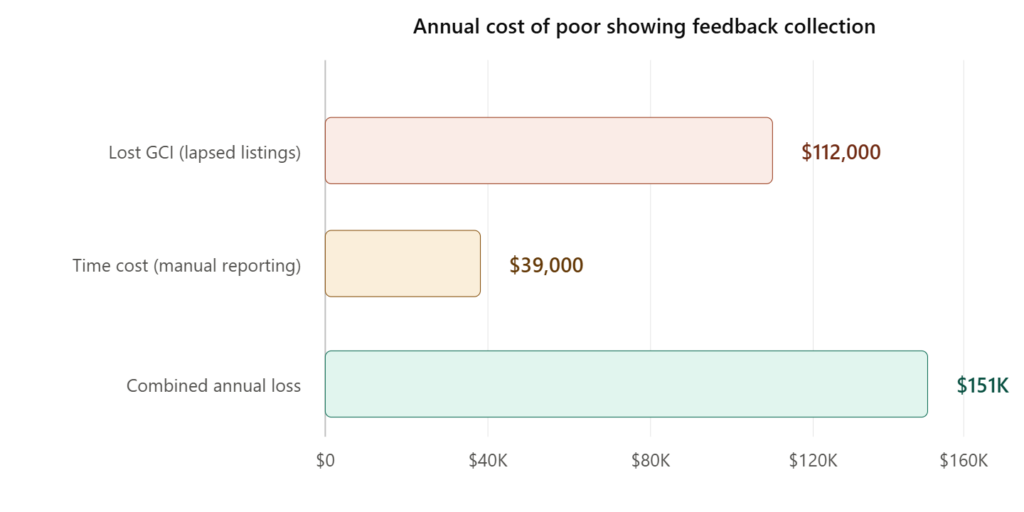
Let’s put a number on it. An agent managing 12 active listings loses an average of two listings per quarter to competitors at renewal — often because the vendor felt underinformed. Each listing is worth an average commission of $14,000. That’s $28,000 in lost GCI every three months, or $112,000 per year.
On top of that, agents who can’t deliver structured showing feedback collection spend roughly 5 hours per week chasing responses and writing reports manually. At a blended hourly value of $150 (based on average agent GCI divided by working hours), that’s $750 per week or $39,000 per year in time cost.
Combined, a single agent is leaving approximately $151,000 on the table annually — not from poor negotiating, not from bad marketing, but from a broken feedback process. That figure doesn’t include the referrals lost when vendors feel disappointed in the campaign experience. In a referral-driven business, those downstream losses are often larger than the direct ones.
How This Plays Out in Practice
It’s a Saturday afternoon in Scottsdale, Arizona. An agent has three showings scheduled on a four-bedroom in the 85254 zip code. She’s at another property, phone on silent during a vendor walk-through.
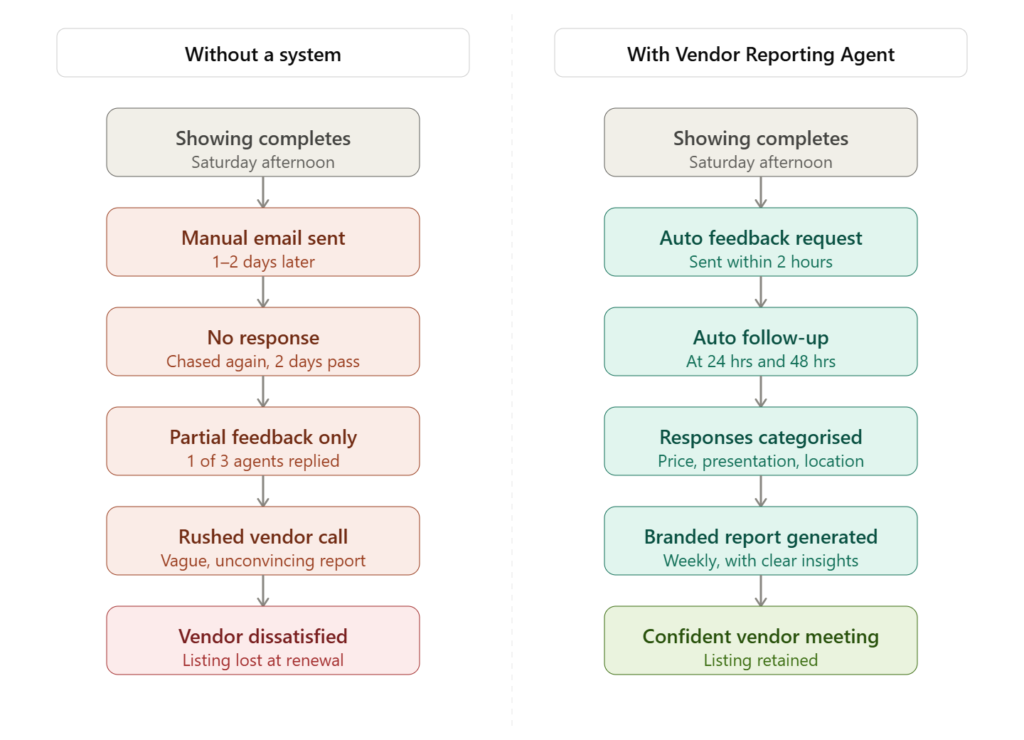
By Sunday evening, without a system in place, she’s sent three manual feedback requests. One buyer’s agent replies with “nice home, client wasn’t sure on price.” The other two don’t respond at all. Monday morning, she has a vendor call. She has almost nothing useful to report. The vendor asks whether the price is right. She doesn’t have enough data to answer confidently. The conversation turns awkward. By Wednesday, the vendor is taking calls from competing agents.
Now run the same Saturday with the Vendor Reporting Agent active. Feedback requests go out to all three buyer’s agents within two hours of each showing — structured, brief, easy to complete on a phone. By Sunday night, two have responded. The agent sees the consolidated responses Monday morning: two mentions of price, one mention of the master bathroom needing updating. She walks into the vendor call with a clear picture. She recommends a $15,000 price adjustment and a quick cosmetic fix. The vendor trusts her. The listing stays.
Why This Matters More in 2026 Than Ever
Buyer behaviour has changed. According to NAR’s 2024 Profile of Home Buyers and Sellers, buyers today view an average of 7 homes before making an offer — down from 10 a decade ago. They’re moving faster, making sharper comparisons, and forming opinions quickly. That means showing feedback collection is more time-sensitive than it’s ever been.
At the same time, vendors have higher expectations. They follow their campaign online, see listing views and enquiry data in real time, and expect their agent to match that level of transparency. An agent who can’t deliver structured, timely feedback after every showing looks out of step with the market.
Beyond that, competition for listings is intensifying. In most markets, vendors have multiple agents to choose from. The difference between winning and losing a listing at appraisal — or retaining it at renewal — often comes down to how professionally the agent communicates. Showing feedback collection is one of the most visible tests of that professionalism.
Bottom Line
Showing feedback collection isn’t a nice-to-have. It’s one of the most direct levers an agent has over vendor satisfaction, listing retention, and long-term referrals. Agents who treat it as an afterthought are handing competitors an easy win.
The fix isn’t working harder. It’s building a system that works while you’re doing everything else. That’s exactly what AI agents are designed for.
See how it works with the Vendor Reporting Agent — or book a strategy call here to find out how AxonEstate can automate your full vendor communication workflow.
Frequently Asked Questions
How often should I be sending showing feedback to my vendors?
Most vendors expect a summary at least once a week, but top agents send updates after every showing cluster — typically within 48 hours. The faster you deliver feedback, the more engaged and confident your vendor stays throughout the campaign.
What if buyer’s agents just don’t respond to feedback requests?
That’s the core problem with manual collection — response rates are low when follow-up is inconsistent. Automated systems that send structured, brief requests within hours of a showing and follow up at 24 and 48 hours consistently achieve far higher response rates than manual outreach.
Does showing feedback actually affect pricing decisions?
Absolutely. When multiple buyers flag the same objection — price, presentation, location — that pattern is your clearest signal that an adjustment is needed. Without structured showing feedback collection, those patterns stay invisible until it’s too late.
Can I automate showing feedback without it feeling impersonal to my vendors?
Yes — when done well, automated feedback actually feels more professional, not less. Vendors receive branded, formatted reports with specific insights rather than a verbal catch-up that might be rushed or incomplete. The format signals that you take the campaign seriously.