Slow response times are quietly draining real estate agents of tens of thousands of dollars in commission every single year. According to Harvard Business Review, firms that contact a web lead within an hour are nearly seven times more likely to qualify it than those who wait even a little longer. Most agents already know speed matters. However, few realize just how much money walks out the door with every missed callback.
The Hidden Price of Slow Response Times in Real Estate
A buyer fills out a contact form at 9 p.m. on a Tuesday. Meanwhile, the agent is at dinner, phone on silent, completely unaware a live lead just landed. By the time that agent checks their messages the next morning, the buyer has already messaged two other agents.
In practice, this is the quiet math behind slow response times. Each delayed reply does not just risk one deal; it resets the buyer’s trust and sends them shopping elsewhere. As a result, the agent never even gets a chance to compete.
According to Zillow’s 2025 Consumer Housing Trends Report for Agents, 47% of buyers and 59% of sellers ultimately hire the first agent who contacts them. That single data point reframes the entire conversation. Specifically, response time is not a soft metric; it is a direct predictor of who wins the listing.
Because most agents juggle showings, paperwork, and client calls simultaneously, leads inevitably sit. Even so, a conscientious agent loses leads simply due to the realities of a packed calendar. The problem is not effort. It is bandwidth.
Meanwhile, the buyer rarely waits around to find out if the agent is just busy or truly uninterested. Instead, they assume silence means disinterest, and they move on to whoever answers next. As a result, that assumption costs agents deals they never even knew they were in the running for.
This pattern repeats across every lead source, from Zillow inquiries to open house sign-in sheets to Facebook ads. Each channel produces the same outcome when follow-up lags: a warm prospect goes cold before the agent ever gets a real shot at the business.
What the Top Agents Actually Do
Maria Gutierrez runs a four-person team out of Tampa, Florida. Two years ago, her team’s average lead response time hovered around three hours. Today, however, every inbound inquiry gets a reply within ninety seconds, day or night.
The shift was not about hiring more people. Maria built a workflow where every lead receives an instant, personalized text the moment they inquire, followed by a human callback within the hour. That means a Saturday afternoon buyer browsing listings during an open house gets engaged immediately, instead of waiting until Monday.
Contrast that with agents who still rely on end-of-day callback batches. As a result, those agents often see leads go cold before they ever pick up the phone. In other words, the lead was never lost to a competitor’s better pitch; it was lost to silence.
Maria’s team now closes roughly 30% more of their internet leads than they did before the change. Meanwhile, her competitors keep wondering why their cost-per-lead keeps climbing while conversion stays flat. The difference is not the lead source. Instead, it is what happens in the first few minutes after the inquiry arrives.
Compare that to David, a solo agent in a nearby Tampa suburb who runs a similar ad budget but checks his leads twice a day. His numbers look respectable on paper, yet he consistently loses motivated buyers to faster-moving teams before he ever gets the chance to make his pitch. Even so, same market, same price point, completely different outcome. Speed, not skill, explains most of the gap.
The Research Behind Slow Response Times in Real Estate
The data on this topic is remarkably consistent across industries. Harvard Business Review’s analysis of online sales leads, conducted by researchers from MIT and Harvard Business School, found something striking. Firms attempting contact within an hour were nearly seven times more likely to have a meaningful conversation with the buyer than those who waited even one additional hour. They were also more than sixty times more likely to connect than firms that waited a full day.
That same research found that 78% of web inquiries go to the company that responds first. In other words, speed alone often decides the outcome before negotiation skill ever enters the picture.
The National Association of Realtors’ Profile of Home Buyers and Sellers reinforces this pattern from the real estate side. The vast majority of buyers and sellers work with an agent, yet most only seriously consider one or two before committing. As a result, that narrow window leaves almost no room for a slow first impression.
Taken together, these findings point to the same conclusion across two very different research traditions. Beyond that, the source barely matters. Whether the study comes from a Harvard business lab or a national real estate trade group, the underlying pattern holds steady. The buyer talks to whoever shows up first, and everyone else competes for leftovers.
How AI Solves Slow Response Times for Real Estate Agents
The good news is that slow response times are a solvable problem, not a fixed cost of doing business. However, agents cannot personally monitor every lead source around the clock, but software can. This is exactly the gap AxonEstate built its platform to close.
The Inbound Lead Responder engages every new lead within seconds of submission. It works regardless of the hour, the source, or what the agent is doing at that moment. Instead of a lead sitting untouched overnight, it gets a warm, conversational reply immediately.
Specifically, the agent:
- Replies to website, portal, and social leads within seconds of submission, 24 hours a day
- Carries on a natural, two-way text and email conversation to gauge intent and timeline
- Asks qualifying questions about budget, financing, and must-have features
- Books showings directly onto the agent’s calendar when the lead is ready
- Flags hot leads for an immediate human call instead of letting them sit in a queue
- Logs every interaction so nothing falls through the cracks between shifts
Because the agent is no longer the single point of failure, leads get a response even during showings, closings, or family dinners. Beyond that, it closes most of the gap that slow response times create.
The Real Cost of Getting This Wrong
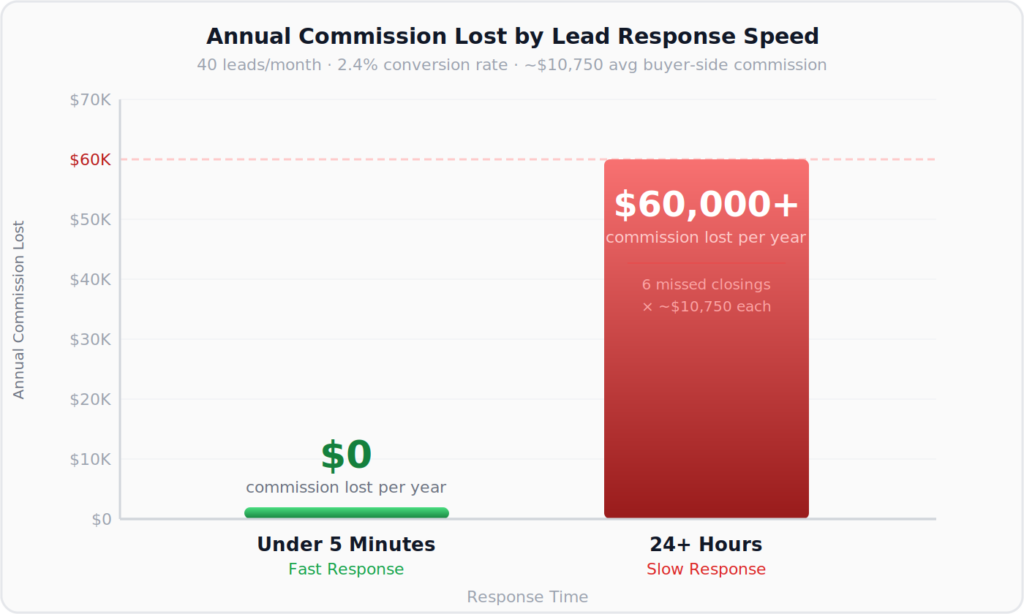
Consider a single agent generating 40 online leads a month, a realistic volume for someone running paid ads or a strong online presence. At an industry-typical 2.4% conversion rate, that is roughly one closed deal a month from that lead pool. In practice, slow response times can cut that conversion rate by more than half, based on the qualification gap documented in lead response research.
That means roughly six fewer closings a year. Specifically, with the national median home price near $429,000 and a typical 2.5% buyer-side commission, each missed deal represents over $10,000 in lost commission. Six missed deals adds up to more than $60,000 in commission left on the table annually, just from leads that went cold before anyone called them back.
That number does not even include the referrals and repeat business those buyers would have generated down the road. Over a five-year span, that single point of friction could easily represent a quarter-million dollars in commission, referrals, and repeat transactions combined. However, few agents ever connect that long-term number back to a delayed text message, but the math holds up every time.
How This Plays Out in Practice
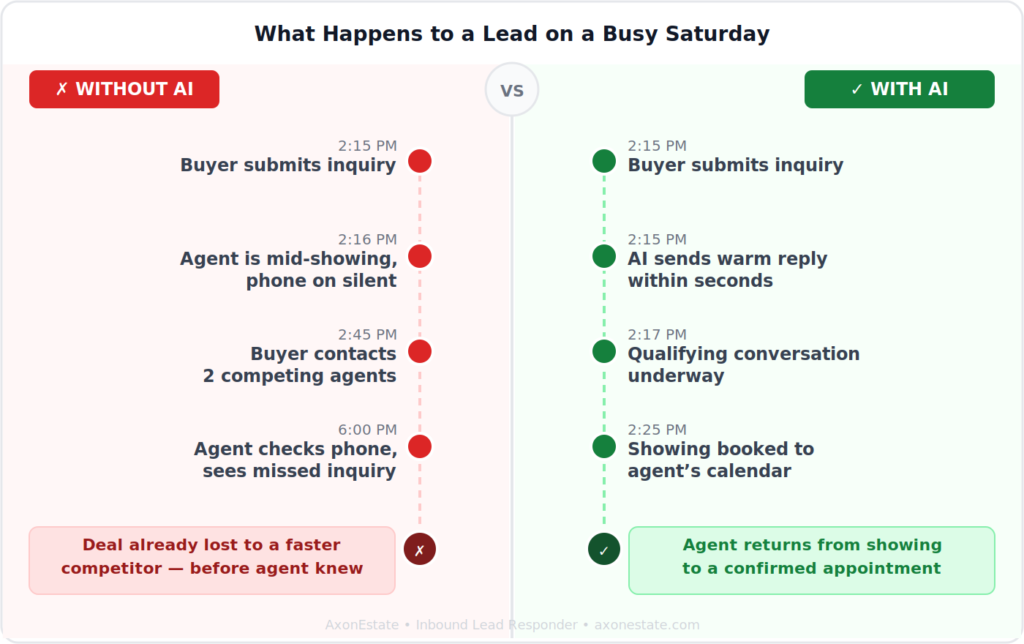
Picture a Saturday afternoon. An agent is mid-showing on a three-bedroom colonial in the suburbs, phone tucked away in her bag. Meanwhile, a buyer browsing listings from her couch submits an inquiry on a downtown condo listing.
Without automated follow-up, that inquiry sits untouched for hours. By the time the agent resurfaces after her showing, the buyer has already messaged two competing agents and scheduled a tour with one of them. As a result, the original agent never even knows the opportunity existed.
In contrast, picture the same Saturday with the Inbound Lead Responder running. The moment the buyer submits her inquiry, she receives a friendly text confirming receipt and asking about her timeline and must-haves. Within minutes, she is mid-conversation, sharing her budget and preferred neighborhoods.
By the time the agent finishes her showing and checks her phone, there is already a qualified lead waiting. A scheduled showing sits on her calendar, instead of a missed opportunity. That is the practical difference between losing a deal to silence and winning one through speed.
Multiply that single Saturday across an entire year of showings, open houses, and weekend errands, and the pattern becomes impossible to ignore. In practice, the agent with automated follow-up captures leads precisely when she is least available to answer the phone herself, which is exactly when most real leads arrive.
Why This Matters More in 2026 Than Ever
Buyer expectations keep climbing every year. According to NAR’s research on buyer search behavior, repeat buyers now make up the majority of the market. These buyers search longer and compare more options before committing. That means they have even less patience for an agent who goes quiet.
At the same time, more sellers and buyers are finding their agents through online channels than ever before. Zillow’s research found that online discovery of agents has more than doubled since 2018. That means more first impressions are happening through a form submission rather than a referral conversation, where slow response times do the most damage.
In a market where buyers can compare three agents in the time it takes to brew coffee, the agent who answers first earns the benefit of the doubt. As a result, everyone else is negotiating from behind before the conversation even starts.
Add in today’s higher home prices, and the stakes per missed lead only grow. The median sale price now hovers near $429,000. That means a single dropped lead carries far more weight than it did even five years ago. Fast follow-up is no longer a nice-to-have; it is a financial necessity.
Bottom Line
Slow response times are not a minor inconvenience. Instead, they are a direct, measurable leak in an agent’s pipeline, one that costs real commission dollars every single month.
The fix does not require working more hours or hiring a full-time assistant. In practice, it requires making sure every lead gets a fast, human-feeling response the moment they reach out, even when the agent cannot personally pick up the phone.
See how it works with the Inbound Lead Responder. Or book a strategy call here to talk through what this could look like for your business.
Frequently Asked Questions
How fast do I actually need to respond to a real estate lead?
Aim for under five minutes whenever possible. In practice, research consistently shows that qualification odds fall sharply once that early window closes, so even a short delay meaningfully hurts your odds.
Can I really lose a deal just because I didn’t text back fast enough?
Yes, and it happens constantly. Specifically, buyers and sellers frequently contact several agents within the same hour, so the first one to respond often gets the appointment.
Isn’t an autoresponder enough to cover slow response times?
A generic autoresponder helps, but it does not qualify the lead or book a showing. Tools like the Inbound Lead Responder carry on a real conversation instead of just acknowledging the message.
What’s the easiest first step to fix this in my business?
In practice, start by tracking your actual average response time for a week. As a result, most agents are surprised by the gap between what they assume and what is really happening.