Sphere of influence marketing is the single highest-ROI activity most real estate agents are currently ignoring. According to the National Association of Realtors, 68% of sellers and 53% of buyers choose an agent they already know or who was referred by someone they trust — yet most agents have no structured system to stay in front of those people. The contacts are already there. The relationships already exist. What’s missing is a consistent, intentional strategy to activate them.
Why Most Agents Are Sitting on a Gold Mine They Never Touch
Sphere of influence marketing sounds simple in theory: stay in touch with people who already like you, and business comes back around. In practice, most agents treat their sphere the same way — they blast a holiday email in December, maybe send a market update in spring, and then wonder why referrals aren’t flowing.
The problem isn’t motivation. It’s infrastructure.
A busy agent juggling active listings, buyer appointments, and new lead follow-up simply doesn’t have the bandwidth to maintain consistent contact with 200-plus people in their database. According to research from Contactually (now part of Compass), the average real estate agent responds to only 11% of their database contacts in any given year. That means nearly 90% of the people who already know and trust you are hearing nothing — and quietly getting recruited by competitors who do show up.
This is a real estate industry problem hiding in plain sight. Sphere of influence marketing isn’t treated as a system. It’s treated as something agents do when they have spare time. Spare time never comes. So the sphere goes quiet, referrals slow, and agents pour budget into expensive lead-gen platforms to replace business they already had.
The agents who build lasting, referral-driven practices don’t hustle harder than everyone else. They build better systems.
What the Top Agents Actually Do
Consider Marcus Hill, a solo agent in Scottsdale, Arizona, who runs a lean operation with one part-time assistant. Marcus generates over 80% of his closings from repeat clients and referrals — not portals, not paid ads. His secret isn’t a massive marketing budget. It’s a calendar-driven, contact-segmented touch plan that runs twelve months a year, every year, without him managing it day-to-day.
Marcus divides his sphere into three tiers: past clients, warm contacts (people who’ve expressed interest but haven’t transacted), and cold contacts (people who know him but haven’t engaged in years). Each tier gets a different communication cadence and a different message. Past clients hear about neighbourhood market shifts. Warm contacts get value-forward content designed to keep the conversation open. Cold contacts get reactivation messages with a soft, low-pressure hook.
The contrast with most agents is stark. The average agent treats their database as one undifferentiated list. They send one message to everyone and measure success by whether anyone replies. Marcus — and agents like him — measure success by the number of intentional touches made per contact per quarter. That shift in thinking is what separates a pipeline that produces consistently from one that only works when you’re working it.
The method is not complex. The discipline to execute it consistently is where most agents fall short.
The Research Behind Sphere of Influence Marketing
The data on sphere of influence marketing is difficult to ignore once you see it laid out. The NAR’s Profile of Home Buyers and Sellers consistently shows that referral and repeat business accounts for over half of all agent-represented transactions nationally — a figure that climbs higher among experienced agents with larger databases.
A study by the real estate CRM platform Follow Up Boss found that agents who contacted their database at least once per month were significantly more likely to receive inbound referrals than those who contacted their sphere quarterly or less. The cadence matters more than the content. Showing up consistently builds the kind of passive brand presence that makes you the agent someone thinks of first when a friend mentions they’re thinking of moving.
Research published in the Harvard Business Review on relationship marketing found that the cost of acquiring a new customer is between five and twenty-five times the cost of retaining an existing one. In real estate terms, that means every dollar spent on sphere marketing generates far more long-term GCI than the same dollar spent on cold lead acquisition through portals or paid search. Yet across the industry, agents still allocate the majority of their marketing spend toward cold lead sources — and underinvest in the contacts most likely to convert.
How AI Solves Sphere of Influence Marketing
The gap between knowing sphere of influence marketing matters and actually executing it consistently is where most agents get stuck. Knowing you should send personalised, value-rich messages to 250 contacts every month is very different from finding the time and energy to do it — especially when every week brings a new closing crisis, a new buyer negotiation, or a new listing appointment to prep for.
This is precisely the problem the Sphere of Influence Agent from AxonEstate is built to solve. Instead of replacing the human relationship, it handles the operational layer that keeps the relationship alive — the touches, the check-ins, the market updates, the anniversaries, the referral asks — so agents can focus on showing up in person when it counts.
Here’s what the Sphere of Influence Agent specifically does:
- Sends personalised, tiered outreach to past clients, warm contacts, and cold contacts on a pre-set cadence — tailored to each segment’s relationship stage
- Monitors contact engagement signals and flags high-intent responses for immediate human follow-up
- Delivers market update messages that use the agent’s local data and brand voice — not generic content
- Triggers milestone messages automatically (home purchase anniversaries, birthdays, local events) to maintain warmth without manual tracking
- Runs re-engagement sequences for contacts who’ve gone quiet, with soft asks designed to surface referral intent
- Surfaces a daily shortlist of contacts who’ve engaged, so the agent knows exactly who to call that morning
The result is a sphere that stays warm twelve months a year — without adding a single hour to the agent’s week.
The Real Cost of Getting This Wrong
Let’s put a number on what a dormant sphere actually costs an agent.
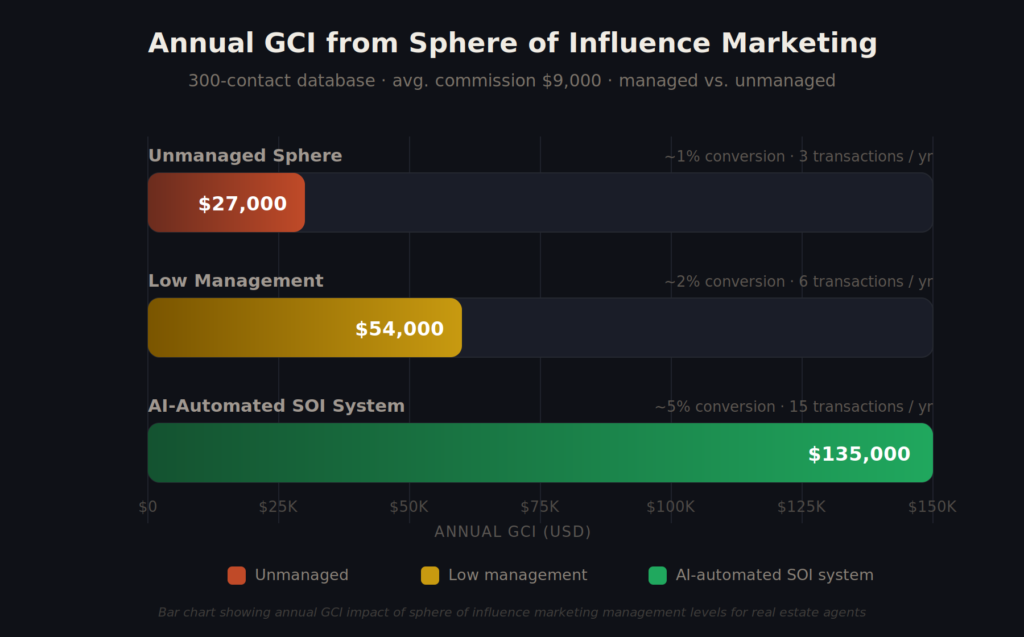
Assume a mid-volume agent has 300 contacts in their database. Industry research suggests that a well-maintained sphere converts at roughly 5% per year — meaning 15 transactions annually from referrals and repeat business. At an average commission of $9,000 per transaction, that’s $135,000 in GCI per year from sphere alone.
Now assume that same agent does nothing intentional with their sphere. Conversion drops to around 1–2% — which industry averages support for agents with no structured touch plan. That’s 3–6 transactions, or $27,000–$54,000 in GCI. The gap between a managed sphere and an unmanaged one is $80,000 to $108,000 in annual income. Every year. From contacts who already know the agent’s name.
That’s not a lead generation problem. That’s a system problem. And it compounds: each year the sphere goes unworked, relationships cool further, competitors move in, and the cost of reactivation increases. An agent who lets their database drift for two years is looking at a recovery window that could take 12–18 months to rebuild — losing income the entire time.
The math makes sphere marketing a non-negotiable investment. The only question is whether you build the system manually or automate it.
How This Plays Out in Practice
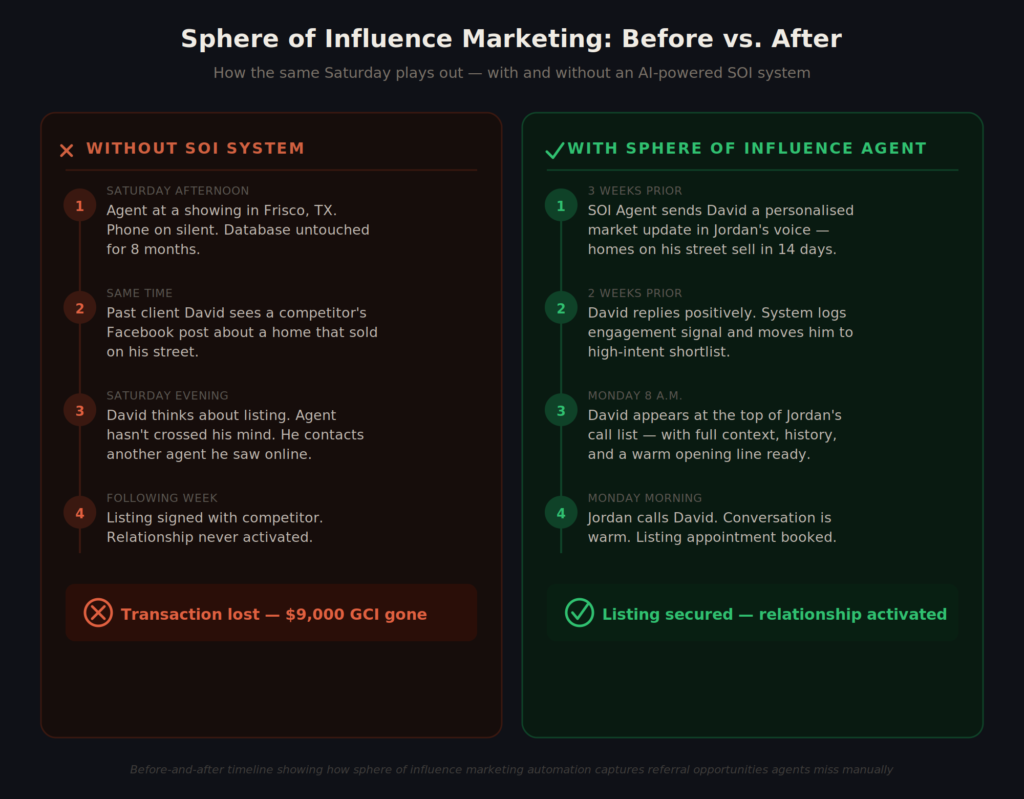
Picture this. It’s Saturday afternoon, and Jordan — a solo agent in Frisco, Texas — is showing a four-bedroom in a new build community. Her phone is on silent. Back at her “office” (her laptop on the kitchen counter), there are 47 contacts in her database she hasn’t spoken to since last year’s holiday card. One of them, a past client named David, just texted another agent after seeing a Facebook post about a home that sold in his neighbourhood. He’s thinking about listing. He didn’t think to call Jordan — not because he doesn’t like her, but because she hasn’t crossed his mind in eight months.
That’s the version of Saturday without a system.
Now picture the same Saturday with the Sphere of Influence Agent running. David received a personalised market update three weeks ago, written in Jordan’s voice, with data specific to his subdivision. It mentioned that homes like his were selling in under 14 days. He replied with a thumbs-up emoji. The agent flagged that signal and put David on Jordan’s shortlist for Monday morning. When Jordan sits down at 8 a.m., David’s name is at the top of her follow-up list — with context, with history, with a warm opening line drafted and ready to send.
Jordan makes the call. David lists. The conversation was never cold — the system kept it warm while she was showing homes, running open houses, and living her life.
Why This Matters More in 2025 Than Ever
Real estate has become a noisier market. Buyers and sellers are bombarded with ads from discount brokers, iBuyers, and portal-driven agent matching services that promise faster, cheaper, and simpler. In that environment, trust has become a scarcer commodity — and the agent who already has a relationship with a prospect holds a significant competitive advantage, but only if they’re actively using it.
According to Zillow’s Consumer Housing Trends Report, 75% of sellers contact only one agent before listing — the first one that comes to mind. Sphere of influence marketing is, at its core, the strategy that makes sure you’re that agent when the moment arrives.
Additionally, rising interest rates and softening transaction volumes in many US markets mean agents can no longer rely on a hot market to bring them referrals by default. In slower markets, the agents who win are the ones with the deepest, most consistently maintained relationships. A structured sphere marketing system isn’t just a competitive advantage in 2025 — it’s a survival strategy.
Bottom Line
Sphere of influence marketing is the highest-converting, lowest-cost source of business most real estate agents are significantly underusing. The contacts are already in your phone. The relationships already exist. What’s missing is the consistent, intentional infrastructure to keep them warm — month after month, year after year.
Most agents know this. Few execute it consistently. The ones who do — who send the right message to the right person at the right cadence — build practices that generate referral business with compounding returns, not linear effort.
If you’re ready to stop letting your database collect dust, the Sphere of Influence Agent — see how it works. Or book a strategy call here and we’ll show you exactly how AxonEstate would build and run your sphere system from day one.
Frequently Asked Questions
How often should I be reaching out to my sphere of influence as a real estate agent?
Research consistently shows that monthly contact is the minimum threshold to keep your sphere warm and generate referrals. More important than frequency is consistency — sporadic outreach is far less effective than a reliable, tiered cadence tailored to each contact segment’s relationship stage with you.
What’s the difference between sphere of influence marketing and general database marketing?
Sphere of influence marketing focuses specifically on people who already have some level of awareness or relationship with you — past clients, referral partners, personal contacts, and neighbours. General database marketing often includes cold or semi-warm leads. Your SOI typically converts at a much higher rate because the trust layer already exists; the goal is to maintain it, not build it from scratch.
Can AI really handle personal outreach without making it feel generic?
Yes — when it’s built correctly. The key is using the agent’s actual voice, real local market data, and contact-specific context (like purchase anniversaries or neighbourhood activity). AI-generated messages that feel generic usually fail because they weren’t trained on the agent’s brand voice or personalised to the recipient. A well-configured SOI agent should produce messages that contacts assume the agent wrote themselves.
How long does it take to see results from a sphere of influence marketing system?
Most agents start seeing inbound referral conversations within 60–90 days of running a consistent touch plan. Reactivating a cold database may take longer — typically 90–120 days to warm contacts back up to conversation-ready. The compounding effect builds over 6–12 months as your name becomes consistently top of mind across your entire sphere.