A text first lead response is quickly becoming the line between agents who close deals and agents who lose them to faster competitors. According to RealScout’s 2026 lead generation research, 78% of buyers work with whichever agent responds first, and the average agent still takes 917 minutes — more than 15 hours — to make contact. That gap is where deals quietly disappear. The agents winning right now aren’t better negotiators. They’re just faster.
Why Most Agents Get Text First Lead Response Wrong
Leads don’t arrive on a schedule. A buyer scrolling Zillow at 9 PM submits an inquiry, and by the time an agent checks their phone the next morning, that buyer has already toured a home with someone else. RealScout’s research found that 62% of real estate inquiries come in outside normal business hours, which means most brokerages are unstaffed for the majority of their lead volume.
Meanwhile, consumer behavior has shifted hard toward text. RealScout also reports that 89% of consumers prefer text over a phone call as their first point of contact, yet many agents still default to dialing. That mismatch costs money. Each unresponsive lead represents $7,500 or more in potential lost commission, based on the same research.
The problem isn’t effort. Agents are busy at showings, in negotiations, or simply asleep when the lead comes in. Without a systematic speed-to-lead process, contact becomes a matter of luck rather than design.
Even conscientious agents lose this race for reasons outside their control. A single portal inquiry is often broadcast to three or four competing agents at the same time, so whoever replies first effectively wins the conversation before anyone else’s phone even buzzes. In that environment, good intentions don’t close deals. Systems do.
What the Top Agents Actually Do
Contrast two agents working the same lead source. Marcus Webb runs a four-person team in Charlotte and treats every new inquiry the same way: a text goes out within a minute or two, referencing the exact listing the buyer viewed. His contact rate on portal leads sits well above the industry norm, because the buyer is still on their phone when the reply lands.
Now picture the more common scenario. An agent in a similar market gets the same lead, but finishes a showing first, then checks email over lunch, then finally calls around 3 PM. By then, the buyer has already exchanged texts with two other agents and stopped answering unknown numbers altogether.
The difference isn’t talent. Marcus isn’t a stronger closer than his slower counterpart. He simply removed the delay between “lead submitted” and “lead contacted.” That single habit compounds across every lead source he uses, turning an average pipeline into a genuinely competitive one.
Speed alone isn’t the whole story, though. AgentZap’s research on agent behavior found that 44% of agents give up after just one follow-up attempt, which means Marcus’s speed advantage keeps paying off long after the first text, simply because he keeps showing up when others have already quit.
The Research Behind Text First Lead Response
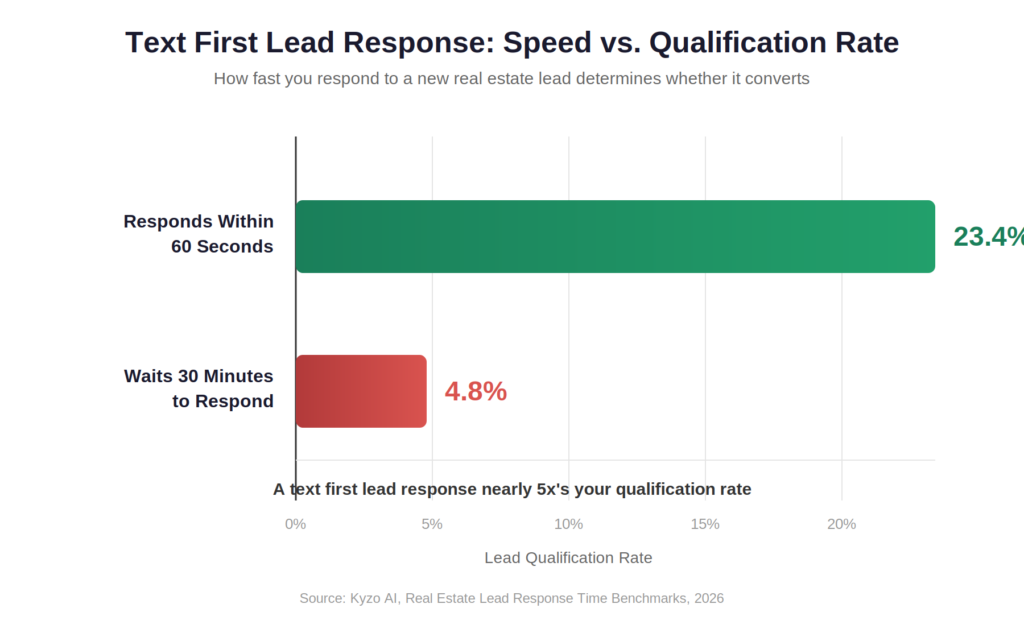
The data behind speed to lead is remarkably consistent across independent studies. Research cited by Jamil Academy, drawing on work from MIT and InsideSales.com, found that agents contacting a lead within 5 minutes are 21 times more likely to qualify it than those who wait 30 minutes. Separately, Kyzo AI’s analysis of brokerage response data found leads contacted within 60 seconds convert at 23.4%, compared with just 4.8% after a 30-minute delay.
Opendoor’s review of lead-source performance adds further weight, noting that speed-to-contact under 5 minutes can lift conversion rates by 5 to 10 times compared with a 30-minute response window. Persistence compounds that speed advantage even further. Research cited by AgentZap found that 80% of real estate sales require five or more follow-up contacts, yet the same study found most agents abandon a lead well before that point.
Taken together, these studies point to the same conclusion: the qualifying window for a real estate lead is measured in minutes, not hours, and a text first lead response inside that window changes the outcome more than any other single variable agents control.
How AI Solves Text First Lead Response
This is exactly the gap AxonEstate‘s Inbound Lead Responder was built to close. Instead of asking a busy agent to drop everything the moment a lead comes in, the AI agent handles that first text automatically, day or night, referencing the specific property or search that triggered the inquiry.
That matters because, as Deal Machine OS notes, CRM and automation adoption already correlates with a 29% increase in sales for agents who use it consistently. Layering an always-on responder on top of that foundation closes the remaining gap: the human delay between lead capture and first contact.
In practice, the Inbound Lead Responder:
- Sends a personalized first text within 60 seconds of lead capture, referencing the listing or search that prompted the inquiry
- Asks qualifying questions about timeline, budget, and pre-approval status in natural conversation
- Works 24/7, covering the 62% of leads that arrive outside business hours
- Logs every exchange directly into the agent’s CRM with full context
- Hands off a warm, qualified conversation to the human agent once the lead is ready to talk
- Continues a structured follow-up sequence automatically if the lead goes quiet
Agents stay in control of the relationship. The AI just makes sure nobody waits 15 hours for a reply, and every message respects standard SMS consent and opt-out requirements so teams aren’t left managing compliance manually.
The Real Cost of Getting This Wrong
Run the numbers on a mid-sized team generating 40 leads a month from paid portals. If half of those leads arrive after hours or during a showing and sit unanswered for even 30 minutes, the conversion penalty documented by Kyzo AI — 23.4% versus 4.8% — effectively cuts that segment’s qualification rate by more than three-quarters.
On leads worth an average of $7,500 in potential commission, as RealScout’s research estimates, losing the qualification race on just 10 leads a month adds up to $75,000 in commission opportunity walking out the door annually. Scale that across a full year, and a single team can be quietly forfeiting close to a million dollars in potential GCI purely because replies arrived too late.
None of that spend shows up on a marketing report. It never gets flagged as wasted ad budget, because the lead did convert — just with a competing agent instead. That’s not a marketing problem. It’s a plumbing problem, and it’s fixable with the right system in place.
How This Plays Out in Practice
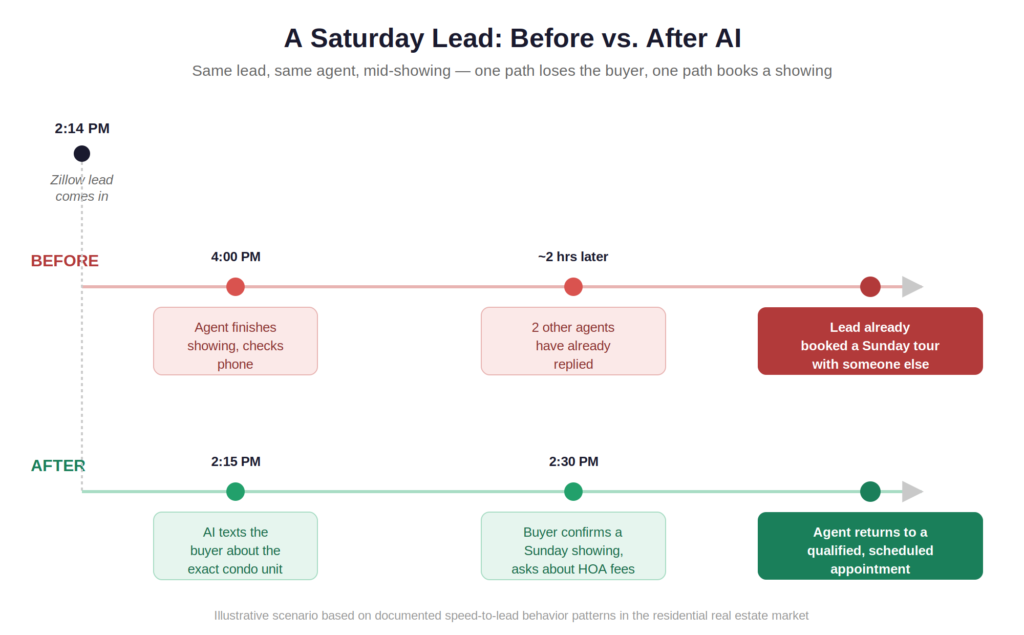
It’s a Saturday afternoon and an agent is mid-showing on a three-bedroom colonial in the suburbs, phone silenced out of respect for the buyers standing in front of them. At 2:14 PM, a new Zillow inquiry comes in for a downtown condo listing. Without automation, that lead sits untouched until the showing wraps at 4 PM, and by then two other agents have already replied, and one has already scheduled a Sunday tour.
By the time the agent finally sees the notification, the buyer has moved on mentally, if not literally. Replying now feels less like following up and more like catching up, and the odds of winning that conversation back have already dropped sharply.
With a text first lead response system running, the story changes. At 2:15 PM, the AI agent sends a personalized text referencing the exact condo unit, confirms the buyer’s timeline, and asks whether they’d like to see it this weekend. By 2:30 PM, the buyer has confirmed a Sunday showing and asked a follow-up question about HOA fees, which the AI answers instantly. The human agent finishes the colonial showing, checks their phone, and finds a qualified, scheduled appointment waiting — no lost afternoon, no cold lead.
Why This Matters More in 2026 Than Ever
Buyer expectations have shifted permanently. Consumers now compare real estate response times to the instant service they get from every other app on their phone, and patience for a next-day callback has largely disappeared. Deal Machine OS reports that CRM adoption alone correlates with a 29% increase in sales, underscoring how much of the current gap between top and average producers comes down to systems rather than sales skill.
At the same time, competition for the same lead has intensified. Portals like Zillow and Realtor.com routinely distribute a single inquiry to multiple agents simultaneously, so the agent who replies first effectively removes the others from contention. Kyzo AI’s brokerage data shows that the top 5% of teams already respond in under 60 seconds and convert at more than three times the industry average, which means the gap between fast teams and slow ones is widening, not narrowing.
In a market where leads are shared and margins are tighter, a text first lead response isn’t a nice-to-have anymore. It’s table stakes for staying competitive.
Bottom Line
Speed to lead isn’t a soft metric. It’s the difference between 78% of buyers becoming your client and 78% of buyers becoming someone else’s. The agents pulling ahead in 2026 aren’t working harder; they’ve simply removed the delay between a lead raising their hand and someone responding, and they’ve built a system that behaves the same way at 2 PM on a Tuesday as it does at 11 PM on a Saturday.
Make a text first lead response your default, not your exception. Inbound Lead Responder — see how it works, or book a strategy call here to see it running against your own lead sources.
Frequently Asked Questions
Is texting really better than calling a new lead first? For the initial touch, yes — most consumers prefer text because it’s low-pressure and lets them respond on their own time. A quick opening text combined with a phone call attempt shortly after tends to outperform either channel alone.
How fast do I actually need to respond to beat the competition? Under 5 minutes is the widely cited threshold, but the data increasingly points to under 60 seconds as the real advantage window, especially on shared portal leads where multiple agents get the same inquiry at once.
Won’t leads know it’s an AI texting them and get annoyed? Most don’t mind, as long as the message is relevant and helpful rather than generic. Referencing the specific listing or search the lead engaged with makes the first text feel useful, not robotic.
What happens after the AI qualifies a lead — do I lose control of the conversation? No. The AI handles the first response and qualification, then hands off a warm, scheduled conversation to you with full context logged in your CRM, so you step in once the lead is actually ready to talk.
Sources
- Real Estate Lead Generation Strategies That Convert — RealScout
- Real Estate Lead Response Statistics: 15 Numbers Every Agent Should Know in 2026 — AgentZap
- Real Estate Lead Conversion Rate Benchmarks 2026 — Jamil Academy
- 7 Proven Real Estate Lead Sources That Convert in 2025 — Opendoor
- 75+ Real Estate Lead Generation Statistics (2026) — Deal Machine OS
- Real Estate Lead Response Time: Convert 23% With 60-Second Speed — Kyzo AI