Every unanswered inquiry chips away at your bottom line. In fact, missed real estate leads are costing agents far more than most of them realize. According to the National Association of Realtors’ 2025 research on home buyers and sellers, 78% of buyers end up working with whichever agent responds to them first. That means every hour a lead sits untouched, a competitor moves closer to claiming a commission that should have been yours.
Why Missed Real Estate Leads Are Piling Up
Most agents don’t lose leads because they’re bad at their job. Instead, they lose them because they’re doing their job — showing a house, sitting at a closing table, driving between appointments — while a new inquiry sits unread in a fourth inbox nobody’s watching. It’s a structural problem, not a character flaw, and it shows up in the response-time data across the entire industry.
Specifically, research from Solvea on real estate lead response found that agents across a 2014 sample of 384 US brokers took an average of 917 minutes, over 15 hours, to respond to a buyer inquiry. Nearly half of all inquiries received no response at all. That means the gap hasn’t closed since; if anything, it’s widened as more leads arrive through more channels.
Because of this fragmentation, the problem runs deeper than any one missed message. A lead from a portal lands in one email account. Meanwhile, a text from a past client lands on a phone, and a website form fills a CRM nobody checks on weekends.
As a result, even conscientious agents end up missing real estate leads simply because no single person is watching every door at once. One missed inquiry rarely feels like a crisis in the moment, so it’s easy to shrug off. Over a full quarter, though, those individually forgivable gaps add up to a pipeline that’s noticeably thinner than it should be.
What the Top Agents Actually Do
Contrast two agents in the same mid-sized market. Priya runs a four-person team in Charlotte and built her business on a simple rule: every inquiry gets a reply within five minutes, day or night, through an automated first-touch system that hands off to a human once the lead is qualified. As a result, her team closed 61 transactions last year, and she can point to specific leads that came in at 11 p.m. on a Saturday and converted because nobody else called them back before Monday.
In contrast, there’s Marcus, a solo agent in the same market with comparable listing inventory and a similar marketing budget. Marcus is a strong negotiator and his clients love him once he’s engaged. However, his lead follow-up happens whenever he “gets a minute,” which some weeks means Thursday.
The difference isn’t skill or work ethic. Instead, it’s infrastructure. Priya’s system means no missed real estate leads sit for hours while she’s at a showing. Meanwhile, Marcus is functionally competing with one hand tied behind his back, and his conversion numbers show it — even though, one-on-one, he’s arguably the better agent of the two.
More importantly, neither agent works fewer hours than the other. Priya simply removed the part of the job that depended on her being reachable the exact moment a stranger decided to inquire, and let a system handle it until she was free to take over.
The Research Behind Missed Real Estate Leads
The data on speed-to-lead is remarkably consistent across more than a decade of research. Specifically, MIT researcher Dr. James Oldroyd, working with InsideSales.com on a study of 1.25 million sales leads, found that contacting a lead within five minutes makes an agent 21 times more likely to qualify that lead compared to waiting 30 minutes, and roughly 100 times more likely to make contact at all.
At the same time, Zillow’s own Premier Agent data points in the same direction, showing close to a 400% swing in response rates when agents reply within the first two minutes of an inquiry instead of letting it sit. Meanwhile, a California Association of Realtors report found that 94% of consumers expect a reply within an hour, yet only about 36% of agents actually deliver one. That 58-point gap is where most missed real estate leads quietly disappear.
Taken together, these studies span nearly two decades and several different research teams. Even so, they all point to the same conclusion: speed isn’t one factor among many in lead conversion. In practice, it’s often the deciding one, ahead of pricing strategy, marketing spend, or even an agent’s negotiating skill.
How AI Solves Missed Real Estate Leads
Once you see the pattern, the fix stops looking optional. Agents can’t personally monitor five inboxes and a phone line 24 hours a day. That’s exactly the gap an AI lead-response system is built to close.
AxonEstate’s Inbound Lead Responder is built around this exact problem. Instead of a lead sitting untouched until an agent resurfaces from a showing, it monitors every channel a lead might arrive through and replies immediately, every time. That means missed real estate leads stop being a daily occurrence and become an occasional one. It’s one of several specialist agents inside the broader AxonEstate platform, each built to close a specific gap in an agent’s day.
In practice, the Inbound Lead Responder:
- Replies to new inquiries from your website, Zillow, Realtor.com, and other portals within seconds, at any hour
- Asks qualifying questions in natural conversation to sort serious buyers from casual browsers
- Books showings directly onto your calendar without back-and-forth scheduling messages
- Flags hot leads for an immediate human handoff when urgency or intent is high
- Logs every conversation and lead detail straight into your CRM automatically
- Keeps working nights, weekends, and holidays, when nearly half of inquiries come in
The Real Cost of Getting This Wrong
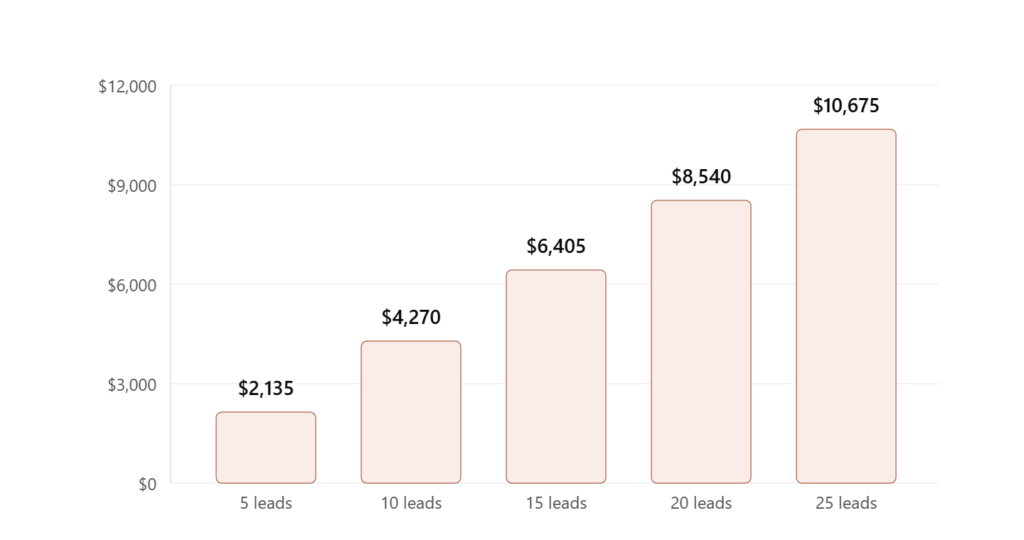
Here’s where the number in this post’s title comes from. Specifically, the current national median home price sits around $405,000, and the average buyer’s-side commission runs about 2.82%, based on a February 2026 agent survey from Clever Real Estate. That works out to roughly $11,400 per closed deal before any brokerage split, or about $8,540 after a typical 70/30 split with the brokerage.
Beyond that, internet and portal leads convert to closed transactions at an industry average of somewhere between 2% and 5%, depending on lead source and how well they’re worked. At the middle of that range, a single lead is worth about $427 in expected commission the moment it lands in your inbox.
Multiply that by the leads that go unanswered every month — even a modest 15 to 20 of them — and an agent is quietly writing off $6,000 to $8,500 a month, every month, without ever noticing the leak. Over a full year, that’s $72,000 to $102,000 in commission income that simply evaporates, often without ever showing up as a line item anywhere in the business.
How This Plays Out in Practice
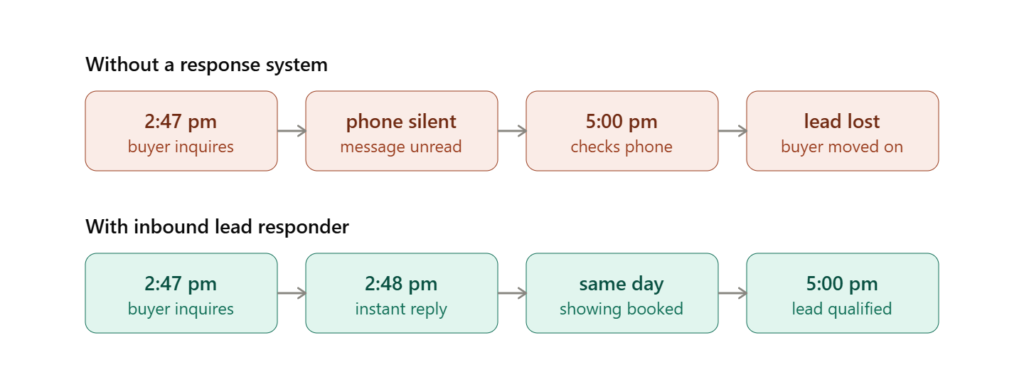
It’s Saturday afternoon. You’re walking a family through a three-bedroom colonial in a suburb you know well, phone on silent because you’re mid-showing. At 2:47 p.m., a buyer three towns over submits an inquiry on a condo listing through your website. Without a response system, that message sits until you’re back in the car around 5 — and by then, the buyer has already messaged two other agents whose names appeared higher in their search results.
Now run the same Saturday with the Inbound Lead Responder active. At 2:48 p.m., the buyer gets a reply, gets two qualifying questions answered in a natural back-and-forth, and books a Tuesday evening showing, all before you’ve finished walking your current clients through the kitchen. Instead of a missed real estate lead, you get a scheduled appointment and a name you already recognize before you ever pick up the phone.
On top of that, multiply this single Saturday by every evening, weekend, and mid-showing gap across a full month. This is why one agent’s calendar stays full while another wonders where all the leads went.
Why This Matters More in 2026 Than Ever
The 2024 NAR settlement changed how buyer representation works, and the ripple effects are still showing up in 2026. Buyers now sign written agreements with an agent earlier in their search. That means the agent who earns that first conversation often keeps the client for the whole transaction.
Because of this, the stakes on responsiveness have risen considerably. NAR’s most recent research on buyer behavior found that 95% of buyers rate an agent’s responsiveness as “very important,” and 75% of buyers interview only a single agent before committing to working with them. In other words, missed real estate leads aren’t just lost opportunities anymore — they’re lost relationships that would have lasted an entire transaction and beyond.
Add tighter inventory and more agents competing for the same pool of serious buyers, and the picture sharpens further. Finally, the agent who answers first isn’t just winning a lead; they’re often winning the only real shot they’ll get at that client all year.
Bottom Line
Missed leads aren’t a minor inefficiency. Instead, they’re a direct, calculable drain on GCI, and the math above shows exactly how fast it adds up. Speed to lead is one of the few variables in real estate that’s almost entirely within an agent’s control.
That means fixing it doesn’t require working longer hours. It simply requires making sure no inquiry ever sits unanswered because you were somewhere else, doing your job. See how Inbound Lead Responder handles this around the clock, or book a strategy call here to walk through what it would look like for your business.
Frequently Asked Questions
How much does a missed real estate lead actually cost me?
Based on current median home prices and average commission splits, a single lead is worth roughly $427 in expected commission on average. Miss 15 to 20 a month, and that’s several thousand dollars in lost income you never see itemized anywhere.
Isn’t a five-minute response time unrealistic when I’m at showings all day?
It’s unrealistic for a human working alone. This is exactly why agents are turning to automated first-response systems that reply instantly while you step in once a lead is qualified.
Will an AI response feel robotic to my leads?
Modern systems like the Inbound Lead Responder are built to hold a natural, conversational exchange rather than send a canned autoresponder. Most leads don’t realize they’re not texting with a person until you tell them.
Do I still need to follow up personally if I have an AI responder?
Yes, and that’s the point. The system handles instant first contact and qualification, so by the time you personally step in, you’re talking to a warm, interested buyer instead of cold-calling a stranger hours later.
Sources
- Real Estate Lead Response Statistics: 15 Numbers Every Agent Should Know in 2026 — AgentZap
- Real Estate Lead Response Time: Tips & Data (2026) — Solvea
- 3 Critical Takeaways from the New NAR Study on Digital Real Estate Search — Call Action
- REALTOR® Technology Survey — National Association of Realtors
- Real Estate Commission Statistics 2026: Rates by State — Agentsorted
- Real estate lead response time: Stop losing leads to faster agents — Fyxer