Automated vendor reporting in real estate is one of the most underused tools available to agents managing investor and vendor relationships. Most agents understand the value of consistent communication. Yet when it comes to actually executing it — week after week, across 10, 20, or 30 contacts — the manual workload becomes the reason it never gets done. This guide breaks down how to automate vendor and investor reporting in a way that keeps every update feeling personal, relevant, and professional.
Why Automated Vendor Reporting in Real Estate Changes the Game
Most agents don’t think of vendor reporting as a strategic differentiator. They treat it as an obligation — something they’ll get to when they have time, which usually means never consistently. That framing is expensive.
Think about what actually happens when you are the agent who communicates proactively, reliably, and on a schedule — without being asked. Your investors refer you. Your vendors prioritize your deals. Your referral partners keep your name at the top of the list. They do this because in an industry where most agents are hard to reach and unpredictable in follow-through, you become a rare commodity: the professional who keeps people informed. According to the National Association of Realtors, 41% of buyers find their agent through a referral from a friend or family member — making consistent communication a direct driver of pipeline growth.
Consider a commercial agent in Dallas named Marcus Webb. He maintained weekly communication with 22 investor clients — covering market conditions, relevant properties, and active transaction updates. Initially, this cost him roughly 8 hours per week. After automating the reporting layer, he brought it down to 90 minutes. His referral rate from those 22 clients stayed above 60% of his annual deals. His client relationships didn’t weaken — because the communication remained consistent in quality and personal in tone, even though the production was automated.
That’s the target: personal in tone, automated in execution.
What “Vendor Reporting” Actually Covers in Real Estate
Before building a system, it helps to understand the full scope of what automated vendor reporting in real estate actually addresses. The category is broader than most agents realize.
Investor clients need property performance updates, market comparables, and portfolio summaries on a regular cadence. Builder and developer relationships require progress updates, sales absorption reports, and foot traffic data. Referral partners — mortgage brokers, attorneys, financial advisors — benefit from knowing when deals close, when referrals get placed, and what your pipeline looks like.
Beyond that, sellers deserve regular listing updates: showing feedback, comparable market activity, and offer status — not just a call when something dramatic happens. Team leaders can also use automated reporting to keep agents informed on pipeline status, lead conversion, and activity metrics without holding a meeting for every single update.
The common thread across all of these is repetition. The same structured information gets delivered to the same people on a consistent schedule. This is precisely the category of work that shouldn’t require fresh creative effort every single week.
Why Manual Vendor Reporting Breaks Down Over Time
The failure pattern is predictable. You intend to send the update. Life gets busy and it slips a day. Then it slips another. Eventually, the client sends a “just checking in” message — and now you owe them an explanation for the delay on top of the actual update. That’s more work, not less.
Worse, some clients quietly stop reaching out. They’ve learned not to expect consistency from you. That’s the slow erosion of a professional relationship — not one dramatic failure, but gradual disengagement over months. A Salesforce study on customer retention found that 68% of clients leave a service provider because of perceived indifference — not because of a single mistake.
There’s also a personalization problem specific to manual reporting. When you’re writing the same update for 15 people, you inevitably start copying and pasting. The message becomes generic. You swap the names, but the content stays identical. Sophisticated investors and vendors notice — and they draw the right conclusion.
Automated vendor reporting in real estate solves both problems simultaneously. It enforces consistency by removing human scheduling friction. At the same time, it enables genuine personalization at scale by pulling recipient-specific data rather than recycling the same text.
The Framework: What a Strong Automated Reporting System Does
Not all automation is equal. Understanding what separates useful reporting from empty templated noise matters before you implement anything.
1. It Pulls from Real, Current Data
Generic updates aren’t updates — recipients learn quickly when they’re getting filler. A good automated reporting system pulls from actual numbers: market statistics, days on market, property valuations, and transaction status. The goal is to give the recipient information they can act on or at least reference in a real conversation. Resources like Zillow Research and Redfin’s Data Center provide the kind of live market data that makes automated reports genuinely useful.
2. Automated Vendor Reports Are Personalized to Each Recipient
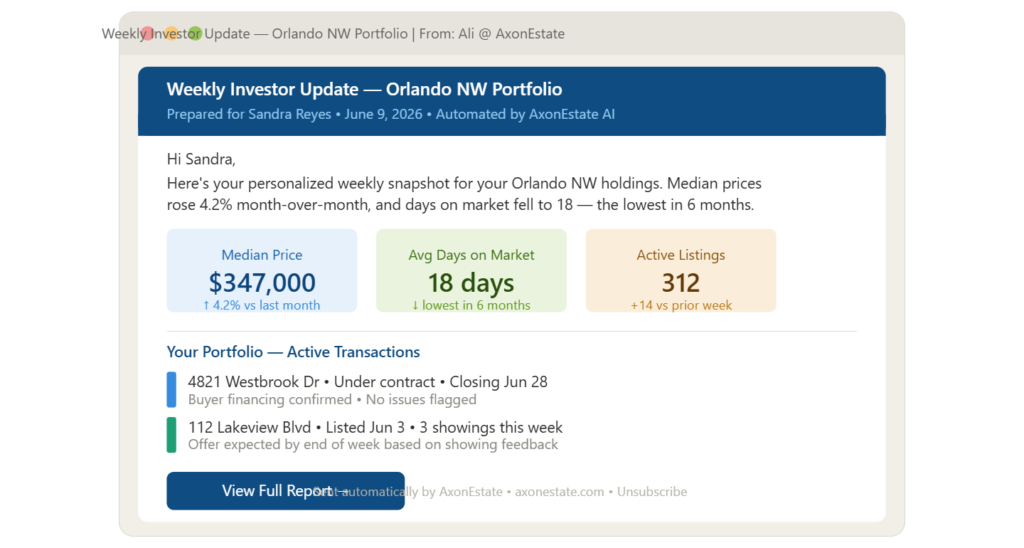
An investor with properties in two specific zip codes doesn’t need a city-wide market summary. They need what’s happening in those two zip codes. A builder tracking absorption on a new development doesn’t need a residential buyer sentiment overview. Personalization in automated vendor reporting means delivering relevance — not just swapping a first name at the top of an email.
3. It Maintains a Consistent, Human-Sounding Voice
This is where most off-the-shelf automation breaks down. Templated reports feel templated. The language tends to be stiff, the structure rigid, and recipients can tell they’re looking at a mail merge. Effective automated vendor reporting in real estate either writes in your voice specifically or produces natural, conversational language that doesn’t read as machine-generated.
4. It Triggers on Events, Not Just Schedules
Time-based cadences — every Monday, monthly summaries — are a baseline. The most valuable communication, however, is event-triggered: when a comparable property sells in an investor’s target area, when a listing receives meaningful activity, or when market metrics shift materially. This kind of triggered reporting demonstrates awareness that no generic newsletter can replicate.
5. It Flags When Human Involvement Is Required
Automated systems should know their limits. A well-configured reporting workflow surfaces situations that require a personal call — a deal complication, a significant market shift, a relationship that needs direct attention — rather than handling them automatically.
What to Automate and What to Keep Personal
Automated vendor reporting in real estate works best when applied selectively. Not every touchpoint should be systematized.
Automate: Regular market updates. Portfolio performance summaries. Listing activity reports. Weekly or monthly deal status updates. Pipeline overviews for referral partners. Team performance summaries.
Keep personal: Bad news should always come from you directly. If a deal falls through, a property appraises low, or a timeline extends significantly, that requires a direct call — never an automated message. First impressions should always stay personal too. The first communication with a new investor or vendor partner sets the tone; a template is the wrong way to open a relationship. Any situation involving nuance, negotiation context, or significant decision points also needs a human voice behind it.
The goal is not to automate your relationships. The goal is to automate the repeatable layer — so you have more time and energy for the moments that require you specifically.
How AxonEstate’s Vendor Reporting Agent Handles This in Practice
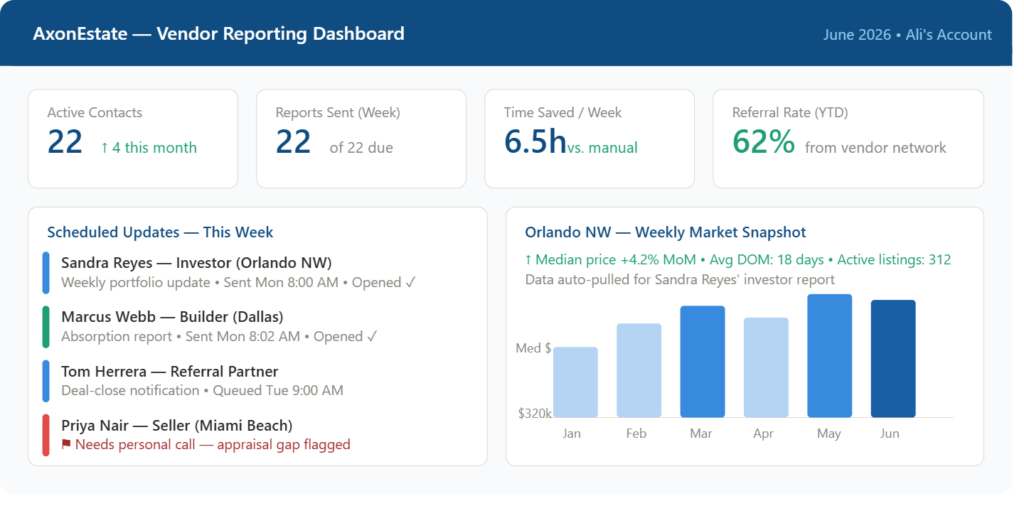
AxonEstate’s Vendor Reporting Agent handles the execution layer of vendor and investor communication — drafting, scheduling, and delivering regular updates based on each contact’s profile, preferences, and the live data relevant to them.
In practice, your investors hear from you on a consistent cadence with neighborhood-specific information. Your referral partners receive deal-close notifications as they happen. Your sellers get regular listing updates without you spending time producing individual reports for each one.
When a situation requires direct involvement — a deal that needs explaining, a relationship that needs a personal touch — the system flags it rather than automating past it. The practical output: communication that used to take 5 hours a week gets handled, your name stays in front of the right people with useful information, and you’re available for the conversations that actually move deals forward.
The ROI Argument for Automated Vendor Reporting
Here’s a straightforward way to calculate the value. If you have 20 investor and vendor contacts, and maintaining those relationships generates even 4 referral deals per year at an average commission of $8,000, that’s $32,000 annually. If manual reporting takes 4 hours per week, you’re spending roughly 200 hours a year on it.
Automated vendor reporting in real estate cuts that time by 70–80% for most agents, according to McKinsey’s real estate automation research. You recapture 140–160 hours annually — time that goes back into active prospecting, showing appointments, or simply fewer 11pm evenings writing market summaries. The referral value stays intact. The time cost drops dramatically.
Ready to stop writing the same updates every week?
See how AxonEstate’s Vendor Reporting Agent works →
Bottom Line
Vendor and investor reporting is easy to do once, difficult to do consistently, and extraordinarily valuable when done well. Agents who build a reputation for reliable, proactive communication outlast any ad campaign or lead generation service they could ever buy. Referral networks built on consistent follow-through are compound assets — they grow over time, require no ongoing spend, and are nearly impossible for competitors to replicate.
Automated vendor reporting in real estate is how you build that reputation without sacrificing 5 hours every week to make it happen. Use AI for the execution. Use your time for the relationships.
Frequently Asked Questions
Q: Is automated vendor reporting appropriate for high-net-worth investor clients?
Yes — provided the setup is right. The key is personalization: updates tailored to a client’s specific portfolio and market interests feel individual, even when produced automatically. High-net-worth clients don’t object to efficiency; they object to being treated as generic.
Q: How often should automated vendor reports go out?
It depends on the relationship type. For investors with active transactions, weekly updates work well. For passive buy-and-hold investors, monthly is typically sufficient. Referral partners benefit from bi-monthly market updates plus deal-close notifications as they occur.
Q: Can automated vendor reporting work for seller communication?
Absolutely. Regular seller updates — showing feedback, comparable sales activity, days-on-market context — rank among the highest-value applications of this type of automation. Proactive seller communication also reduces inbound “any updates?” calls significantly, which alone saves meaningful time each week.
Q: What if I have contacts who prefer phone calls over email?
Automated reporting can prepare you for those calls rather than replace them. A system-generated summary gives you the data and talking points; you deliver them in person. In that model, automation still reduces prep time substantially even when the touchpoint remains a direct call.
Sources
- National Association of Realtors — Real Estate in a Digital Age
- Salesforce — Customer Retention Research
- Zillow Research — Housing Market Data & Reports
- Redfin Data Center — Real-Time Real Estate Market Data
- McKinsey & Company — Real Estate Automation & AI Insights