AI search visibility is turning into the dividing line between agents who get recommended and agents who get skipped entirely. According to BrightLocal’s 2026 Local Consumer Review Survey, 45% of consumers now use AI tools like ChatGPT, Gemini, and Perplexity to find local service providers, up from just 6% a year earlier. That’s a sevenfold jump in twelve months, and most real estate agents haven’t noticed the shift. This is exactly the gap that’s quietly costing agents their next listing.
The AI Search Visibility Problem Real Estate Agents Aren’t Tracking
Most agents still measure their online presence the old way: Google rank, website traffic, maybe a boosted social post. Meanwhile, buyers and sellers are increasingly asking an AI assistant to just name a name, and most agents have no idea what that assistant says back.
In fact, SOCi’s 2026 Local Visibility Index analyzed more than 350,000 business locations and found that ChatGPT recommends only 1.2% of them when someone asks for a local option. For real estate, where referrals and reputation already carry enormous weight, being left out of that answer isn’t a minor SEO gap. It’s a direct hit to pipeline.
Unlike a Google results page, an AI assistant doesn’t show ten options and let the user scroll through them. It gives one or two names and stops there. If an agent isn’t one of those names, they simply don’t exist to that buyer, no matter how good their actual service is.
This is why AI visibility deserves the same attention agents once gave their Google Business Profile. Ignoring it doesn’t pause the problem or buy an agent more time. It just makes the gap wider every single month, quietly, with no alert to tell them it’s happening.
What the Top Agents Actually Do
Take Melissa Grant, who leads a six-agent team in Charlotte, North Carolina. Earlier this year, she noticed her seller leads had started arriving already familiar with her name, her recent sales, and her specialty in downtown condos. Curious, she asked ChatGPT and Perplexity who they’d recommend for a condo sale in her neighborhood. Her name came up both times, alongside an accurate summary of her recent closings and her years of experience.
Compare that to Danny Osei, a solo agent working that same submarket. When he ran the identical test, no AI tool mentioned him at all. His website was accurate, but his name, service area, and specialties were inconsistent across Zillow, Realtor.com, and his Google Business Profile. As a result, that quiet mismatch left him out of the running before a buyer ever picked up the phone.
The difference wasn’t talent or experience. It was consistency. Melissa’s listings, reviews, and profile data lined up everywhere an AI model might pull from, so the model had something clean to recommend. Danny’s didn’t, so the model simply moved on to someone else.
That single distinction is turning into one of the sharpest divides in real estate marketing today, and most agents don’t yet know which side of it they’re on.
The Research Behind AI Search Visibility
The shift away from typed search queries is well documented. Search Engine Land’s analysis, conducted with Profound, examined 41 million results across ChatGPT, AI Overviews, Perplexity, and Copilot, and found that ChatGPT’s answers overlap with the standard Google results page barely more than one time in ten. In other words, ranking well on Google no longer guarantees a mention anywhere else.
Separately, Whitespark’s Q2 2026 tracking found that Google’s AI Overviews now appear on the vast majority of searches that mix research and buying intent — precisely the kind of query a home buyer or seller types before ever contacting an agent directly.
SOCi’s Local Visibility Index adds one more piece to the picture: businesses that do get recommended by AI tools average a 4.3-star rating with consistent details across every platform, not just a strong Google presence. In other words, being findable in one place is no longer enough to earn the recommendation.
How AI Solves the AI Search Visibility Gap
Fixing this by hand is a full-time job no agent has time for. Between MLS updates, closings, and client calls, nobody is manually auditing four different portals every week to check whether their name, service area, and listings still match.
In practice, this is exactly the kind of ongoing, detail-heavy monitoring that AxonEstate’s Portal Performance Agent was built to handle. Instead of treating Zillow, Realtor.com, and Google Business Profile as separate chores, and hoping AI tools eventually pull accurate data on their own, the agent keeps that information consistent everywhere automatically, around the clock.
Specifically, it:
- Cross-checks name, service area, and specialty listings across Zillow, Realtor.com, and Google Business Profile every week
- Flags mismatched contact details or outdated listing photos before they confuse an AI crawler
- Tracks review volume and star-rating trends portal by portal, since AI tools weigh both heavily
- Sends a weekly performance snapshot showing exactly where visibility is slipping
- Surfaces which portals are driving the most inquiry volume, so agents know where to focus first
- Alerts the agent when a competitor’s profile activity picks up in their service area
Even so, none of this replaces an agent’s relationships or expertise. It simply makes sure AI tools have accurate, current information to recommend when a buyer or seller asks. For a broader look at how the full AI workforce supports a team beyond this one agent, visit AxonEstate.
The Real Cost of Getting This Wrong
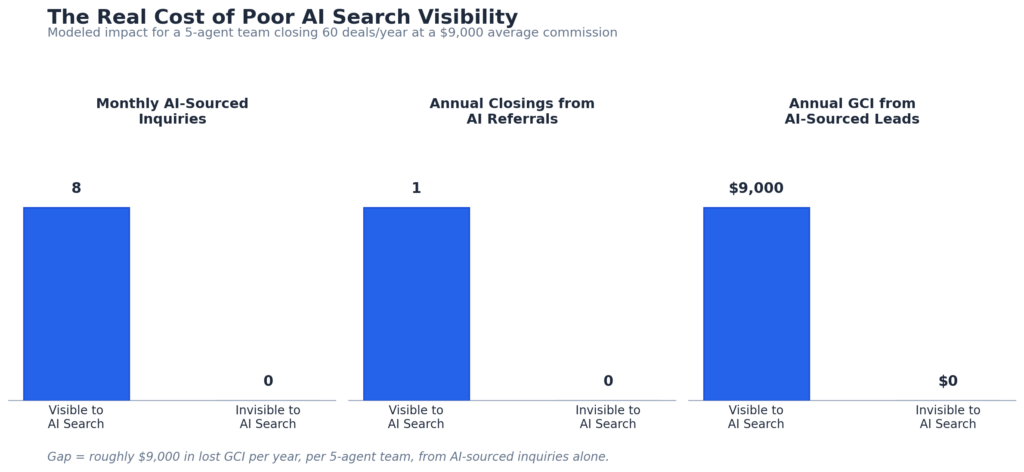
Consider a five-agent team that closes 60 transactions a year at an average commission of $9,000. If just 8% of their annual inquiries now start with an AI assistant instead of Google — a conservative read of BrightLocal’s numbers — and the team is invisible to those tools, that’s roughly 25 to 30 missed inquiries a year, gone before anyone on the team even knows they existed.
At a typical 3% lead-to-close rate for online inquiries, that gap works out to about one lost closing annually. One missed transaction at that average commission is $9,000 in GCI walking straight to a competitor who happened to have their listings straight. Multiply that across every team in a competitive market, and poor AI search visibility stops looking like a technical detail and starts looking like a line item.
How This Plays Out in Practice
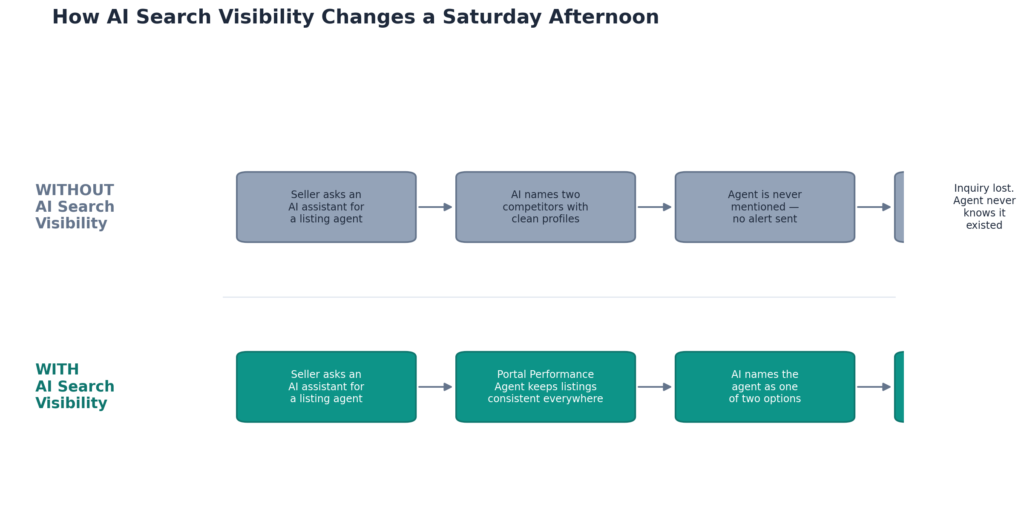
It’s a Saturday afternoon in early spring. An agent is mid-showing on a three-bedroom bungalow in a leafy suburb, phone on silent, focused entirely on the buyer standing in front of them. Forty minutes away, a seller who inherited a downtown condo opens ChatGPT and types, “who’s a good listing agent near Uptown for a condo sale?” Without a Portal Performance Agent in place, the assistant names two competitors whose profiles are clean and consistent across platforms. The original agent’s name never comes up, and they never learn the inquiry existed at all.
Now picture that same Saturday with AxonEstate running quietly in the background. The Portal Performance Agent has spent the week making sure that agent’s specialty, recent sales, and service area are identical across every portal an AI model might reference. When the seller asks the same question, the agent’s name is one of the two mentioned. By Monday morning, there’s a message waiting: a warm inquiry, already primed with the agent’s track record, sitting in the inbox instead of a competitor’s.
The showing didn’t change. The agent’s skill didn’t change. In other words, what changed is simply whether that invisible moment on Saturday afternoon turned into a lead or a loss.
Why This Matters More in 2026 Than Ever
Housing conditions are only sharpening this shift. NAR’s 2025 Profile of Home Buyers and Sellers found that most buyers now start their search online, even as agents remain the most trusted source once contact is made. That first online moment is increasingly an AI conversation instead of a search bar.
Google confirmed the direction at I/O 2026, announcing that its AI Mode had passed 1 billion monthly users, with AI Overviews increasingly folding directly into those AI-driven conversations. Meanwhile, a separate industry study found that 37% of consumers now begin their searches with an AI tool rather than a traditional search engine, a share that keeps climbing every quarter.
For agents, that means the earliest, most decisive part of a buyer or seller’s search — the part where a shortlist gets made — is moving somewhere most agents have never checked. Waiting for AI search visibility to plateau isn’t a strategy, because the trend line points in one direction only.
Bottom Line
AI search visibility isn’t a future problem. It’s already deciding who gets the call and who gets skipped, often without either agent ever knowing a chance existed in the first place.
The agents pulling ahead aren’t necessarily working harder. They’re making sure their information is accurate and consistent everywhere an AI model might look, then letting that consistency do the quiet work of getting them recommended.
If you want to see where you currently stand, check out Portal Performance Agent — see how it works — or book a strategy call here to talk through what’s showing up, or not, for your business right now.
Frequently Asked Questions
How do I even know if I show up in AI search results? Open ChatGPT, Gemini, or Perplexity and ask each one to recommend an agent in your area. If your name doesn’t come up in the first one or two answers, you’re likely invisible to that tool right now, even if you rank well on Google.
Is this just another version of SEO I have to worry about? Not exactly. Traditional SEO ranks web pages, while AI tools recommend a name based on how consistent your information is across every platform, not just where your website sits in search results.
Do my Zillow and Realtor.com profiles actually matter for this? Yes, more than most agents realize. Research shows AI assistants lean heavily on cross-platform data, so mismatched names, service areas, or specialties across those profiles quietly hurt your odds of being named.
How long does it take to improve AI search visibility once I start? Most agents see the biggest jump within 8 to 12 weeks of getting their listings, reviews, and service area consistent everywhere, though the exact timeline depends on how competitive your market already is.
Sources
- How Consumers Use AI to Find Local Businesses in 2026 — Cheers
- Local Business AI Search: The 2026 Playbook — EvolveAMZ
- ChatGPT vs Google Search in 2026: Market Share, Query Data — QuickSEO
- Why ChatGPT Recommends Your Competitor — Core6
- NAR 2025 Profile of Home Buyers, Sellers Reveals Market Extremes — National Association of REALTORS®
- AI & ChatGPT Statistics for 2026 — Instant Press