Speed on expired listings is the single biggest edge available to agents right now. REDX’s national MLS tracking found that more than 78,000 listings expire without selling every week, a number that has climbed 83% in just two years. Somewhere inside that flood of frustrated sellers sits your next signed listing agreement. The agent who picks up the phone first almost always walks away with it.
The Real Problem With Speed on Expired Listings
Every agent in your market can pull the same expired listings feed. The moment a listing drops off the MLS, it turns into a race, and most agents lose that race without ever realizing they were in one.
Sellers who just watched their home sit unsold for months feel frustrated, embarrassed, and skeptical of agents in general. Even so, they still need to sell. That combination makes them some of the most reachable, most motivated leads in real estate, provided you reach them before someone else does.
According to Espresso Agent, fewer than three in ten expired sellers relist with their original agent, and nearly four in ten sign with a brand-new agent within 30 days. That gap is your opportunity.
The real problem is timing, not opportunity. By the time most agents finish pulling the day’s expired list, checking public records, and drafting a personalized approach, hours have already slipped by. Other agents called first. Some already booked the listing appointment.
Manual research is the bottleneck here. One agent working alone can research and call maybe 15 to 20 expired leads a day before the rest of the job takes over. Meanwhile, teams running automated systems are already three or four touches deep with the same seller before lunch.
This isn’t a knock on hardworking agents. Pulling records and writing a message that doesn’t sound like a form letter takes real time, and that time is exactly what a motivated seller doesn’t give you.
What the Top Agents Actually Do
Consider a solo agent named Marcus Webb, who runs a two-person team out of Franklin, Tennessee. Two years ago, Marcus chased expired listings the same way most agents do: a spreadsheet, a stack of printed sheets, and whatever time was left after showings.
He closed maybe two expired listings a quarter. That changed once he automated the first touch. Instead of manually pulling the list each morning, Marcus set up a system that flags new expireds within minutes of the status change and sends a personalized outreach message before he has even finished his coffee.
Marcus still makes the calls himself. He still writes the personal notes. What changed is that he’s no longer racing the clock on research. By the time he dials, the seller has already seen a thoughtful, specific message referencing their actual property, not a generic script.
The contrast with agents who skip this step is stark. They spend their mornings on data entry instead of conversations. Because of this, their close rate on expireds stays flat year after year, while agents like Marcus pull ahead simply by removing the delay between “listing expires” and “seller hears from me.”
That’s the entire game. Not a better script. Not more charisma. Just less time between opportunity and outreach.
Marcus still spends his evenings on strategy instead of spreadsheets, and that shift alone changed how his whole business feels week to week.
The Research Behind Speed on Expired Listings
The research on response speed is not new, but it keeps getting more relevant. According to Real Trends and InsideSales.com’s lead response study, agents who reach a lead within five minutes are roughly 21 times more likely to qualify that lead than agents who wait 30 minutes.
That data was originally built around inbound web leads, yet the underlying mechanic applies directly to expired listings. A seller who just watched their home fail to sell is, in effect, a fresh lead the instant that status changes. The clock starts ticking the moment the listing expires, not the moment you happen to notice it.
Meanwhile, REDX reports that roughly 44.6% of expired sellers relist within 30 to 35 days, almost always with a different agent than the one who listed it originally. In other words, the seller is going to hire somebody fast. The only real question is whether that somebody responded first.
Some newer industry tracking goes further, describing top-performing teams that now target sub-60-second response windows for any lead that shows intent. That benchmark keeps shifting downward, not upward, which means the agents comfortable checking a list once a day are falling further behind every quarter, not staying even.
How AI Solves the Speed Problem on Expired Listings
Speed is a systems problem, not a willpower problem, and that’s exactly where AI earns its place in your business. No agent can manually monitor every MLS status change across their entire farm area in real time. Software can.
This is where the Outbound Prospecting Agent from AxonEstate changes the math. Instead of you or your assistant checking for new expireds once or twice a day, the agent watches for status changes continuously and starts the outreach sequence within minutes.
That shift matters because the agent isn’t sending a generic blast. It pulls the property’s listing history and price changes, then drafts a message referencing those specifics before handing you a call-ready lead. You still close the deal. The agent just makes sure you’re the first voice the seller hears.
That’s what turns speed on expired listings into a repeatable system, not a lucky morning. Paired with the rest of AxonEstate, the agent handles:
- Monitoring MLS expired-status changes in near real time across your market area
- Pulling property history, price reductions, and days-on-market automatically
- Drafting a personalized first-touch message referencing the specific property
- Queuing the lead for a call the moment it’s ready, with context attached
- Logging every touch so nothing falls through after the first message
- Flagging sellers who show engagement so you know who to call first
Instead of spending your morning on research, you spend it on conversations with sellers who are already expecting to hear from someone like you.
The Real Cost of Getting This Wrong
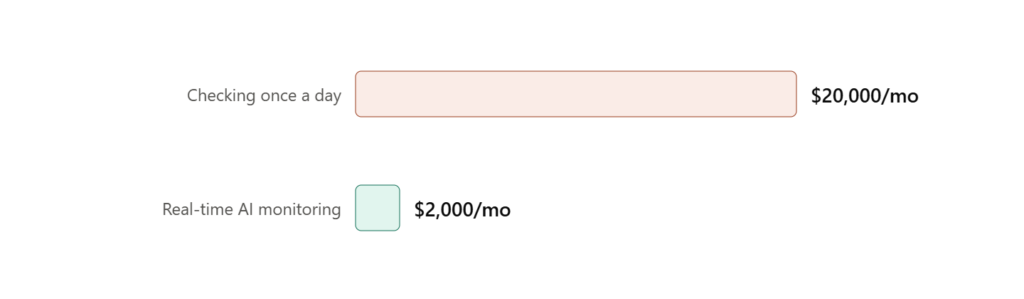
Run the numbers on a single missed morning and the cost becomes obvious. Say your market produces 10 new expired listings a week in your target area. If you’re checking that list once a day instead of catching it within minutes, a competing agent beats you to roughly half of them, a conservative estimate given how many teams now run automated alerts.
That’s five lost opportunities a week, or about 20 a month. Even a modest 10% conversion rate on those missed leads works out to two lost listings monthly. At a typical $400,000 sale price and a 2.5% commission, that’s roughly $20,000 in lost GCI every single month, just from being slow.
Multiply that across a full year and you’re looking at close to $240,000 in commission that went to whichever agent happened to call first. That number doesn’t include the referrals and repeat business those sellers would have generated down the line.
For a two- or three-agent team, that gap compounds fast. Losing even a third of that volume to slower response times is often the difference between a good year and a record one.
How This Plays Out in Practice
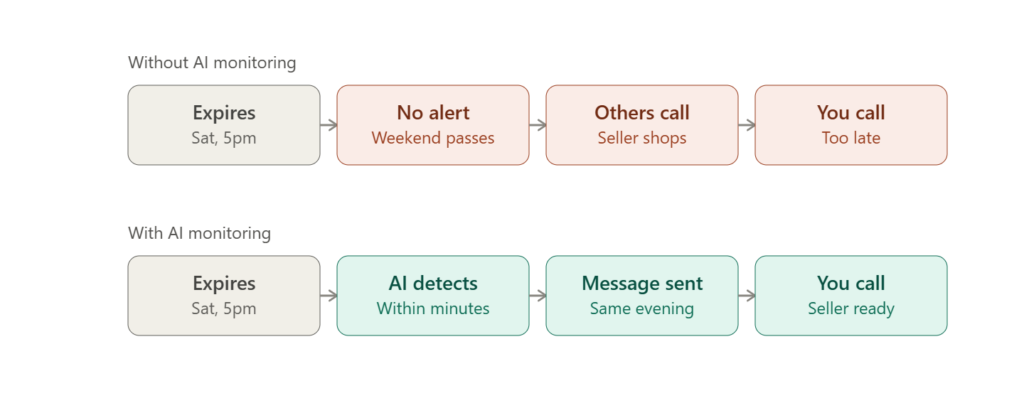
Picture a Saturday afternoon. You’re at a showing for a three-bedroom colonial in a quiet suburb, phone on silent, fully focused on the buyers in front of you. Across town, a listing that’s been sitting for 97 days officially expires at 5 p.m.
Without a system in place, you won’t see that status change until Monday morning, if you see it at all before someone else does. By then, the seller has likely already fielded two or three calls from competing agents, one of whom probably already has a listing appointment on the calendar.
With the Outbound Prospecting Agent running, the story looks different. The moment the listing status flips, the agent pulls the property details, drafts a message referencing the home’s 97 days on market and its one prior price cut, and queues it for outreach. Meanwhile, you’re still at your showing, completely unaware anything happened.
By the time you check your phone that evening, there’s a warm, context-rich lead waiting instead of a cold spreadsheet entry. You call Monday morning, and the seller already recognizes your name because of the message that landed hours after their listing died, not days later.
Nothing about your Saturday changed. You still gave the buyers in front of you your full attention. The only difference is that a second opportunity was quietly building in the background instead of slipping away while your phone stayed on silent.
Why This Matters More in 2026 Than Ever
This matters more in 2026 than it has in years. According to NAR’s most recent existing-home sales report, total housing inventory sits at 1.55 million units with a 4.5-month supply, and homes are taking longer to move than they did during the frenzied years of the early 2020s.
More inventory sitting longer means more listings expiring, and more expired sellers shopping for a new agent at any given moment. Instead of a handful of expireds trickling in each week, many markets are seeing a genuine surge.
That shift changes the competitive landscape. Even so, most agents still rely on the same manual habits they used five years ago. The agents who adapt their process now, before the surge becomes the new normal, are the ones who will own this lead source going forward.
At the same time, buyer and seller expectations have moved toward instant communication in nearly every other part of life, from food delivery to customer service. Sellers notice when an agent responds like it’s still 2015. That gap in experience is exactly why speed on expired listings keeps mattering more, not less, as inventory grows.
Bottom Line
Speed on expired listings isn’t a nice-to-have anymore. It’s the difference between building a pipeline off the most motivated sellers in your market and watching a competitor take them one call at a time.
The agents winning this space aren’t necessarily better negotiators or better marketers. They’re just faster to the phone, backed by a system that removes the research delay between “listing expires” and “seller hears from someone.”
If you’re still checking expired listings manually once a day, you’re already behind. Outbound Prospecting Agent — see how it works, or book a strategy call here to talk through what this looks like for your specific market.
Frequently Asked Questions
How fast do I actually need to respond to an expired listing to make a difference?
Aim for same-day, ideally within the first few hours of the status change. Research on lead response consistently shows conversion rates drop sharply once you pass the first hour, and expired sellers behave the same way as any other motivated lead.
Won’t a personalized AI message feel fake to a seller who’s already frustrated?
Not if it’s built from real data. A message referencing the property’s actual days on market and price history reads as informed, not automated, which is the opposite of the generic scripts most sellers are used to hearing.
Do I still need to make the calls myself, or does the AI handle that too?
You still make the calls. The Outbound Prospecting Agent handles the monitoring, research, and first-touch message so you’re calling a warm, informed lead instead of starting from a blank spreadsheet.
What if another agent already called before my system catches the listing?
You’ll still be early relative to most of the market, since the majority of agents aren’t running automated monitoring at all. Being second or third beats being fifteenth, and consistent early contact compounds over months.
Sources
- The Expired Listing Surge Agents Can’t Ignore in 2026 — REDX
- Real Estate Lead Response Statistics: 15 Numbers Every Agent Should Know in 2026 — AgentZap
- Proven Techniques to Turn Expired Listings into Hot Leads — Espresso Agent
- NAR Existing-Home Sales Report Shows 3.2% Increase in May — National Association of Realtors